
Space saving outdoor furniture for small balconies

For a small balcony or patio, the fastest wins come from compact two-seater sofas, storage benches, and folding sets. These three types free the most usable floor space while still giving you somewhere comfortable to sit. If you’re shopping now, start here:
- Compact two-seater sofas — the Rosalie 2 seater Sofa, Keter Salta 2 Seater Sofa - Oat Cushions, and Emma 2 seater Sofa all sit neatly against a wall and leave circulation space in front
- Folding chairs and tables — fold flat against a wall or into a cupboard when not in use
- Storage benches and deck boxes — seat guests and hide cushions, tools, or toys underneath
- Extendable or nesting tables — expand for meals, collapse for everyday use
- Modular lounge pieces — rearrange to suit the occasion, from quiet mornings to weekend gatherings
Any of these will do more for a tight space than a fixed dining set. The sections below walk you through how to choose, measure, and maintain them.
Table of Contents
- What types of space-saving outdoor furniture work best?
- How do you measure a balcony and plan a layout that actually fits?
- What should you check before buying compact patio furniture?
- How to combine storage and seating to free up more floor space
- Which materials hold up best in Australian outdoor conditions?
- Simple maintenance steps that keep compact furniture lasting longer
- Why recycled-resin and easy assembly matter for Australian small spaces
- What should you budget for compact outdoor furniture in Australia?
- How to choose designs that look good and save space at the same time
- How to get more from modular and multi-use furniture over time
- Key takeaways
- The honest case for keeping it simple outdoors
- Ketergroup picks for small balconies and patios in Australia
- FAQ
What types of space-saving outdoor furniture work best?
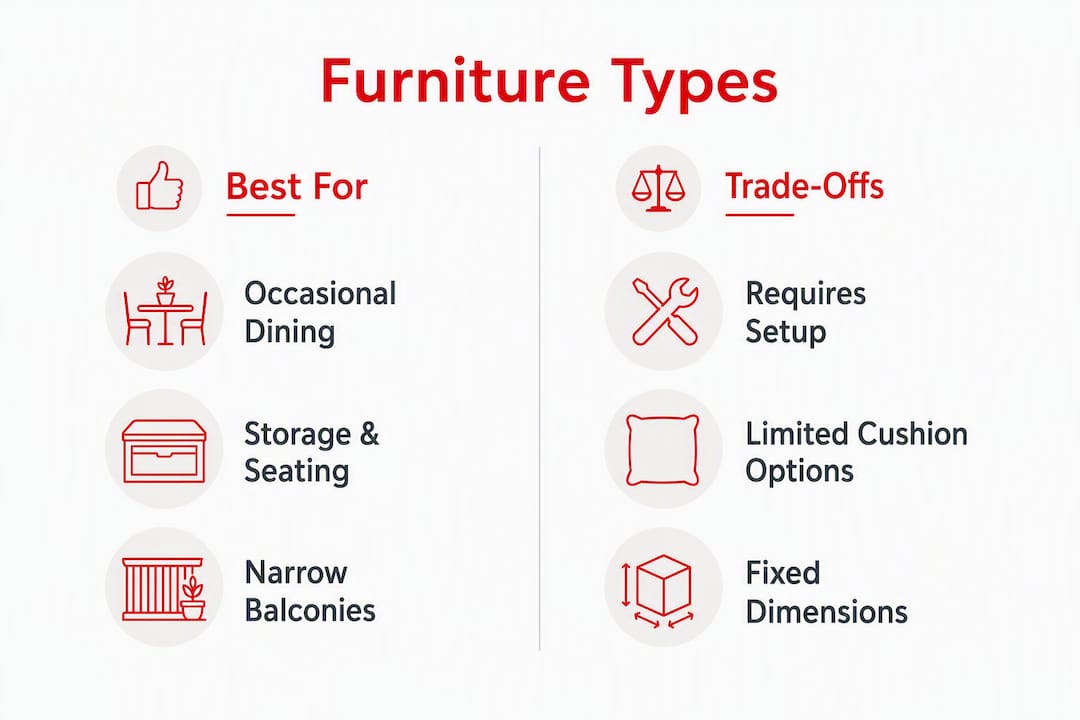
Not every compact furniture style suits every situation. The table below maps each type to its best use case, so you can match the furniture to your actual needs rather than guessing.
| Type | Best for | Stored footprint | Trade-off |
|---|---|---|---|
| Folding chairs and tables | Occasional dining, guests | Very small (leans flat) | Less comfortable for long sits |
| Stackable chairs | Frequent entertaining | Moderate (stacked column) | Need somewhere to stack |
| Extendable/leaf tables | Daily dining that scales up | Same as base table | Heavier than folding options |
| Nesting tables/stools | Side surfaces, casual drinks | Minimal (slide under each other) | Limited load capacity |
| Storage benches/deck boxes | Seating plus hidden storage | Fixed, but dual-purpose | Lid access needs clearance |
| Compact two-seater sofas | Daily lounging, small couples | Fixed footprint, wall-hugging | Not easily moved |
| Modular lounge sets | Flexible entertaining | Varies by configuration | Higher upfront cost |
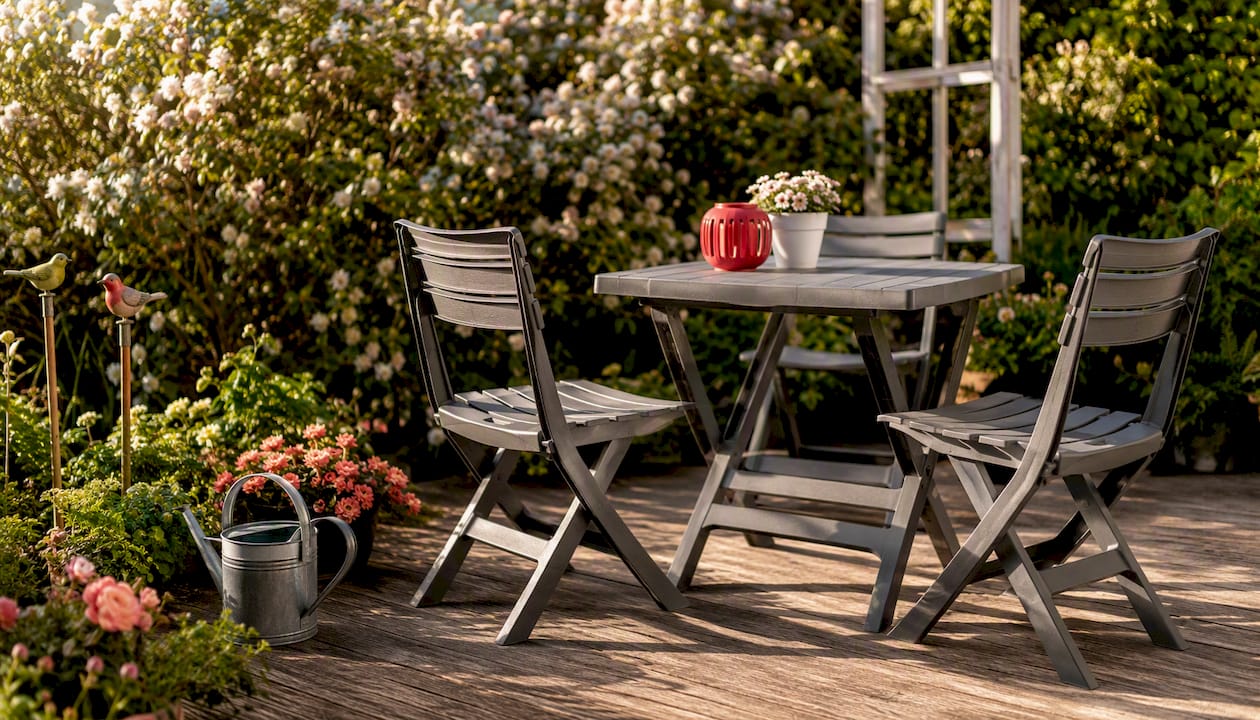
A folding set makes sense if you use the balcony occasionally or need to clear the floor regularly. A compact sofa is better when you want a permanent, comfortable spot that stays put. Storage benches earn their keep in any scenario because they eliminate the need for a separate storage box.
For a narrow apartment balcony, the Keter Salta Balcony Set is worth a look as a ready-made compact option. If you prefer individual pieces you can mix, the Emma Arm chair 2 Pack pairs well with a small nesting table.
How do you measure a balcony and plan a layout that actually fits?
Measure floor area, door swing, and circulation zones before you buy anything. Getting this wrong is the single most common reason outdoor furniture ends up returned or resold.
- Measure three times. Take the full width and depth of your outdoor area, then measure again at the narrowest point (often near a sliding door or railing post). Note both.
- Mark the door swing. A sliding door needs no clearance, but a hinged door can eat 60–90 cm of usable floor space. Draw this arc on your floor plan before placing furniture.
- Allow 60–75 cm for circulation. You need at least 60 cm to walk comfortably between pieces. On a very narrow balcony, push seating to one side and keep the path clear.
- Note fixed features. Mark railing positions, planter boxes, downpipes, and power points. These are non-negotiable obstacles.
- Sketch three layouts. Try a wall-hugging arrangement (sofa against the back wall, small table in front), a corner arrangement (L-shape seating in one corner), and a centred arrangement. The wall-hugging layout usually wins on narrow balconies.
Common balcony footprints and what fits:
- Narrow long balcony (2 m × 4 m): One compact two-seater sofa, a small nesting table, and two foldable outdoor chairs stored flat when not in use.
- Square balcony (3 m × 3 m): A compact lounge set with a coffee table, or a bistro table with two chairs plus a storage bench along one wall.
- Compact courtyard (4 m × 4 m): A modular lounge set in one corner, a folding dining table against the opposite wall, and a deck box doubling as a side table.
Pro Tip: On wind-prone balconies above the third floor, choose lightweight recycled-resin pieces you can bring inside easily, and use removable adhesive hooks rather than permanent anchors for any wall-mounted accessories.
What should you check before buying compact patio furniture?
Choose pieces that balance a small folded footprint with multifunction and durable materials. That combination prevents the most common regrets.
Must-have features checklist:
- Folded or stored dimensions listed on the product page (not just assembled size)
- Easy DIY assembly with clear instructions and minimal tools
- Lift points or handles for moving pieces through narrow apartment doors
- Quick-dry cushion fabric that won’t stay damp after rain
- UV-stable recycled-resin or powder-coated aluminium frame
Questions worth asking before you buy:
- Will it fit through my apartment door or lift? (Check the assembled width against your door frame.)
- How much does it weigh? Heavier pieces can become difficult to move solo.
- Are replacement cushions available? Cushions wear before frames do.
Red flags to avoid:
- No UV resistance rating or material specification
- Only assembled dimensions listed, with no folded or stored size
- Heavy fixed frames with no modular or folding option
- Cushion fabric described only as “outdoor” with no quick-dry claim
Keter product pages typically list assembly details and weather-resistant construction notes, which makes it easier to compare pieces side by side before committing.
How to combine storage and seating to free up more floor space
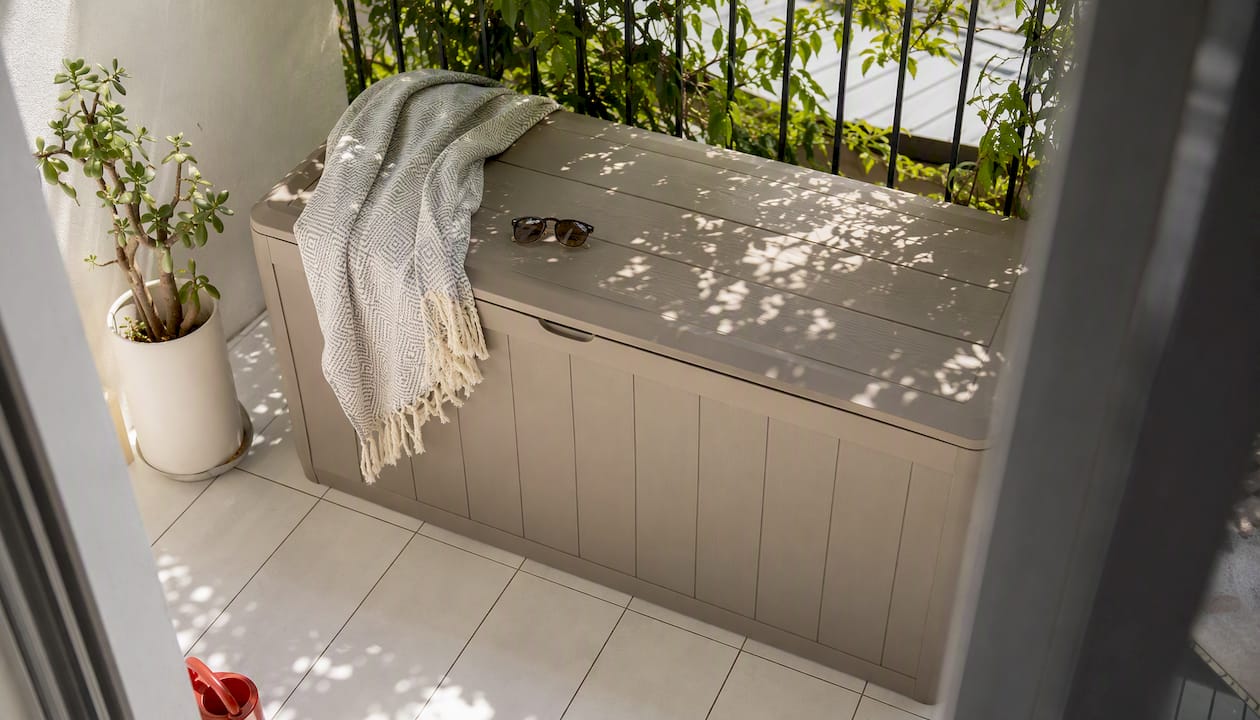
Storage benches and deck boxes that double as seating are the most space-efficient swap you can make on a small balcony. One piece replaces two: a chair and a storage box.
- Storage benches sit along a wall, hold cushions or garden tools inside, and seat one or two people on top. They work especially well on square balconies where a wall run is available.
- Deck boxes like the Store It Out Max handle larger volumes (up to 1200 L) and can support a seat cushion on the lid, turning a storage unit into an occasional bench.
- Coffee tables with internal storage keep small items (candles, remotes, sunscreen) off the surface and out of sight.
- Modular storage organisers like the Keter Connect Storage Organizer stack vertically, using height rather than floor area.
A practical before-and-after: swap a bulky four-piece dining set for a storage bench along the back wall plus two foldable outdoor chairs. You recover roughly half the floor area for evening use, and the chairs fold flat in seconds. For more ideas on this approach, the Ketergroup guide to balcony storage ideas covers apartment-specific scenarios in detail.
Pro Tip: Before using a storage bench as a seat, check the product’s load rating. Many Keter storage pieces are designed with reinforced lids that accept cushions and handle regular seating use without modification.
Which materials hold up best in Australian outdoor conditions?
Recycled-resin frames are the practical first choice for most Australian balconies. They’re light enough to move solo, resistant to UV fading, and won’t corrode in coastal salt air. That combination is hard to match with heavier materials.
Here’s how the main options compare:
Recycled/recyclable resin handles UV, humidity, and salt air without rusting or splintering. It needs only a wipe-down to clean, and Ketergroup’s approach centres on this material across its outdoor furniture range, supporting a circular product lifecycle.
Powder-coated aluminium is equally corrosion-resistant and lighter than steel, but metal fixings can still pit in heavy coastal exposure. Rinse salt spray off monthly if you’re within a few kilometres of the ocean.
Teak looks beautiful and handles weather well, but it’s heavy, requires periodic oiling, and costs more than resin alternatives.
Quick-dry outdoor fabric for cushions is non-negotiable in Australia’s humid summers. Standard polyester retains moisture and can develop mildew within days; solution-dyed acrylic or quick-dry polyester blends dry in hours.
For coastal homes specifically, the combination of recycled-resin frames and quick-dry cushions stored indoors when not in use gives the lowest maintenance load year-round.
Material note: Ketergroup uses recyclable resin across its outdoor furniture range, which means the frames resist UV degradation and won’t rust, crack, or splinter under Australian summer conditions.
Simple maintenance steps that keep compact furniture lasting longer
A monthly wipe-and-air routine is all most recycled-resin pieces need. Neglect is what shortens outdoor furniture life, not the Australian climate itself.
Monthly tasks:
- Wipe resin frames with a damp cloth and mild detergent
- Rinse metal fixings with fresh water (especially in coastal areas)
- Air cushions in a shaded spot for a few hours
Seasonal tasks:
- Check all fixings and tighten any that have loosened
- Inspect cushion fabric for mildew spots and treat with a diluted white vinegar solution
- Fold or stack pieces you won’t use over winter and store them under cover
| Task | Frequency | Notes |
|---|---|---|
| Wipe resin frames | Monthly | Mild detergent, rinse well |
| Rinse metal fixings | Monthly (coastal) | Prevents salt pitting |
| Air cushions | After rain or monthly | Shade only, not direct sun |
| Check and tighten fixings | Each season | Especially after high winds |
| Deep clean and inspect | Annually | Before and after summer |
| Store folding pieces | Extended absence | Under cover or indoors |
Ketergroup’s product care guidance recommends quick-dry cushions for Australian outdoor use, which cuts the drying time after rain from hours to minutes and reduces mildew risk significantly.
Why recycled-resin and easy assembly matter for Australian small spaces
Recycled-resin hits the sweet spot for Australian small-space outdoor furniture: durable, light, and genuinely low maintenance. That’s not marketing language; it’s the practical reason the material dominates compact outdoor furniture designed for apartment balconies and small patios.
Ketergroup builds its outdoor furniture range around recyclable resin, which means frames resist UV degradation, won’t rust near the coast, and can be wiped clean in minutes. For a small balcony where every piece needs to earn its place, that low-maintenance profile matters as much as the compact footprint.
Assembly is the other factor buyers underestimate. A piece that takes two people and three hours to build is a problem on a fourth-floor apartment with no lift access for large boxes. Ketergroup designs its products for straightforward DIY assembly, and product pages include assembly details so you can judge the effort before buying.
Pro Tip: When comparing products online, look for listings that publish both assembled and stored dimensions. If only the assembled size is listed, contact the retailer before purchasing — a sofa that won’t fit through your apartment door is an expensive mistake.
What should you budget for compact outdoor furniture in Australia?
Prices vary by material, size, and whether a piece is purely functional or multi-use. As a general guide for the Australian market:
- Folding chairs (single): Budget options start at around $30–$60 each; quality resin or aluminium pieces sit higher.
- Compact bistro or balcony sets (table + 2 chairs): Entry-level sets begin around $150–$250; mid-range resin sets with cushions typically fall in the $300–$600 range.
- Compact two-seater sofas: Expect $400–$900 for a weather-resistant resin-frame sofa with cushions, depending on the brand and cushion quality.
- Storage benches and deck boxes: Functional resin storage benches start around $200; larger deck boxes with seating capacity sit higher.
- Modular lounge sets: These range broadly from $600 upward depending on the number of modules and cushion grade.
The best value usually comes from pieces that serve two functions: a storage bench that seats guests, or a sofa set that includes a coffee table with storage. Spending a little more on a multi-use piece often costs less than buying two separate items.
How to choose designs that look good and save space at the same time
Functionality and aesthetics don’t have to compete. A few design principles make a small outdoor area feel considered rather than cluttered.
Stick to two or three colours. A neutral frame (graphite, oat, or natural teak tones) with one accent cushion colour reads as intentional. Mixing too many frame finishes on a small balcony makes the space feel busy.
Choose low-profile pieces. A sofa or lounge set with a lower back height opens up sightlines and makes a compact space feel larger. High-backed chairs can feel oppressive on a narrow balcony.
Use vertical space. A wall-mounted planter or a tall, narrow storage organiser draws the eye upward and frees floor area. The Keter Connect Storage Organizer stacks vertically and keeps the floor clear.
Match the frame finish to your flooring. A graphite resin frame on timber decking creates contrast that reads as deliberate. The same frame on grey concrete tiles blends in and feels calmer.
For styling inspiration specific to small patios, the Ketergroup blog post on transforming your patio into a designer escape covers colour, layout, and product pairing ideas in detail.
How to get more from modular and multi-use furniture over time
Modular outdoor seating earns its cost over time because you can reconfigure it as your needs change. A two-piece modular set bought for a small apartment balcony can expand with an extra module when you move to a larger space.
The key is buying pieces designed to connect or pair with future additions. Check whether the brand offers matching ottomans, side tables, or extra seat modules before committing to a set. Ketergroup’s lounge range includes pieces like the Orlando Outdoor Lounge Set with Adjustable Coffee Table, where the table adjusts between coffee and dining height, giving you two functions from one piece.
For everyday flexibility, think in configurations rather than fixed arrangements. Morning coffee might call for two chairs facing the view; an evening with guests calls for the sofa plus the folding chairs pulled out from storage. Furniture that moves easily and stores compactly supports both without compromise. The small patio furniture ideas guide on the Ketergroup site walks through several real layout configurations worth bookmarking.
Key takeaways
Compact two-seater sofas, storage benches, and folding sets are the most effective space-saving choices for small Australian balconies and patios, especially when made from weather-resistant recycled resin.
| Point | Details |
|---|---|
| Measure before you shop | Record floor area, door swing, and a 60–75 cm circulation clearance before choosing any piece. |
| Prioritise multi-use pieces | A storage bench or deck box that doubles as seating replaces two separate items and frees floor space. |
| Choose recycled-resin frames | UV-stable, corrosion-resistant, and light enough to move solo — the practical choice for Australian conditions. |
| Check folded and stored dimensions | Only buy pieces that list both assembled and stored sizes; this prevents door-width surprises. |
| Ketergroup for Australian options | The Rosalie, Salta, and Emma sofa ranges plus storage organisers cover most small-space scenarios available in Australia. |
The honest case for keeping it simple outdoors
There’s a tendency to overthink small outdoor spaces — to hunt for the perfect modular system or the most photogenic bistro set before committing to anything. In practice, the spaces that work best are the ones where someone made two or three deliberate choices and stopped there.
A compact sofa against the back wall, a small table in front, and a storage bench along the side: that’s genuinely enough for most Australian balconies. The furniture doesn’t need to do everything. It needs to be comfortable, easy to clean, and light enough to move when you want to sweep the floor or bring pieces inside before a storm.
What I find most encouraging about the direction Ketergroup has taken with its recycled-resin range is that it removes the maintenance anxiety that used to make outdoor furniture feel like a commitment. When a frame won’t rust, fade, or splinter, you stop worrying about it and start actually using the space. That shift, from managing furniture to enjoying it, is the whole point.
Ketergroup picks for small balconies and patios in Australia
These Ketergroup pieces are well suited to small balconies and patios across Australia, covering compact seating, flexible lounging, and practical storage.
Rosalie 2 seater Sofa — a compact two-seater with a wall-hugging profile, suited to narrow balconies where you want a permanent, comfortable seat without sacrificing circulation space.
Keter Salta 2 Seater Sofa - Oat Cushions — the warm oat cushions work well on timber decking or light-coloured tiles. A practical pick if you want the sofa to feel like part of a considered colour scheme rather than an afterthought.
Emma 2 seater Sofa — pairs naturally with the Emma Arm chair 2 Pack for a coordinated lounge setup that can expand or contract depending on how much space you have available.
Emma Arm chair 2 Pack — two matching armchairs that work as standalone seating on a square balcony or as companion pieces to the Emma sofa on a larger patio.
For storage, the Keter Connect Storage Organizer keeps cushions, tools, and accessories off the floor without taking up much room. All pieces are built from weather-resistant recycled resin and designed for straightforward DIY assembly.
Browse the full range and find the right fit for your space at ketergroup.com.au.
FAQ
What is the best outdoor furniture for a small balcony?
Compact two-seater sofas, folding chairs, and storage benches work best for small balconies. They keep the floor clear while still providing comfortable seating and practical storage.
How much clearance do you need between outdoor furniture pieces?
Allow at least 60 cm between pieces for comfortable circulation. On very narrow balconies, push seating to one wall and keep the path to the door completely clear.
Is recycled-resin outdoor furniture suitable for coastal Australian conditions?
Yes. Recycled-resin frames resist UV fading and won’t corrode in salt air, making them a practical choice for coastal homes. Rinse metal fixings with fresh water monthly to prevent pitting.
How do you maintain compact outdoor furniture in Australia?
Wipe resin frames monthly with mild detergent, air cushions after rain, and check fixings each season. Quick-dry cushions reduce mildew risk significantly in humid Australian summers.
Can a storage bench really replace a separate chair and storage box?
It can, and often should. Many Ketergroup storage products feature reinforced lids rated for regular seating use, so one piece handles both functions without any modification.


