
Outdoor cushion storage: keep cushions dry and mould-free

The best approach to outdoor cushion storage is a weather-resistant, ventilated storage box sized to your cushions, used only after cushions are fully clean and dry. That single rule prevents the vast majority of mould, odour, and fabric damage Australian homeowners deal with each season.
Here is a quick shortlist by common need:
- Small balcony or apartment patio: A compact resin storage box sized for two to four seat cushions and taking up minimal floor space. Resin handles coastal salt air and UV exposure without rusting or warping.
- Outdoor dining set (4–6 seats): A mid-size box suitably sized to store dining chair cushions without over-compressing them. Gardening Hub recommends a 200–300L box for a standard dining set’s cushions.
- Large lounge or sofa set: Use a storage box sized for bulky back cushions and seat pads that need room to breathe, or consider two smaller boxes side by side.
Pro Tip: Monthly checks and desiccant replacement are the single most effective routine for preventing internal moisture and mould, regardless of which storage format you choose.
Table of Contents
- Which storage type suits your space?
- How to prepare cushions so they don’t go mouldy
- What does ‘weather resistant’ actually mean?
- How to size your storage and where to place it
- Maintenance schedule for stored cushions
- Ketergroup picks for Australian cushion storage
- Quick buying checklist and red flags
- Key takeaways
- The case for ventilation over waterproofing
- FAQ
Which storage type suits your space?
Outdoor storage comes in several formats and the right one depends on how much you need to store, how often you access it, and how much floor space you can spare.
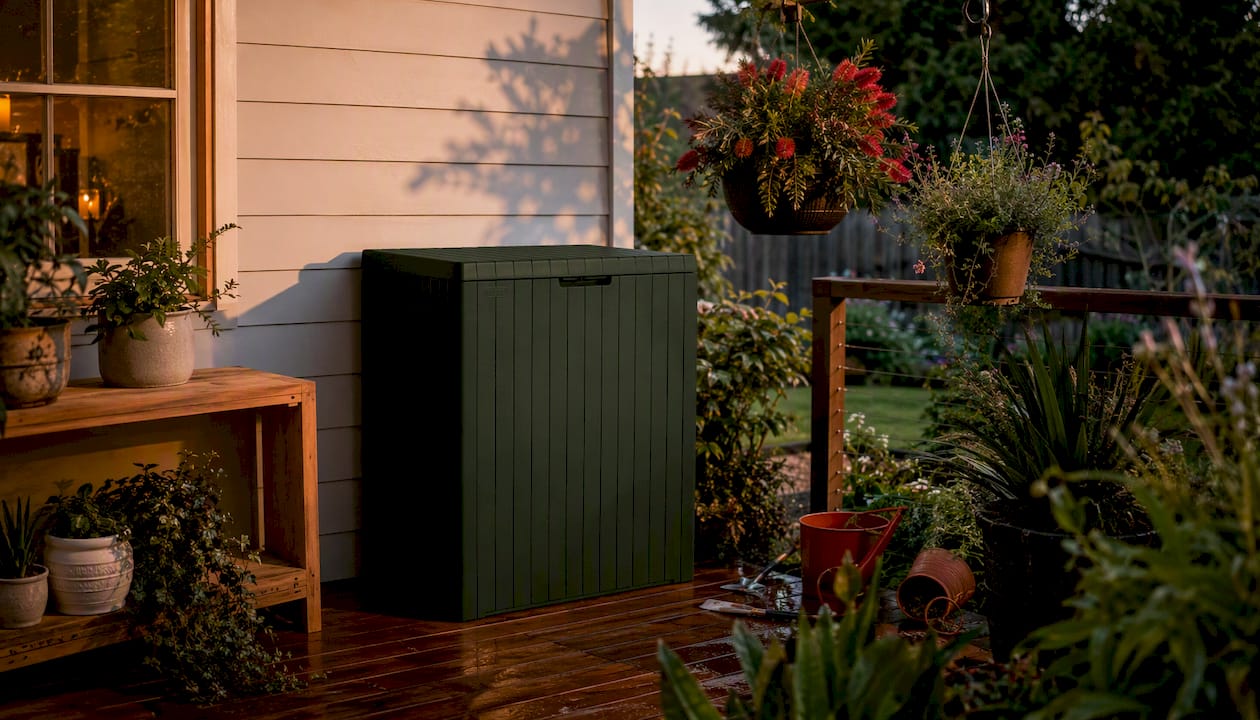
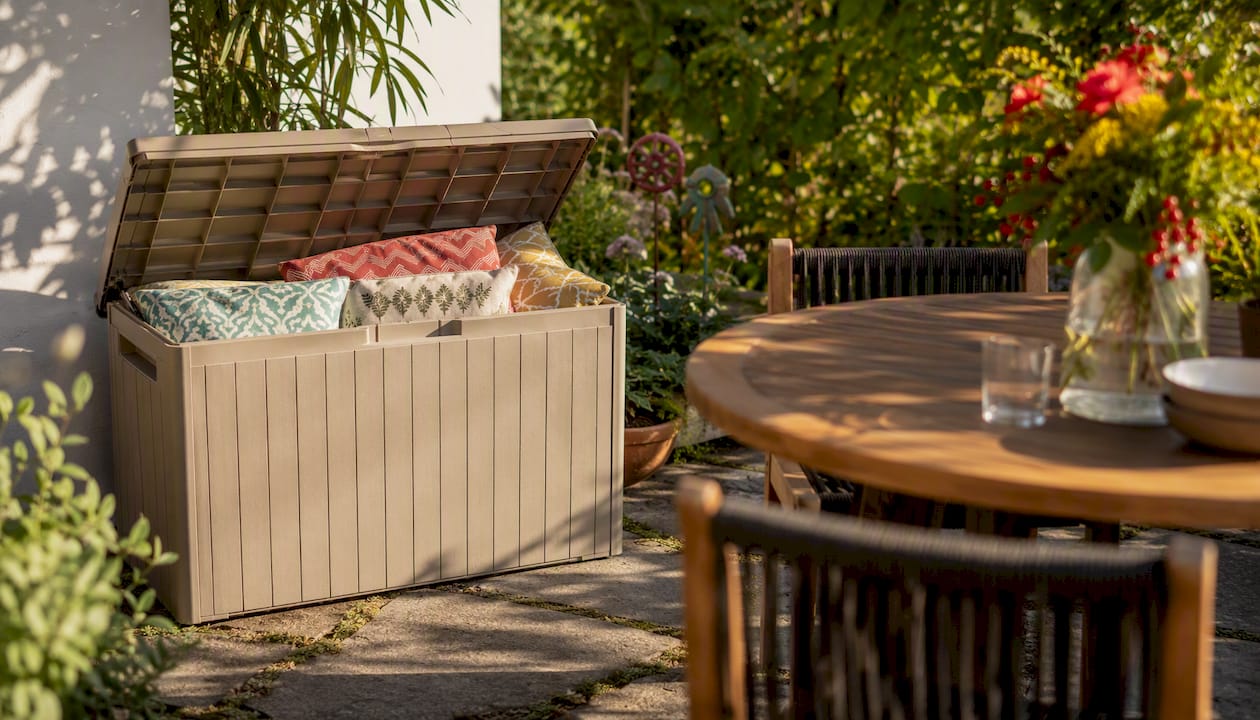
Storage boxes and chests are the most popular choice for cushion storage. They sit flat, open from the top, and keep cushions accessible without needing to move anything else. Most quality resin boxes include vented lids or mesh panels that allow airflow while keeping rain out. These are the go-to for dining sets and lounge areas.
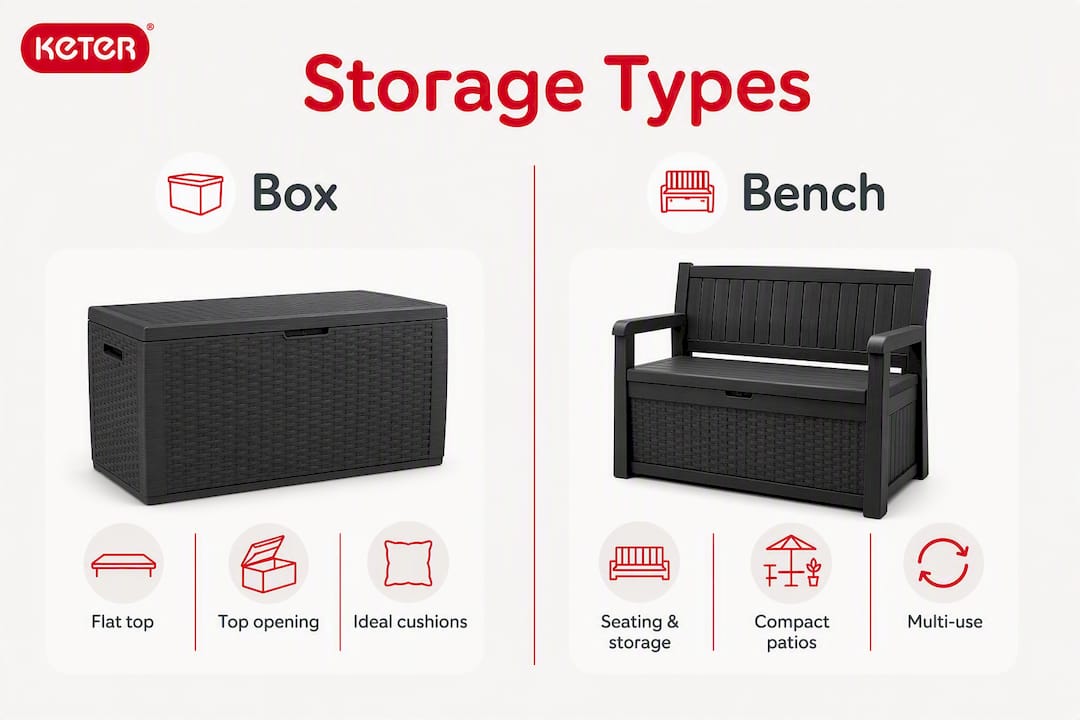
Storage benches and ottomans pull double duty: seating on top, storage inside. They work well on smaller patios where every piece of furniture needs to earn its place. The trade-off is capacity. Most storage benches hold 100–150L, which suits a few seat cushions but not a full lounge set.
Compact vertical storage cabinets are worth considering when floor space is tight but you have wall height to use. They are better suited to garden tools and accessories than bulky cushions, which tend to compress awkwardly in a tall, narrow space.
Small outdoor sheds make sense when you have a large volume of cushions, outdoor toys, and garden gear all needing a home. A shed gives you the most capacity and the best airflow, particularly if it has vented panels or a ridge vent. The footprint is larger, so they suit backyards rather than balconies. For ideas on combining sheds and storage boxes in a single backyard layout, the Ketergroup backyard organisation guide is a practical starting point.
Breathable storage bags are a budget-friendly option for seasonal storage in a garage or under a covered verandah. Look for 600-denier Oxford fabric with mesh venting rather than fully sealed plastic. They fold flat when empty, which is handy, but they offer no structural protection and are not ideal for exposed outdoor placement.
Red flags to avoid:
- Fully sealed, airtight plastic tubs with no vents. Trapped humidity accelerates mould even when cushions go in dry.
- Metal boxes without rust-resistant coating. In coastal or tropical Queensland and NSW, untreated metal corrodes quickly.
- Bags or boxes with no drainage. Standing water pooling inside is worse than no storage at all.
How to prepare cushions so they don’t go mouldy
Clean, fully dry cushions are the non-negotiable starting point. Storing even slightly damp cushions in any container, ventilated or not, creates the warm, humid conditions mould needs. Storing damp cushions or sealing them in non-breathable containers fosters mould, and the damage often sets in within days.
Follow this routine before every storage period:
- Remove covers and check zips and seams. Broken zips let moisture in; frayed seams let filling escape. Fix both before storing.
- Wash covers according to the care label. Most outdoor fabric covers can be machine washed on a gentle cycle. Spot-clean inserts with mild soap and water.
- Dry completely, 24–48 hours minimum. Stand cushions on their edge in a shaded, well-ventilated spot. Shade matters: extended direct sun fades fabric even as it dries. Press excess moisture out with towels first to speed the process.
- Reapply fabric protection if needed. Products like 303® Fabric Guard restore water and stain repellence after cleaning. One application before storage adds a useful layer of defence.
- Place silica gel or activated charcoal sachets inside the box. Two to three sachets in a 300L box is a reasonable starting point. Position them near the base, not buried under cushions.
- Arrange cushions with gaps between them. Flat-stacked cushions with no airflow between them trap humidity. Stand thinner cushions on edge or alternate orientations to keep air moving.
Pro Tip: In enclosed areas like a garage or shed, a small battery-powered or solar vent fan makes a noticeable difference. Even intermittent airflow disrupts the still, humid conditions mould prefers.
What does ‘weather resistant’ actually mean?
‘Weather resistant’ and ‘waterproof’ are not the same thing, and the difference matters when you are choosing a patio cushion storage box. A waterproof container has no gaps, no drainage, and no airflow. That sounds ideal until you realise that cushions release moisture over time, and a sealed container traps it inside.
Weather-resistant storage is designed to shed rain and handle UV exposure while still allowing controlled airflow. That is exactly what you want for cushions. Good airflow is the best defense against mould, and quality storage boxes achieve this through mesh panels, strategically placed vents, or gasketed lids that seal against rain but breathe.
Feature checklist for Australian conditions:
- UV stabilisation. Australian UV intensity is among the highest in the world. A box without UV-stabilised resin will fade, crack, and become brittle within a few seasons.
- Recycled resin or HDPE construction. Resin-based storage boxes perform well in Australian conditions, offering UV resistance and low maintenance compared with timber or metal.
- Vented or gasketed lid. Look for mesh panels or a lid design that sheds water without creating a sealed chamber.
- Raised base or elevated feet. Keeps the base off wet ground and prevents water from wicking up through the floor of the box.
- Lockable lid. Useful if the box is in a shared space or near a pool area.
- Drainage option. Some boxes include a small drainage plug at the base for any condensation that does accumulate.
Material comparison at a glance:
| Material | Pros | Cons | Best climate fit |
|---|---|---|---|
| Resin / recycled resin | UV resistant, low maintenance, lightweight | Can look utilitarian | All Australian climates |
| Timber | Attractive, natural look | Needs oiling/sealing, can warp | Temperate, sheltered spots |
| Metal (powder-coated) | Durable, modern look | Can heat up, rust risk near coast | Inland, low-humidity areas |
Timber boxes look beautiful on a sheltered verandah in Melbourne or the Adelaide Hills, but they need annual oiling and are not a good fit for tropical Darwin or a beachside block in Manly. Resin is the practical choice for most Australian homes because it asks almost nothing of you in return.
Pro Tip: When reading product specs, look for capacity in litres and internal dimensions, not just external measurements. A box with thick walls can have significantly less usable internal space than its external size suggests.
How to size your storage and where to place it
Getting the capacity right is the step most people skip, and it is why cushions end up over-compressed or spilling out of a box that looked big enough in the product photo.
Sizing formula: Measure each cushion’s length × width × thickness in centimetres, then multiply to get cubic centimetres. Divide by 1,000 to convert to litres. Add 20–30% to that total to allow for airflow between cushions. That is your minimum box capacity.
As a practical guide, Gardening Hub recommends a 200–300L box for a standard dining set’s cushions, and 400–500L for a lounge area with back cushions and seat pads.
| Setup | Suggested capacity | Approximate cushion count |
|---|---|---|
| 2-seat balcony setting | 100–150L | 2–4 seat cushions |
| 4-seat dining set | 150–200L | 4–6 dining cushions |
| 6-seat dining set | 200–300L | 6 dining cushions |
| 3-seat lounge + chairs | 300–400L | 6–10 mixed cushions |
| Large lounge set | 400–500L+ | 10 mixed cushions |
Placement matters as much as capacity. A storage box sitting in a low-lying spot that collects water after rain will have moisture problems no matter how good the lid seal is. Choose a level, slightly elevated spot, ideally under a pergola or eave. Keep it away from downpipes and garden beds that hold moisture. In coastal areas, rinse the exterior of the box occasionally to remove salt residue, and check that the base feet are not sitting in pooled water.
For small patios and balconies, the Ketergroup small patio guide has practical layout ideas that show how a compact storage box can double as a side table or step.
Maintenance schedule for stored cushions
Storage boxes are not a set-and-forget solution. A simple monthly routine is what separates cushions that come out fresh in spring from ones that smell musty and show mould spots.
Weekly (after storms or heavy rain):
- Check the lid seal and clear any debris blocking vents or drainage holes.
- If water has pooled on the lid, wipe it off and check the interior for any ingress.
Monthly (during off-season storage):
- Open the box and inspect for damp spots, unusual smells, or visible mould.
- Check that silica gel sachets are still active (most change colour when saturated). Replace moisture absorbers every 3–6 months depending on your local humidity.
- Clear vents and mesh panels of dust, spider webs, or leaf litter.
Seasonal (start and end of storage period):
- Deep clean cushion covers before storing and again before bringing them back out.
- Reapply a fabric protection spray like 303® Fabric Guard after cleaning to restore water repellence that UV exposure and washing gradually reduce. For professional-grade surface protection on your outdoor furniture and hard surfaces, TrueSeal Coating’s residential services are worth considering alongside DIY spray options.
- Wipe down the interior of the storage box with a mild bleach solution (1 part bleach to 10 parts water), rinse, and allow to dry fully before repacking.
Pro Tip: A small solar-powered vent fan mounted in a shed or large cabinet keeps air circulating even when you are not checking. They cost very little to run and make a real difference in humid climates.
When to replace cushions: if mould has penetrated the insert foam and the smell persists after washing, or if the foam has sagged beyond recovery, replacement is the practical call.
Ketergroup picks for Australian cushion storage
Ketergroup designs its storage boxes from UV-stabilised recycled resin, which suits Australian conditions well: no rust, no warping, and no annual maintenance beyond a wipe-down. All three products below are available on ketergroup.com.au with full capacity and dimension specs.
| Product | Capacity | Best for | Key features |
|---|---|---|---|
| Keter City Box 113L | 113L | Small patio, 2–4 cushions | Compact footprint, weather-resistant resin, easy assembly |
| Keter City Box 113L 2-Pack | 2 × 113L (226L total) | Modular storage, multiple spaces | Two boxes for flexible placement or larger volume |
| Keter Springwood 305L | 305L | Dining set or small lounge | Mid-size capacity, green finish, weather-resistant lid |
Keter City Box 113L This compact box is the right call for a balcony, courtyard, or any spot where floor space is limited. It fits two to four standard seat cushions comfortably, assembles without tools, and handles UV and rain without any special treatment. The footprint is small enough to tuck beside a two-seat setting.
Keter City Box 113L 2-Pack Two boxes give you 226L of total capacity and the flexibility to split storage across two areas, one near the dining setting and one near the lounge, for example. The modular approach also means you can add a third box later if your cushion collection grows.
Keter Springwood 305L At 305L, this is the practical choice for a 4–6 seat dining set or a compact lounge setting. The green finish suits garden environments and blends with planted borders. Like all Keter resin products, it is made from recycled materials and requires no painting or sealing.
Check the internal dimensions on the product page against your cushion measurements before ordering. External dimensions can be misleading when walls are thick.
Quick buying checklist and red flags
Before you confirm any purchase, run through these checks:
Must-confirm specs:
- Capacity listed in litres (not just “large” or “XL”)
- Internal dimensions (length × width × depth) to verify your cushions fit without compression
- Venting or mesh panels confirmed in the product description
- Raised base or feet to keep the box off wet ground
- Delivery available to your postcode in Australia
- Returns policy clearly stated
Red flags:
- No capacity listed in litres. A box described only by external dimensions or vague size labels is hard to evaluate.
- Fully airtight seal with no venting. Fine for tools, not for cushions.
- Metal construction with no rust-resistant coating, particularly if you live near the coast.
- No drainage option on a box intended for exposed outdoor placement.
- Missing or vague assembly instructions. A box that arrives as a puzzle with no guide wastes your afternoon.
Questions worth asking before buying:
- Does the lid seal keep rain out while still allowing airflow?
- Is the resin UV-stabilised, or will it fade and crack within a few seasons?
- What is the base construction: flat plastic or raised feet?
Key takeaways
A weather-resistant, ventilated storage box sized to your cushions, used only with fully clean and dry cushions, is the most reliable way to prevent mould and extend cushion life in Australian conditions.
| Point | Details |
|---|---|
| Always store dry cushions | Allow 24–48 hours drying time before packing; damp cushions mould quickly in any container. |
| Size by litres, not box name | Use 200–300L for a dining set, 400–500L for a lounge set; measure cushions and add 20–30% for airflow. |
| Choose ventilated, weather-resistant storage | Avoid airtight sealed tubs; look for UV-stabilised resin with vents or mesh panels. |
| Check monthly, replace desiccants every 3–6 months | A quick monthly inspection and fresh silica gel sachets prevent internal moisture build-up. |
| Ketergroup options available in Australia | The City Box 113L, City Box 2-Pack, and Springwood 305L cover small to mid-size cushion storage needs. |
The case for ventilation over waterproofing
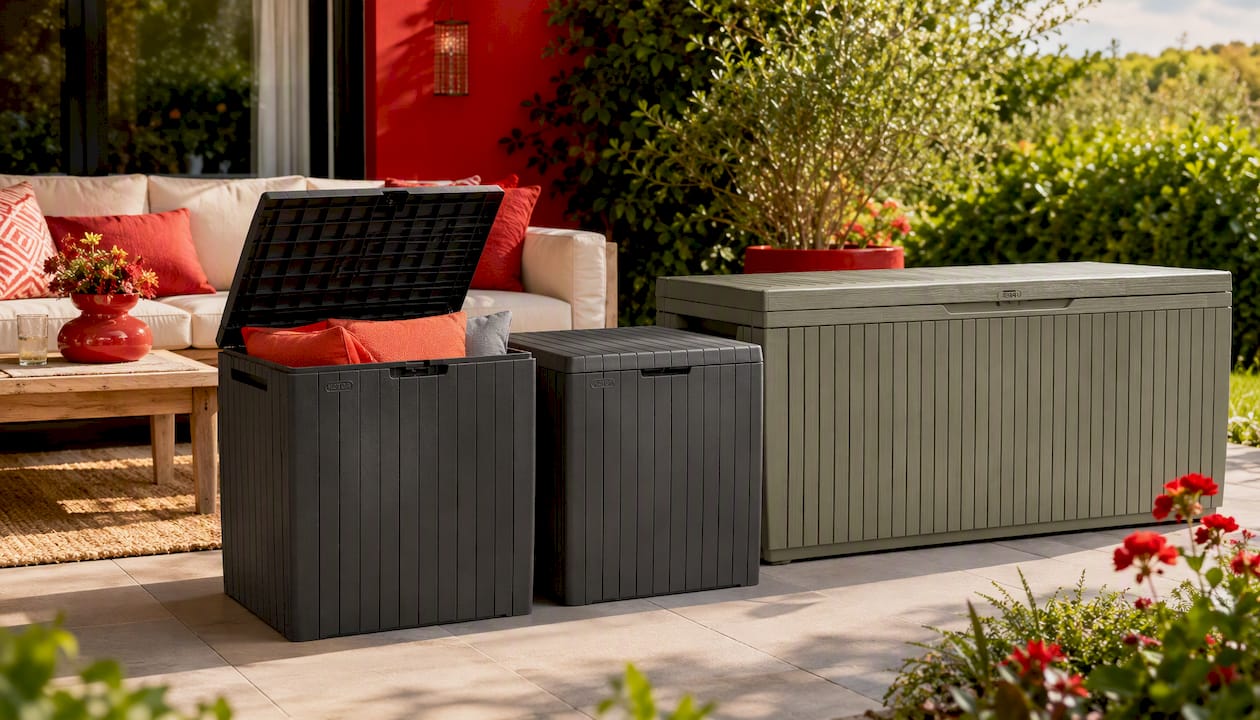
Most people shopping for outdoor cushion storage reach for the most sealed, waterproof-looking box they can find. The instinct makes sense: Australian weather is unpredictable, and the idea of rain getting in feels like the biggest risk. But the bigger risk, in practice, is what happens inside a sealed container over weeks and months.
Cushions off-gas moisture even when they feel dry to the touch. Foam inserts hold residual humidity from the air around them. A fully sealed box traps all of that, and given enough time, the result is the musty smell and mould spots that make people think their cushions are ruined. They often are not ruined, just stored incorrectly.
The right storage solution breathes. It keeps rain off the top while letting air move through the sides or base. That is a design choice, not a compromise, and it is why quality resin boxes with vented lids outperform airtight tubs for this specific use case. Pairing that with a monthly check routine and fresh desiccants is not complicated. It is just the routine that actually works.
FAQ
What is the best storage for outdoor sofa cushions?
A weather-resistant resin storage box with vented panels is the best option for outdoor sofa cushions. Choose a capacity of 400–500L for a full lounge set, and always store cushions fully dry to prevent mould.
How do you store outdoor cushions so they don’t go mouldy?
Clean and fully dry cushions for 24–48 hours before storing, place silica gel sachets inside the box, and check monthly for damp spots or smells. Replace desiccants every 3–6 months depending on your local humidity.
How do you preserve outdoor cushions in storage?
Reapply a fabric protection spray like 303® Fabric Guard after washing and before storing, keep cushions in a ventilated weather-resistant box, and inspect them monthly during the off-season.
Do outdoor storage boxes keep cushions dry?
A quality weather-resistant storage box with a gasketed or vented lid keeps rain off cushions effectively. No storage box eliminates internal humidity entirely, which is why desiccants and monthly checks remain important alongside the box itself.


