
Protect Your Bond: 4 Renter Friendly Outdoor Storage Options

The safest bets are portable resin storage boxes, slimline freestanding cabinets, storage benches, and small resin flat-pack sheds that typically sit under council permit thresholds. All four suit renters because none of them need to be bolted down. Before you buy or install anything, get written consent from your landlord or property manager and keep a copy. That one step decides whether your storage solution becomes a bond headache later.
TL;DR:
- Portable resin storage boxes are ideal for renters because they are lightweight, weather resistant, and easy to move with no drilling or fixing needed.
- Always obtain written landlord approval before installing any outdoor storage and specify the exact dimensions and location in your formal request.
- Use non-penetrating, reversible anchoring methods such as ballast or removable straps to secure your storage without damaging the property.
- Placement on pavers or a hard stand prevents turf damage and helps avoid drainage disputes during inspections or at lease end.
- Keep detailed photos, receipts, and written permissions to prevent bond disputes related to outdoor storage installation or removal.
Table of Contents
- What counts as renter friendly outdoor storage?
- How do I get landlord and council approval?
- Can I install outdoor storage without damage?
- Which materials actually suit rental life?
- How do I maintain storage and avoid bond claims?
- Why resin storage suits renters better than most alternatives
- Damage-free installation techniques worth copying
- How do you secure stored items in a rental?
- How do you make the most of a small outdoor space?
- What’s the best storage option for a short lease?
- How do you clean and maintain storage to keep landlord approval?
- Publisher-recommended products for renters
- Official tenancy and council resources
- A practical reminder before you buy anything
- Sources
- FAQ
What counts as renter friendly outdoor storage?
Renter friendly outdoor storage means anything freestanding, easy to shift, and installed without drilling, concreting, or permanent fixing to the property. It’s the difference between a “chattel” (something you own and can take with you) and a “fixture” (something legally attached to the property that may become the landlord’s). Legal guidance on the distinction between chattels and fixtures is worth understanding before you buy, because it shapes what you’re actually allowed to remove when you move out.
Here’s how the main renter-friendly categories stack up against each other.
- Portable deck and patio boxes. Fully freestanding, no assembly onto the building itself, and ideal for balconies, courtyards, and small backyards. You can pick one up and carry it if you need to reposition it for lawn mowing or an inspection.
- Slimline vertical cabinets. Narrow footprints, often in the 56 to 79 centimetre width range, so they tuck against a wall on a tight balcony without eating your usable space. Good for garden tools, chemicals, and anything you’d rather lock away from curious hands.
- Storage benches. Double as outdoor seating, so they don’t scream “storage unit” to a property manager doing a walk-through, and they’re easy to slide rather than fix in place.
- Small resin flat-pack sheds. Useful when you need real volume, but check the footprint against council rules and get landlord sign-off regardless of size, as even an exempt structure still needs the owner’s blessing.
Match the product to the job: cushions and pool gear suit a lidded box, bikes and tools want a cabinet with a lockable door, and anything valuable belongs somewhere with a secure latch rather than an open bench.
How do I get landlord and council approval?
Every approval conversation starts the same way: in writing, before the item arrives. Verbal “yeah that’s fine” from a property manager means nothing if a dispute comes up at the final inspection.
- Submit a written request first. In Queensland, this typically means using Form 23, and the landlord or agent must respond in writing within a reasonable response time, often about four weeks. Other states have their own equivalent forms, so check with your local tenancy authority before assuming Form 23 applies to you.
- Check strata or body corporate rules if you’re in an apartment or townhouse. Landlord approval alone often isn’t enough in a strata scheme, where the body corporate can have its own separate approval process and timeline.
- Put the essentials in your written request: dimensions, exact location, base or anchor method, who pays for installation and removal, and confirmation of who insures the item.
Skipping any of these steps is how a simple storage box turns into a shed dispute over drainage, insurance, or who owns the structure when the lease ends.
Can I install outdoor storage without damage?
Yes, and it comes down to base choice and anchoring method rather than the storage unit itself. The goal is full removability. When you vacate, the yard should look exactly like it did on your entry condition report.
- Sit freestanding storage on pavers or a hardstand area, not directly on lawn. This protects turf and avoids the drainage complaints that come up in shed disputes.
- Use ballast, sandbags, or a removable anchor kit for wind stability instead of screwing anything into decking or concrete.
- Non-penetrating brackets can secure lightweight items to a balcony railing where the building allows it, but check with your property manager first, since even a clip-on bracket counts as an alteration in some buildings.
- Add anti-slip pads or rubber feet under boxes and cabinets to stop decking scuffs, and shift the unit every few weeks to avoid a permanent dead patch or a damp mark underneath.
- Bring in a professional for anything involving a slab, concrete anchor, or electrical connection, and get written sign-off on the work so there’s a paper trail if a dispute comes up later.
Pro Tip: Photograph the exact spot before you place anything and again once it’s installed. Keep the photos with your written permission and any receipts. If a bond dispute ever comes up, dated photos are worth more than your memory of “it was already like that.”
Which materials actually suit rental life?
Material choice decides how easy your storage is to move, how much upkeep it needs, and whether a landlord will even say yes.
| Material | Weight & portability | Maintenance | Renter suitability |
|---|---|---|---|
| Resin / recycled plastic | Light, one or two people can shift it | Wipe clean, no rust or rot | High, aligns with no-drill installs |
| Steel | Heavy, often needs two or more people | Prone to rust in coastal air, needs repainting | Moderate, frequently needs anchoring or approval |
| Timber | Moderate, but bulky | Needs sealing and treatment against weather | Lower, often treated as a permanent structure |
Resin storage is weather resistant and stays light enough to carry between properties, which is exactly what a renter needs from a piece of gear you might move house with twice in two years. Steel holds up structurally, but its weight usually means anchoring, and anchoring usually means asking permission. Timber looks great on a balcony, yet it demands regular oiling or sealing, and landlords often treat a built timber structure as a permanent fixture rather than something you’re free to remove.
When you’re comparing products, prioritise UV-stable resin, straightforward flat-pack assembly, a lid or door that locks, some ventilation to stop mustiness, and built-in lift points so you can actually pick the thing up when moving day arrives.
How do I maintain storage and avoid bond claims?
Bond disputes over outdoor storage almost always trace back to two things: undocumented permission and neglected grounds underneath the unit.
- Shift freestanding items every few weeks to stop dead grass patches and water pooling, which are the most common grounds-related complaints property managers raise.
- Photograph the site on install and again on removal, and keep both sets of images alongside your written landlord permission.
- Reinstate the surface if asked. For lawn, that’s usually basic top-dressing and reseeding; for pavers, relaying a couple of shifted stones is normally enough.
- Check your contents insurance covers portable outdoor storage, and tell your landlord about anything that could be read as a permanent addition, even if you’re confident it isn’t one.
Why resin storage suits renters better than most alternatives
Some outdoor storage is designed and manufactured from durable, recyclable resin, built with renters and space-conscious households in mind. The weather resistant shells, lightweight construction, and simple flat-pack assembly hit the three things a rental situation actually demands: portability, a small footprint, and installation you can undo in an afternoon. None of it needs a drill, a slab, or a tradesperson.
That combination matters more than it sounds. A resin storage box that two people can lift into a van beats a beautifully built timber structure you can’t take with you when the lease ends.
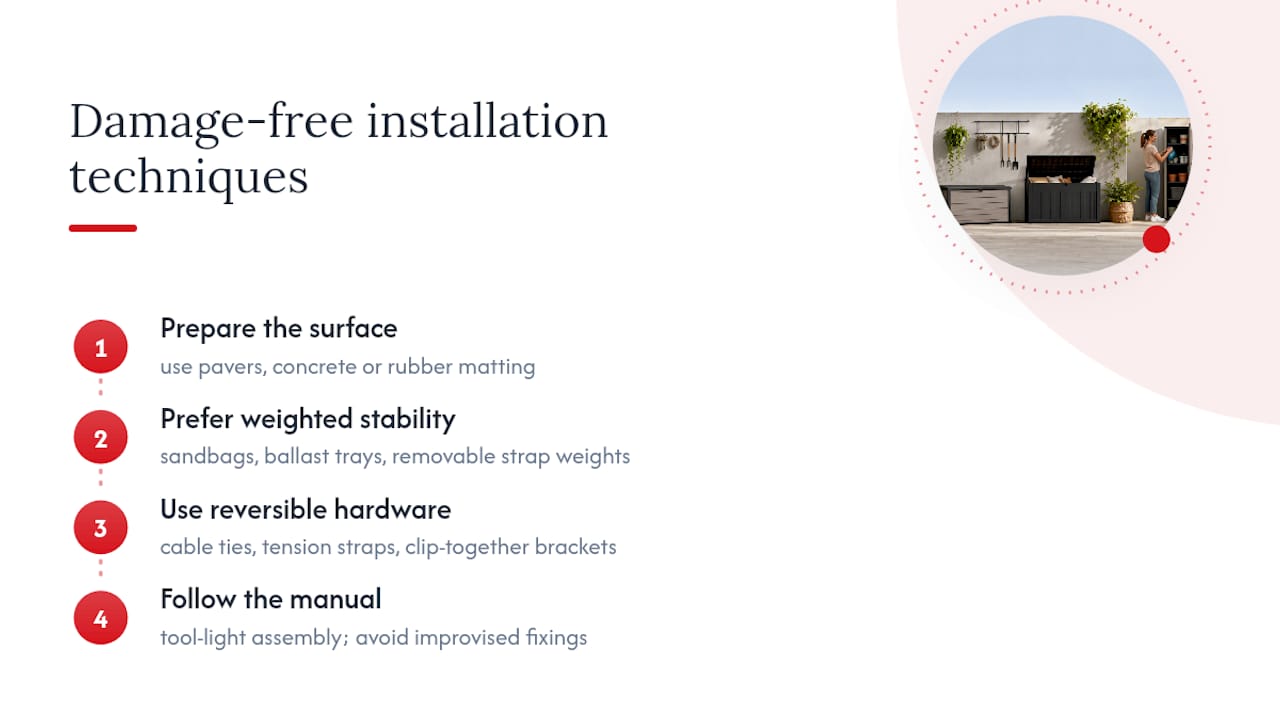
Damage-free installation techniques worth copying
The renters who avoid bond arguments tend to follow the same handful of habits, regardless of what they’re storing.
Start with the surface, not the structure. A paved area, a concrete pad, or even a thick rubber matting layer keeps weight and moisture off the lawn and gives you a clean, flat base you can photograph before anything goes on top of it. If your balcony or patio is already tiled or decked, you’re most of the way there already.
For anything freestanding, weighted stability beats fixed stability. Sandbags tucked against the base, filled ballast trays, or a removable strap anchored to a portable weight all do the job wind bracing usually calls for, without a single screw going into the structure. Where a balcony railing bracket is genuinely needed, choose a clamp-style, non-penetrating design and confirm with your property manager that clamping onto the railing itself is fine, since some buildings restrict even that.
Keep hardware reversible. Cable ties, tension straps, and clip-together brackets can all be removed without a trace, unlike screws, brackets driven into brick, or adhesive fixings that pull paint off when they come away. If a technique needs a drill bit to undo it, it’s not renter friendly, no matter how sturdy it looks in the display photo.
Finally, treat the manual as a checklist, not a suggestion. Products like Keter’s flat-pack ranges are built around tool-light assembly processes specifically so you’re not improvising a fixing method that voids your bond.
How do you secure stored items in a rental?
Security for rental storage comes down to lock quality, sightlines, and where you place the unit, since you can’t install cameras or hardwired alarms without the same approval hurdles as any other fixture.
Choose storage with a lockable lid or door as standard, rather than relying on an aftermarket padlock through a flimsy hasp, which is often the weakest point on a cheap box. Position units where they’re visible from inside your home or from a well-lit common area. Storage tucked into a dark, unseen corner of a shared yard is far more likely to be targeted than one sitting near a lit doorway.
For genuinely valuable gear, tools especially, a slimline cabinet with a proper lock beats an open bench every time, since anything with a hinged bench lid can be lifted without needing to defeat a lock at all. If your rental has shared outdoor space, ask whether other tenants have access to the same area, and factor that into where you place anything expensive.
A discreet cable lock through wheels or handles adds a second layer for bikes stored in a cabinet or against a wall, and it costs little compared to replacing a stolen bike. Renters insurance is worth checking too. Portable storage contents are sometimes excluded or capped under standard contents policies, so confirm your cover extends to items kept outdoors before you assume you’re protected.
How do you make the most of a small outdoor space?
Small courtyards and balconies punish bulky storage fast, so the trick is choosing shapes that work with the space rather than against it.
Vertical storage almost always beats horizontal storage on a tight footprint. A slimline cabinet against a wall uses a fraction of the floor space a wide chest-style box needs, while still holding a similar volume of gear. If you’ve only got a narrow side path or a compact balcony, measure the width available before you shop, since a cabinet in the 56 to 79 centimetre range will often fit where a standard deck box won’t.
Dual-purpose furniture earns its keep in small spaces. A storage bench gives you seating and hidden storage in one footprint, which matters when every square metre of a balcony is doing double duty as a dining spot, a plant corner, and a place to dry washing.
Stack thinking vertically where you can. A cabinet with adjustable shelving lets you use the height of the unit properly instead of piling loose items on top of each other where the bottom layer becomes unreachable. And keep frequently used items, like a broom or a watering can, in the most accessible spot, so you’re not unpacking the whole box every time you need something small.
What’s the best storage option for a short lease?
Short leases call for storage you can pack down fast and take with zero fuss, which usually rules out anything with a built base or a footprint over a square metre or two.
A single mid-sized resin box is often the smartest move if you’re only in a place for six to twelve months. It holds a genuinely useful amount, from cushions to gardening gear, and most flat-pack resin designs disassemble down to a manageable size for a car boot or a moving van. You’re not paying removalists extra for something bulky.
If you’re renting month to month or subletting, skip anything with an assembly time over half an hour. The whole point of temporary storage is that setup and teardown shouldn’t feel like a project. A lidded box you can lift straight into a vehicle beats a shed you’d need to dismantle with tools before moving day.
Consider borrowing or hiring for genuinely short stints, particularly for bulky seasonal items like camping gear you might only need for a few months of the year. Buying a full-sized shed for a six-month lease rarely pays off, whereas a compact box scales down cleanly to whatever your next place needs.
How do you clean and maintain storage to keep landlord approval?
Keeping a landlord happy with your storage arrangement isn’t a one-off conversation. It’s an ongoing habit that shows up at every routine inspection.
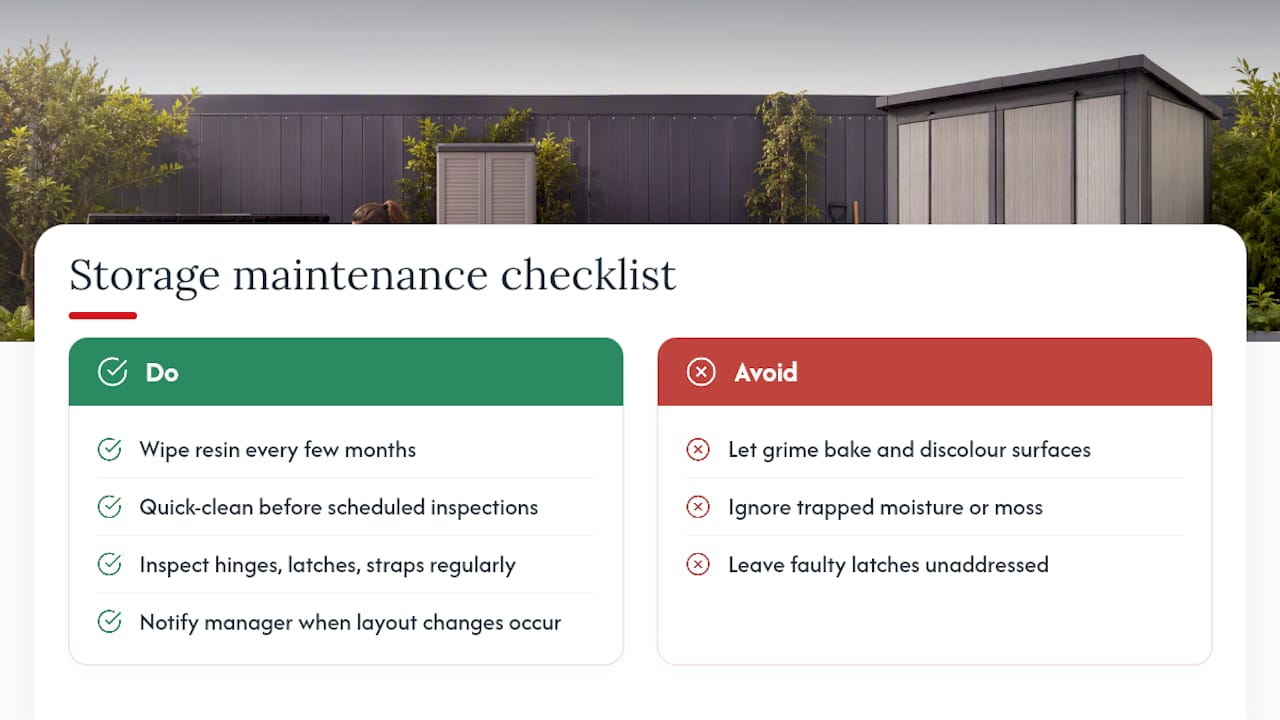
Wipe resin surfaces down every few months with a mild detergent and a soft brush, particularly in the tracks and hinges where dirt and pollen build up. Unlike timber, resin won’t rot or need resealing, but grime left to bake on in the sun can still discolour the surface over time. A quick clean before a scheduled inspection makes a noticeable difference to how the whole yard presents.
Check the ground underneath periodically. If you’ve followed the advice to place storage on pavers or hardstand rather than lawn, there’s less to worry about, but even a paved area can trap moisture and grow moss if it’s never lifted and aired out. Moving the unit for an afternoon every couple of months solves this without any real effort.
Keep an eye on hardware too. Hinges, latches, and any removable anchor straps should be checked for wear, especially if the unit is exposed to strong coastal weather. A latch that’s stopped closing properly isn’t just an inconvenience, it’s a security gap.
Finally, revisit your written approval if your circumstances change. If you add a second box, swap a bench for a cabinet, or reposition something closer to a fence line, a quick message to your property manager confirming the change keeps your paper trail current and avoids any awkward surprises at the next inspection.
Publisher-recommended products for renters
If you’ve secured written permission and measured your space, a handful of options in the Keter range genuinely suit the renter brief. For balconies or small courtyards where every centimetre counts, the Keter City Box gives you 113 litres of lockable, weather resistant storage in a footprint compact enough to sit beside a table setting without dominating the space.
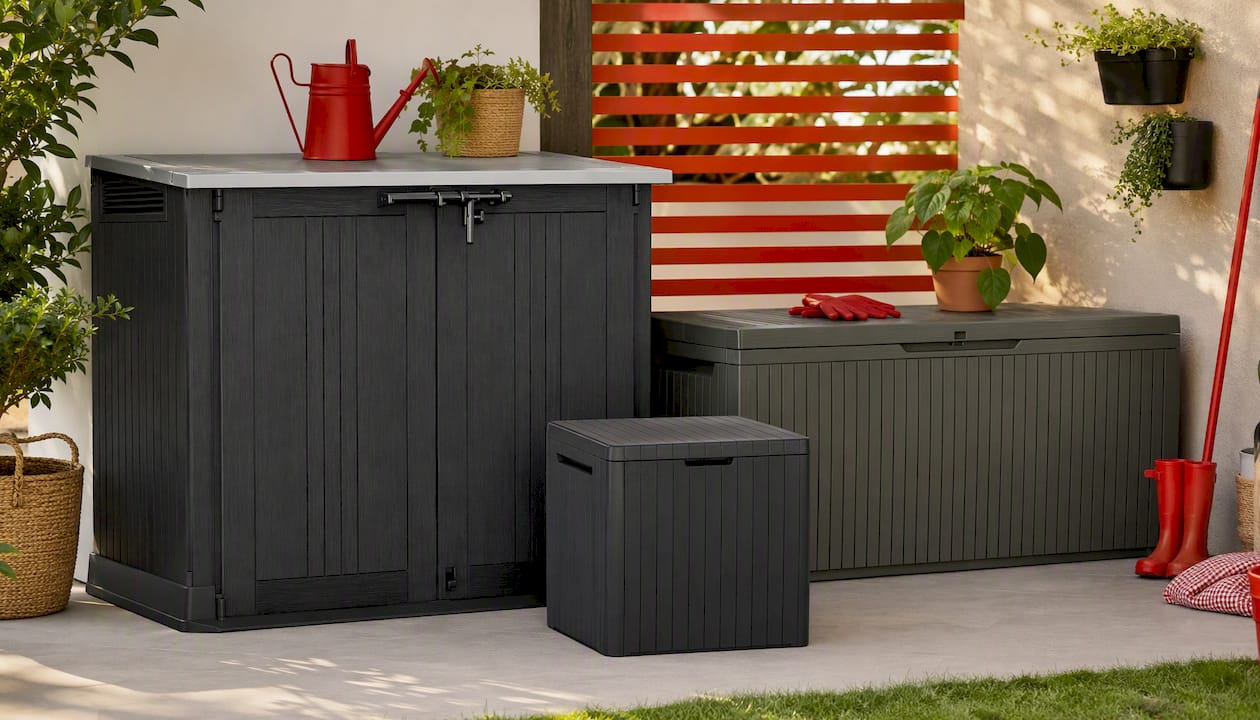
For a backyard with a bit more room, the Keter Springwood 305L storage box holds cushions, tools, and garden gear behind a lockable lid, and its resin build means you can shift it to mow underneath without wrestling a heavy steel cabinet. If you need genuine shed-level capacity and your council thresholds and landlord approval line up, the Store It Out Prime shed, available at Bunnings, offers 880 litres of enclosed storage while staying under the resin, no-permanent-fixing category most renters need to stick to.
Whichever you choose, the order of operations stays the same: confirm your written permission, measure the space, then buy. Storage bought first and approved second is how bond disputes start.
Official tenancy and council resources
Check your own documents before installing anything: the RTA’s fixtures and structural changes guidance covers Form 23, your state or territory’s council shed and permit rules vary locally, and strata properties should confirm body corporate requirements directly with their owners corporation.
A practical reminder before you buy anything
Get everything in writing before a single box arrives, photograph the site, and match the product to your actual space rather than what looks good online. Renters who skip the paperwork are the ones who end up arguing about it at the final inspection. Choose sensibly, document everything, and the storage question stops being a source of stress.
— Liza
Sources
- Fixtures and structural changes | Residential Tenancies Authority
- Can you put a shed on a rental property in Australia?
FAQ
Can I install a shed on a rental property?
Only with written landlord permission and, in most cases, confirmation that the structure falls under your council’s exemption thresholds, generally under 10 square metres and 2.4 metres in wall height.
Do I need council approval for a small resin storage box?
Small portable storage boxes typically don’t trigger council development approval, but you still need written landlord consent before installing one.
What’s the safest way to secure outdoor storage without drilling?
Use ballast, sandbags, or a removable anchor kit for wind stability, and sit the unit on pavers or a hardstand rather than fixing it to the structure.
How long does a landlord have to respond to a storage request?
In Queensland, landlords or agents must respond in writing in a reasonable time to a formal request submitted via Form 23, following local tenancy authority guidance.; other states have similar written-request processes worth checking directly.
Which material is best for renter-friendly outdoor storage?
Resin or recycled plastic is generally the best fit, since it’s weather resistant, lightweight enough to move without help, and doesn’t need the anchoring that heavier steel or timber structures often require.


