
Recycled plastic outdoor furniture: the Australian buyer's guide

Recycled plastic outdoor furniture is an excellent choice for Australian homes and commercial spaces. It handles the harsh sun, coastal salt air, and heavy rain without rotting, rusting, or demanding annual maintenance. Three reasons stand out:
- Durability without upkeep. Quality recycled-plastic furniture requires no painting, staining or sealing, and can be cleaned with mild detergent and water.
- Genuine sustainability credentials. Products like those from Replas have a high recycled plastic content, diverting post-consumer waste from landfill and supporting a circular economy.
- Proven lifespan in tough conditions. Well-made, UV-stabilised pieces have a much longer lifespan than untreated timber in Australian outdoor conditions.
Ketergroup’s Australian range offers weather-resistant furniture and outdoor storage built from recycled and recyclable resin, designed specifically for the demands of Australian outdoor living.
Table of Contents
- Why choose recycled plastic outdoor furniture?
- What is recycled plastic furniture actually made from?
- How long does recycled plastic furniture last in Australian conditions?
- How to care for recycled-plastic outdoor furniture
- How to choose recycled-plastic outdoor furniture
- Where does recycled plastic furniture work best?
- How recycled plastic furniture is made and tested
- Recycled plastic vs timber and metal: how the costs compare
- Key takeaways
- Why recycled resin makes sense for Australian outdoor living
- Ketergroup’s outdoor furniture and storage range
- Sources and further reading
- FAQ
Why choose recycled plastic outdoor furniture?
The practical case for furniture made from recycled plastic comes down to three things: less work, longer life, and a lighter footprint.
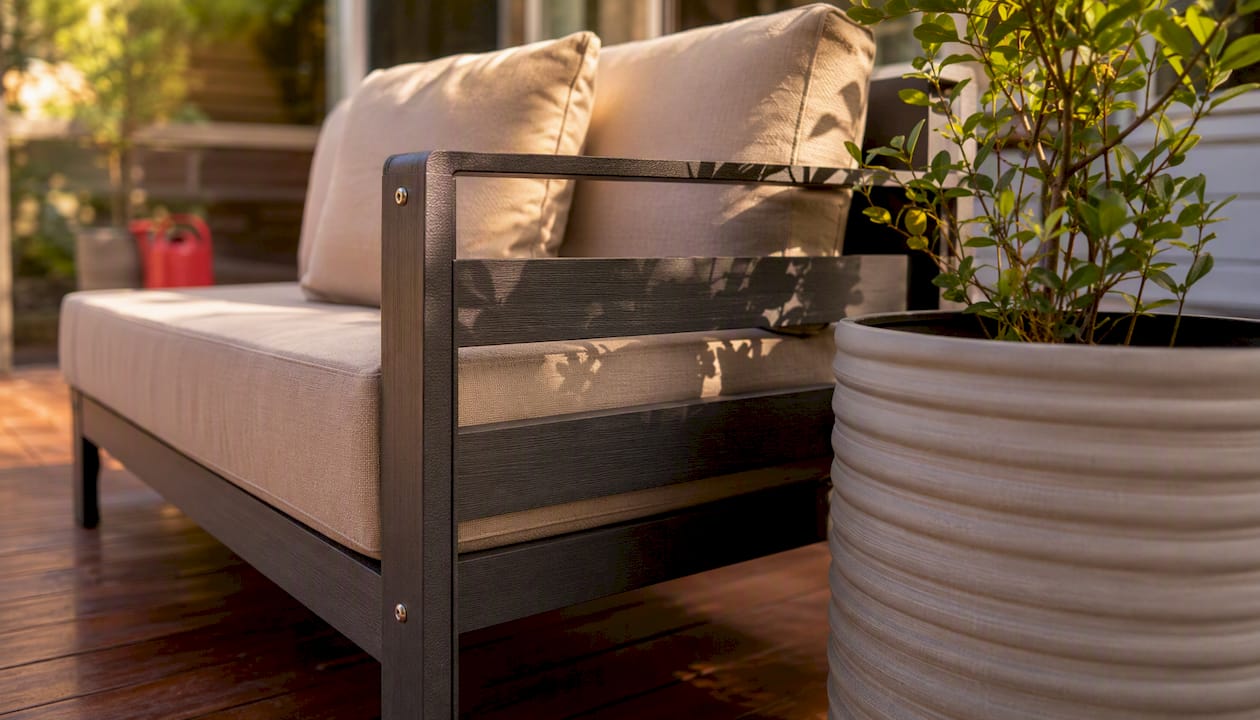
Low maintenance is the headline benefit. Unlike timber, recycled-plastic pieces never need oiling, sanding, or repainting. A wipe-down with mild detergent and a soft brush is genuinely all the routine care required; no painting, staining or sealing is necessary. For busy households and commercial operators managing multiple settings, that saving adds up fast.
Long service life is equally compelling. Untreated hardwood left outdoors in Queensland or coastal WA can degrade within a decade. Recycled-plastic furniture, when properly UV-stabilised, holds its structural integrity and colour for decades. The 20–50+ year lifespan range cited across the industry reflects quality products, not optimistic marketing.
The sustainability story is real, too. Keeping post-consumer plastics in productive use rather than sending them to landfill is a meaningful contribution to the circular economy. Products with 85% or higher recycled content, such as those from Australian manufacturer Replas, demonstrate what’s achievable when the feedstock is managed well.
- No rot, no rust, no insect damage
- Colour-stable when UV-stabilised pigments are used throughout the polymer
- Resistant to moisture, mould, and salt air
- Suitable for coastal, inland, and shaded sites
Pro Tip: Choose pieces with stainless or other corrosion-resistant fasteners, not just weather-resistant plastic boards. Hardware is the most common failure point in coastal installations, and it often gives out long before the plastic does.
What is recycled plastic furniture actually made from?
The industry uses several terms interchangeably, and knowing what they mean helps you read product pages with confidence.
HDPE (High-Density Polyethylene) is the most common polymer used in quality outdoor furniture. It comes primarily from post-consumer milk bottles, detergent containers, and industrial packaging. HDPE is dense, impact-resistant, and takes pigment well, making it the preferred choice for best HDPE outdoor furniture applications.
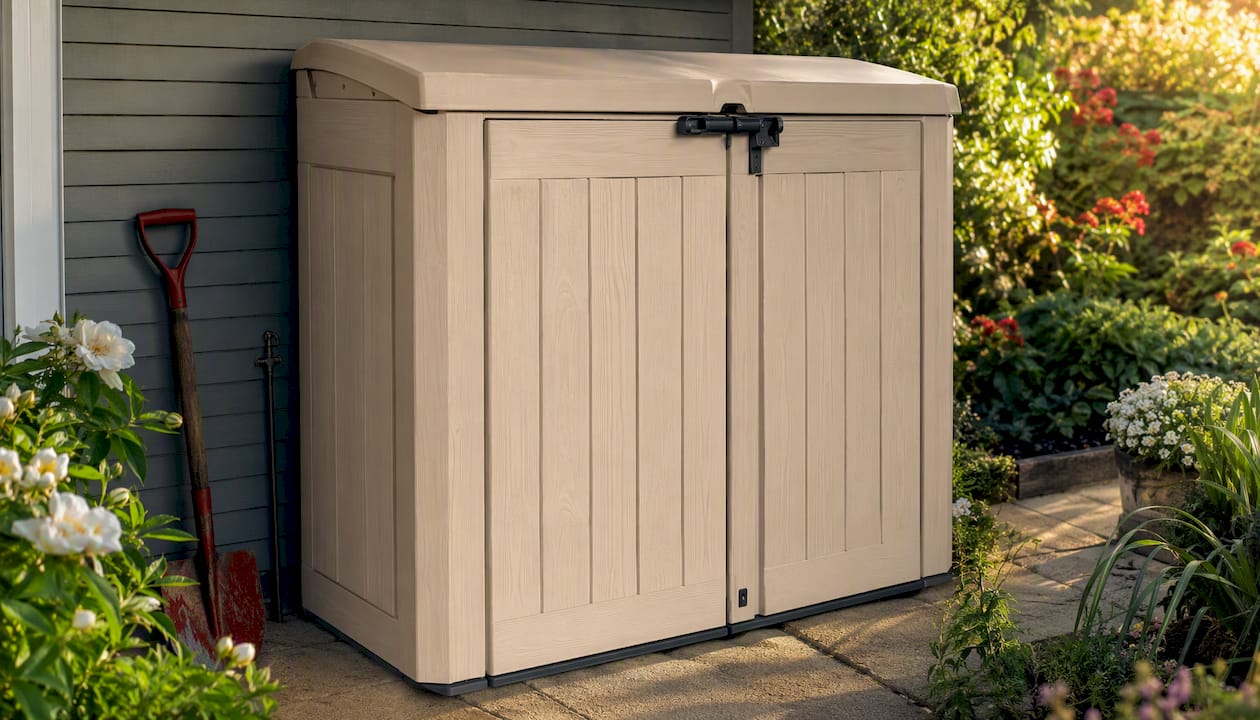
Poly-lumber, polywood, and recycled resin are all trade names for the same basic concept: recycled plastic processed into board or moulded form and used as a structural material. The terms are often used interchangeably in Australian retail, though “recycled resin” tends to appear in moulded-form products while “poly-lumber” describes extruded boards.
Mixed recycled poly blends multiple polymer streams. It’s common in lower-cost products but can be harder to colour consistently and may have lower UV resistance than single-stream HDPE.
When reading product pages, look for:
- Recycled content percentage — 70–85%+ is the benchmark for genuinely recycled products; anything below 50% warrants scrutiny
- UV stabilisation — should be integrated throughout the polymer, not applied as a surface coating
- Masterbatch pigments — lightfast pigments mixed into the polymer before extrusion give far better colour stability than surface dyes
- Corrosion-resistant fixings — stainless steel or marine-grade hardware is the standard for quality pieces
- Impact modifiers — additives that maintain flexibility and toughness in cold or very hot conditions
If a product page doesn’t specify the UV package or recycled-content percentage, that’s worth asking about before you buy.
How long does recycled plastic furniture last in Australian conditions?
The honest answer: 20–50+ years for quality, UV-stabilised products, with the variance driven by four factors.
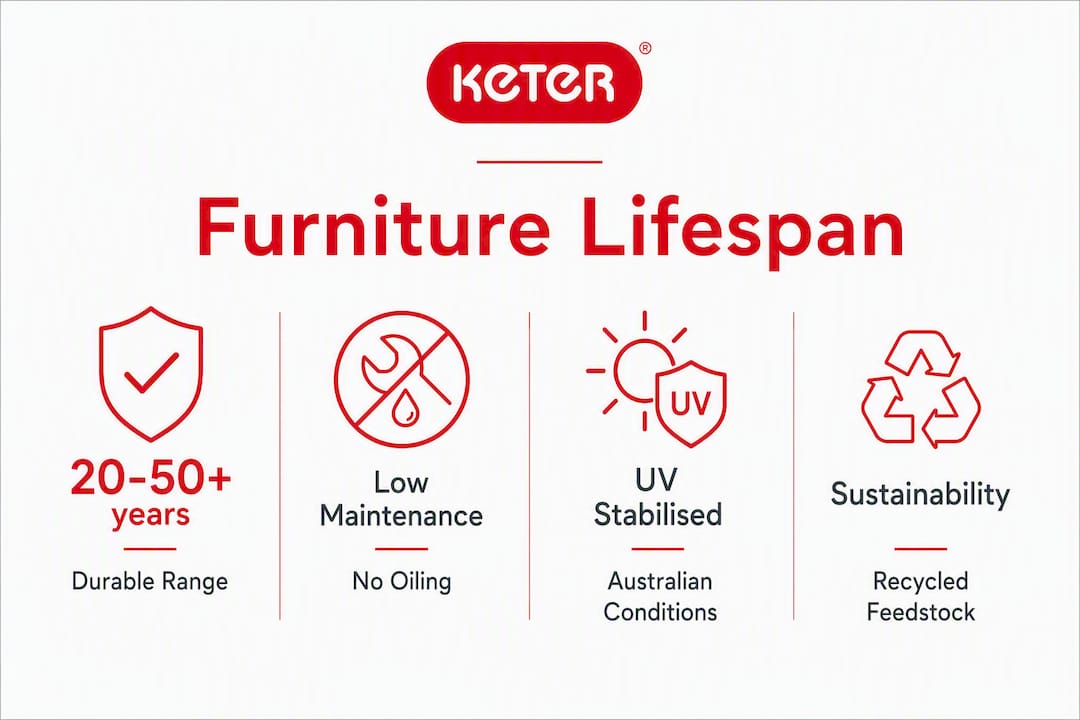
UV stabilisation is the single biggest determinant of long-term performance. Australia’s UV index regularly hits extreme levels, and furniture without an integrated UV stabilisation package will fade and become brittle within a few years. Products with UV stabilisers blended throughout the polymer, rather than applied as a surface treatment, hold their colour and mechanical strength far longer.
Polymer blend and pigment quality matter next. Single-stream HDPE with lightfast masterbatch pigments outperforms mixed-stream blends with surface dyes, particularly in full-sun positions.
Hardware corrosion resistance is the third factor. Stainless steel fasteners are the standard for quality outdoor furniture; zinc-plated or mild steel hardware will rust and fail in coastal or high-humidity environments, sometimes within two or three years.
Mechanical design rounds out the picture. Well-designed pieces account for thermal expansion, which in recycled plastic runs at approximately 0.11 mm per metre per °C. Boards fixed rigidly without expansion gaps can stress fasteners or warp in extreme heat.
| Timeframe | What to expect |
|---|---|
| 0–5 years | No structural change; minor surface scuffing possible in heavy-use settings |
| 5 years | Slight colour shift in low-UV-package products; quality pieces remain stable |
| 20–50+ years | Quality UV-stabilised furniture retains structural integrity; hardware may need inspection |
When requesting datasheets from suppliers, ask specifically for UV package details, testing methodology, and the recycled-content percentage. These three data points separate quality products from budget alternatives.
How to care for recycled-plastic outdoor furniture
The maintenance routine is genuinely simple, which is one of the strongest arguments for choosing this material.
Routine cleaning (every 1–3 months, or as needed):
- Rinse the piece with a garden hose to remove loose dirt and debris.
- Mix a small amount of mild liquid detergent with warm water.
- Scrub with a soft-bristle brush, paying attention to joins and textured surfaces.
- Rinse thoroughly and allow to air dry.
That’s the full routine for most situations. No sealants, no oils, no specialist products required.
For tougher stains:
- Bird droppings and grease: A diluted solution of white vinegar or a citrus-based cleaner works well. Apply, leave for a few minutes, then scrub and rinse.
- Mould or mildew: A diluted bleach solution (roughly one part bleach to ten parts water) applied with a soft brush, then rinsed thoroughly, handles most mould growth. Avoid leaving bleach on the surface for extended periods.
- Stubborn marks: A small amount of isopropyl alcohol on a cloth can lift ink or adhesive residue without damaging the surface.
Heat retention is worth managing in full-sun positions. Recycled plastic absorbs and holds heat more than timber, so cushions or shade cloth are practical additions for seating used during the hottest part of the day. Moving pieces to a shaded position during peak summer heat also extends colour life.
Pro Tip: Inspect all fasteners annually, especially on coastal properties. Tighten any that have loosened due to thermal expansion cycles, and replace any showing signs of corrosion immediately. Catching a failing fastener early is far cheaper than replacing a structural component.
How to choose recycled-plastic outdoor furniture
A structured approach saves time and avoids expensive mistakes, whether you’re buying a single bench or specifying furniture for a commercial project.
Buyer checklist:
- Define the use case — home patio, apartment balcony, council park, café terrace, or poolside. Commercial settings need heavier gauge frames and higher-grade UV packages.
- Check the recycled-content percentage — aim for 70% minimum; 85%+ for genuinely sustainable credentials.
- Confirm the UV-stabilisation method — integrated throughout the polymer is the standard; surface-only treatments are a red flag.
- Assess structural grade — slat thickness, frame wall thickness, and joint design all affect load-bearing capacity and long-term rigidity.
- Verify hardware specification — stainless steel or marine-grade corrosion-resistant fasteners are non-negotiable for coastal sites.
- Check warranty and spare-parts availability — a supplier confident in their product will offer clear warranty terms and stock replacement parts.
Questions worth asking suppliers:
- What UV package is used, and is it integrated or surface-applied?
- What testing has been done on colour retention and structural performance?
- Are sample swatches or test pieces available?
- What are the fabrication tolerances for thermal expansion in longitudinal runs?
Red flags to watch for:
- No UV stabilisation detail on the product page
- Recycled-content percentage not stated or vague (“contains recycled material”)
- Hardware described only as “rust-resistant” without specifying the material
- No warranty information
On colour and finish: timber-look slats in warm browns and greys suit most Australian garden styles and blend well with rendered walls or decking. Solid resin shapes in neutral tones work well in contemporary settings. For outdoor furniture materials guidance specific to Australian homes, Ketergroup’s blog covers the key trade-offs in detail.
Where does recycled plastic furniture work best?
The material suits a wide range of settings, and matching the product type to the location makes a real difference to both performance and aesthetics.
- Home patios and alfresco areas: Dining sets, lounge settings, and two-seater sofas are the most popular choices. The low-maintenance aspect is particularly valued by households with children or pets.
- Apartment balconies: Compact two-seater sofas and folding chairs suit smaller footprints. Weight is worth considering here; moulded resin pieces are generally lighter than extruded poly-lumber frames.
- Council parks and public spaces: Benches, picnic settings, and modular seating are the workhorses of the public furniture market. Fixed anchoring to concrete pads is standard practice for public installations.
- Café terraces and hospitality venues: Stackable chairs and commercial-grade dining settings handle the daily movement and cleaning demands of hospitality use. UV stability is critical in north-facing outdoor dining areas.
- Poolside: Sun loungers and side tables made from recycled resin handle chlorine splash and constant moisture without issue. Non-slip feet and rounded edges are practical features to look for.
- Coastal properties: The combination of UV-stabilised plastic and stainless hardware makes recycled-plastic furniture one of the most practical choices for beachside homes, where salt air degrades timber and metal quickly.
For mobile solutions, moulded resin pieces with built-in handles or lightweight frames are easy to move for cleaning or seasonal storage. Fixed installations, particularly in public settings, benefit from anchor points designed into the frame. Pairing furniture with resin planters in the same material family creates a cohesive outdoor look with consistent maintenance requirements.
How recycled plastic furniture is made and tested
The manufacturing process starts with post-consumer feedstock: milk bottles, detergent containers, industrial packaging, and other HDPE or mixed-plastic streams collected through kerbside recycling and commercial collection programmes.
The plastic is sorted, cleaned, shredded, and melted before being extruded into boards or injection-moulded into shaped components. UV stabilisers, lightfast pigments, and impact modifiers are added to the melt at this stage, which is why integrated treatment is so much more effective than surface coatings. Once the additives are blended throughout the polymer, every cross-section of the finished board carries the same protection.
Surface-applied UV coatings, by contrast, wear away with cleaning and UV exposure over time, leaving the underlying polymer increasingly vulnerable.
Australian manufacturers tune their polymer blends for local conditions: higher UV stabiliser loadings for the extreme UV index, salt-resistant pigment systems for coastal applications, and impact modifiers that maintain performance across the wide temperature range from alpine winters to tropical summers.
Thermal expansion is a real engineering consideration. Recycled plastic expands at approximately 0.11 mm per metre per °C, so well-designed products and installations account for this with expansion gaps in longitudinal board runs and fastener placement that allows movement without stress.
It’s worth acknowledging that recycled plastic is not without environmental trade-offs. Some lifecycle analyses flag concerns about microplastic shedding and the complexity of recycling mixed-polymer products at end of life. The strongest environmental case is made by products using single-stream HDPE with high recycled content, which can be recycled again at end of life into products of similar value.
Pro Tip: Ask your supplier whether UV additives are blended throughout the polymer or applied as a surface treatment, and request a product datasheet. A supplier who can’t provide one is likely sourcing from a manufacturer who hasn’t done the testing.
Recycled plastic vs timber and metal: how the costs compare
The upfront cost of recycled-plastic outdoor furniture is generally higher than entry-level treated pine or powder-coated steel. That gap narrows considerably over a five-to-ten-year horizon once you factor in maintenance costs.
Treated pine outdoor furniture typically needs sanding and resealing every one to two years to maintain appearance and structural integrity in Australian conditions. Hardwood settings require oiling annually. Over a decade, those material and labour costs add up to a meaningful sum, particularly for commercial operators managing multiple settings.
Powder-coated steel and aluminium furniture is competitive on upfront cost and low on maintenance, but neither handles coastal salt air as well as recycled plastic. Corrosion at welds and joints is a common failure point for metal furniture in beachside locations.
Recycled-plastic furniture carries no ongoing maintenance cost beyond cleaning. Its 20–50+ year lifespan means the cost-per-year calculation favours it strongly over timber alternatives, even when the purchase price is higher. For councils, schools, and hospitality venues replacing furniture on a regular cycle, the total cost of ownership argument is particularly strong.
The sustainability premium is also real: you’re paying for recycled feedstock, quality UV packages, and stainless hardware, all of which contribute to the long service life that makes the economics work.
Key takeaways
Recycled plastic outdoor furniture is the most practical, low-maintenance, and genuinely sustainable choice for Australian outdoor spaces when you select UV-stabilised products with stainless hardware and 70%+ recycled content.
| Point | Details |
|---|---|
| Lifespan advantage | Quality UV-stabilised pieces last 20–50+ years, far outpacing untreated timber in Australian conditions. |
| Maintenance simplicity | No painting, staining or sealing required; cleaning with mild detergent and water is the full routine. |
| Specs to request | Ask for UV package details (integrated, not surface-applied), recycled-content %, and hardware specification before buying. |
| Thermal expansion | Allow expansion gaps in longitudinal board runs; recycled plastic expands at approximately 0.11 mm per metre per °C. |
| Ketergroup’s range | Ketergroup offers weather-resistant outdoor furniture and storage built from recycled and recyclable resin, available at ketergroup.com.au. |
Why recycled resin makes sense for Australian outdoor living
There’s a tendency in sustainability conversations to treat “recycled” as a marketing badge rather than a genuine material specification. What actually matters is whether the recycled content is high, the UV package is integrated, and the hardware is built for the environment where the furniture will live. Those three factors determine whether a piece lasts five years or fifty.
What I find compelling about Ketergroup’s approach is the alignment between the material choice and the Australian context. Recycled resin handles the UV index, the salt air, and the temperature swings that shorten the life of timber and metal alternatives. The eco-friendly outdoor furniture framing isn’t just positioning; it reflects a genuine material advantage in Australian conditions.
The other thing worth saying plainly: the low-maintenance argument is often undersold. Homeowners and commercial operators who switch from timber to recycled-plastic furniture consistently report that the absence of annual oiling and sanding is a bigger quality-of-life improvement than they expected. That’s not a small thing when you’re managing an outdoor space through a Queensland summer.
Ketergroup’s outdoor furniture and storage range
Ketergroup’s Australian range covers the most common outdoor furniture and storage needs, all built from weather-resistant recycled and recyclable resin. Here’s where to start depending on what you’re looking for.
Outdoor seating and sofas: The Rosalie 2 Seater Sofa, Keter Salta 2 Seater Sofa with Oat Cushions, and Emma 2 Seater Sofa each offer a compact, weather-resistant seating option suited to patios, alfresco areas, and apartment balconies. Check individual product pages for current availability.
Sun loungers: The Keter Jaipur/Marie Outdoor Sun Lounger is designed for poolside and garden use, with adjustable positioning and easy-clean resin construction.
Lounge sets: The Keter Orlando Outdoor Lounge Set with Adjustable Coffee Table pairs functional seating with a practical coffee table, suited to both small and medium outdoor spaces.
Outdoor storage: The Store It Out Max Shed 1200L, Store It Out Prime Shed 880L, and Store It Out Prime Shed with Pistons 880L round out the range for homeowners who want furniture and storage from the same material family.
View full product specifications and check availability at ketergroup.com.au.
Sources and further reading
These sources are worth consulting for technical detail, independent commentary, and manufacturer specifications relevant to Australian buyers.
- Maintenance-Free Recycled Plastic Outdoor Furniture Guide (Park Furniture Australia) — Independent commentary on cleaning requirements and hardware considerations for Australian installations.
- Is Outdoor Furniture Made From 100% Recycled Plastic: Is It Durable? (Resourceful Living) — Covers UV-stabilisation packages and durability factors in detail; useful for buyers comparing product specifications.
- Properties of Recycled Plastic Products (Replas) — Manufacturer datasheet covering thermal expansion coefficients, material properties, and fabrication guidance. Essential reading for designers and specifiers.
- FAQs (Replas) — Covers recycled-content percentages and additive composition for an Australian manufacturer’s product range.
- How Long Does Recycled Plastic Furniture Last? (Plastecowood) — Industry commentary on lifespan ranges and the factors that determine long-term performance.
- 3 Little-Known Reasons Why Plastic Recycling Could Actually Make Things Worse (The Conversation) — Academic perspective on lifecycle trade-offs and the conditions under which plastic recycling delivers genuine environmental benefit. Useful for understanding the limits of recycled-content claims.
- Eco-Friendly Outdoor Furniture for Australian Homes (Ketergroup) — Ketergroup’s own guidance on material choices and sustainability credentials for the Australian market. Manufacturer source.
- Outdoor Furniture Materials: Your Guide for Australian Homes (Ketergroup) — Practical comparison of outdoor materials including resin and recycled plastic, with advice on matching materials to site conditions. Manufacturer source.
FAQ
What is recycled plastic outdoor furniture called?
It goes by several names: poly-lumber, polywood, recycled resin furniture, and HDPE outdoor furniture are the most common terms. All refer to outdoor furniture made from recycled plastic polymers, most often high-density polyethylene (HDPE), processed into boards or moulded shapes.
How long does recycled plastic furniture last?
Quality, UV-stabilised recycled-plastic furniture typically lasts 20–50+ years, depending on the UV package, polymer blend, hardware quality, and site conditions. Products with integrated UV stabilisers and stainless fasteners perform at the upper end of that range.
What are the disadvantages of recycled plastic outdoor furniture?
The main limitations are heat retention in full-sun positions (it absorbs more heat than timber), higher upfront cost compared with entry-level timber or steel, and the fact that mixed-polymer products can be difficult to recycle at end of life. Choosing single-stream HDPE with high recycled content addresses the recyclability concern.
What is the best recycled plastic outdoor furniture for Australian conditions?
The best options combine an integrated UV stabilisation package, 70–85%+ recycled HDPE content, and stainless or marine-grade hardware. Ketergroup’s weather-resistant resin furniture range is designed for Australian outdoor conditions and is available at ketergroup.com.au.
Recommended
- Eco friendly outdoor furniture for Australian homes – Keter Australia
- Outdoor furniture materials: your guide for Australian homes – Keter Australia
- Transform Your Garden with Adirondack Chairs & Storage Tables – Keter Australia’s Outdoor Solutions
- Adirondack Chairs & Outdoor Furniture: Creating a Relaxing Patio Retreat | Keter Australia


