
Playhouse safety Australia: what to check before playtime

Backyard playhouses can be perfectly safe, but only if you check three things first: the door hinges, the fall height, and the anchoring. Get those right and you have removed the biggest risks in one afternoon.
Here is what matters most, right now:
- Check the hinges: doors should open easily from inside and leave a gap of no more than 1.5 cm at the hinged side, per ACCC guidance, so little fingers don’t get trapped.
- Measure the fall height: if a platform, ladder, or climbing point sits higher than 600 mm off the ground, you need proper impact-absorbing surfacing underneath.
- Confirm assembly and anchoring: loose bolts, missing pegs, or a playhouse that rocks when pushed are the fastest way to turn a fun afternoon into a trip to emergency.
There is no single mandatory Australian standard covering backyard cubby houses, so the ACCC’s guidance and the voluntary AS 4685 playground standards are your best reference points. Before you do anything else, run a quick recall check on the model you own or are considering.
Key Takeaways
Playhouse safety in Australia comes down to three physical checks, hinge gaps, fall height, and surfacing, backed by regular inspection and honest product research rather than reliance on a single mandatory standard.
| Point | Details |
|---|---|
| Hinge gap rule | Keep gaps at hinged doors to 1.5 cm or less to prevent finger trapping, per ACCC guidance. |
| Surfacing threshold | Add impact-absorbing surfacing wherever fall height exceeds 600 mm, at 200 to 300 mm minimum depth depending on critical fall height. |
| Supervision matters most | Falls remain the leading cause of playground injury, so active supervision stays essential even with a well-built playhouse. |
| Check recalls regularly | Search the ACCC’s mandatory standards and recalls page every few months, not just at purchase. |
| Choose weather resistant materials | Resin playhouses like those in Ketergroup’s range resist UV fading and splintering better than untreated timber over an Australian summer. |
Table of Contents
- Which Australian rules apply to playhouse safety in Australia?
- What are the main hazards and how do you prevent them?
- How much fall height needs surfacing underneath?
- What’s a simple routine for inspecting a playhouse?
- What should you look for when buying a playhouse?
- How does Ketergroup support a safer backyard play area?
- What backyard hazards should you check beyond the playhouse itself?
- What labelling and certification marks should you look for?
- Do playhouses need UV protection and weather resistance ratings?
- Where to check official playhouse safety guidance
- The gap between what playhouse labels promise and what actually protects kids
- Set up a backyard play area that’s easy to keep safe
- Sources
- FAQ
Which Australian rules apply to playhouse safety in Australia?
Backyard cubby houses and playhouses sit in an odd regulatory gap. There is no specific mandatory standard for them, unlike car seats or button batteries, which have enforceable requirements. Instead, the ACCC’s guidance fills that space with practical recommendations: adequate ventilation, doors that open freely from inside, and that 1.5 cm hinge gap.
Where things get more technical is the voluntary standards world. The AS 4685 series covers playground equipment design and testing, and AS 4422 governs surfacing. These were written with public playgrounds in mind, but reputable playhouse manufacturers use them as a design benchmark because the physics of a fall doesn’t change in your backyard.
A few things can push a backyard structure into mandatory territory:
- Fixed structures above a certain height may trigger local council building requirements, particularly if permanently attached to a residence.
- Pool-adjacent playhouses can intersect with pool fencing regulations in some states.
- Commercial-grade equipment sold for shared or rental use faces stricter obligations than home-use products.
For most families, the practical takeaway is this: no one is going to fail you on a technicality, but the hinge gap, ventilation, and surfacing checks are non-negotiable.
What are the main hazards and how do you prevent them?
Falls cause most playground injuries, and that includes backyard equipment, according to Kidsafe Victoria. The fix isn’t complicated, but it does need measuring, not guessing.
- Check fall height against age. Under 3 years, the recommended maximum free-fall height is 1.0 m. For 3 to 5-year-olds, it rises to 1.8 m. Beyond 600 mm, impact-absorbing surfacing becomes necessary, not optional.
- Test every hinge and latch. A 1.5 cm gap prevents finger crush injuries. Doors and windows should open from the inside without needing an adult to help, in case a child gets startled or stuck.
- Keep ventilation clear. Enclosed playhouses pushed against a fence or wall can trap heat and block airflow. Recheck vents each season, especially before summer.
- Test for wobble. Push each corner. If the structure rocks, shifts, or the anchor pegs have lifted from the ground, that’s your cue to re-secure before the next play session.
- Watch for small detachable parts on playhouses aimed at toddlers. Anything that can be pulled off and swallowed doesn’t belong on equipment for children under three.
None of this replaces active supervision, which remains the single biggest factor in preventing playground injuries.
Pro Tip: Do the wobble test after any big storm or once a season, not just when you first assemble the playhouse. Ground movement and timber swelling can loosen anchors you’d never notice just by looking.
How much fall height needs surfacing underneath?
The 600 mm rule is the one to remember: any play surface, step, or platform higher than 600 mm above the ground needs impact-absorbing surfacing beneath it. Below that height, a well-mown lawn is generally considered adequate.
Once you’re above the threshold, Play Australia’s surfacing guidance sets minimum loose-fill depths based on the critical fall height (CFH):
- 200 mm minimum for a critical fall height under 2,000 mm.
- 300 mm minimum for a critical fall height of 2,000 mm or more.
- Add 50% extra depth at installation, since loose fill compacts over time and settles below the minimum faster than most parents expect.
Suitable materials include coarse sand, pine bark, or purpose-made playground mulch. Avoid anything with hard inclusions like builder’s sand with stones through it, and skip decorative gravel entirely near fall zones.
Maintenance matters as much as the initial install. Rake loose-fill surfacing regularly to stop compaction near ladder bases and slide exits, the two spots that see the heaviest foot traffic. If you’ve gone with a synthetic rubber surface, check for cracking, lifting edges, or gaps where it meets the playhouse frame. After heavy rain or storms, walk the whole play area and check surfacing depth hasn’t washed away or shifted, particularly on a slope.
What’s a simple routine for inspecting a playhouse?
A five-minute monthly check catches most problems before they become injuries.
- Fasteners and hinges: tighten any loose bolts, check hinge pins haven’t worked loose, and confirm the 1.5 cm gap is still intact.
- Ventilation openings: clear leaves, spider webs, or stored items blocking airflow, especially before hot weather sets in.
- Surfacing depth: dig a finger into the loose fill near ladder bases. If you hit hard ground faster than expected, top it up.
- Sharp edges or splinters: run a hand along timber edges and check resin joints for cracking or UV damage.
- Anchor points: confirm ground stakes or weighted bases are still doing their job after wind or rain.
Seasonally, go deeper. Give the interior a proper clean before summer, check for mould in shaded, damp corners, and inspect for insect nests, particularly in enclosed roof cavities. Before winter, bring cushions, soft toys, and fabric accessories indoors to stop mildew and pest damage.
If you ever find a genuine fault, like a cracked support beam or a hinge that won’t hold its gap, stop using the playhouse until it’s repaired. It’s also worth running a quick search on the ACCC’s mandatory standards and recalls page periodically, since recalls aren’t always well publicised.
What should you look for when buying a playhouse?
The safest playhouse is the one you can assemble correctly and maintain easily. That starts before you even open the box.
- Clear age recommendations printed on the packaging or manual, not buried in fine print.
- Straightforward assembly instructions with numbered steps and diagrams, ideally with a support line or online guide for spare parts.
- Reference to voluntary standards or surfacing information, which signals the manufacturer has actually thought about fall height and impact zones.
- Weather resistant resin construction, which sidesteps two of timber’s biggest backyard problems: splintering as it weathers and softening from rot after repeated rain exposure.
Once you’ve bought it, register the product if that option exists, keep the assembly instructions somewhere you can find them again, and glance at recall listings every few months. A clear assembly guide genuinely reduces the single most common safety gap in backyard equipment: incorrect assembly from skipped steps or misread diagrams.
How does Ketergroup support a safer backyard play area?
Weather resistant resin construction, like the material used across Keter’s outdoor range, doesn’t splinter, doesn’t need repainting, and holds up to UV exposure and rain without the upkeep timber demands. That matters for playhouses specifically, since a lot of backyard injury reports trace back to deteriorating timber edges or corroded fixings that go unnoticed for months.
Getting assembly right the first time removes a major risk factor, and the Keter assembly guide for Australian conditions walks through the process step by step, with the Keter Kids Funtivity outdoor playhouse as one example of a design built for local backyards.
Pro Tip: Keep loose toys, cushions, and pool accessories stored away from the base of the playhouse. Tripping over gear left near ladders and exits is one of the most preventable causes of backyard falls.
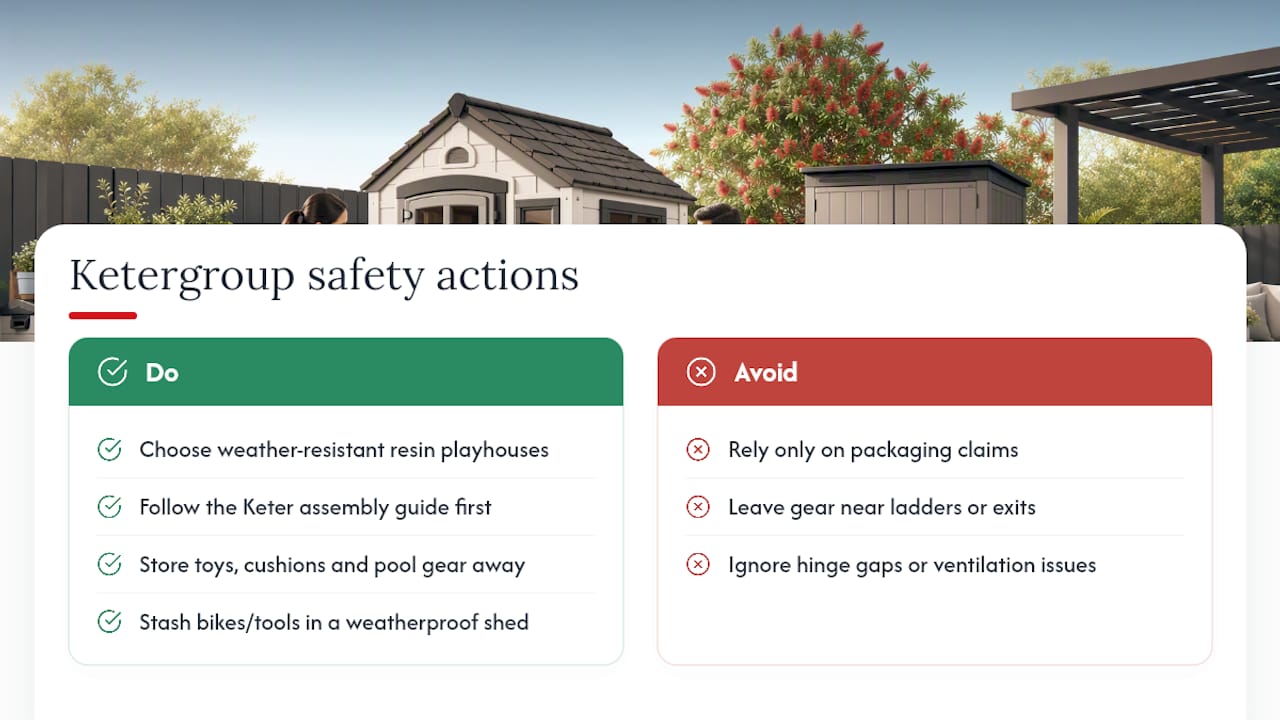
A tidy play area also means somewhere to put everything once playtime is over. The KIS Scuba Box in white (XLarge) and the Curver Style Storage Box Set in Brown both work well for corralling toys, balls, and outdoor cushions that would otherwise end up as trip hazards near the base of a playhouse. For families supervising from the sidelines, a comfortable spot to sit and watch matters too. The Rosalie 2 seater Sofa and the Keter Salta 2 Seater Sofa in Oat Cushions give parents somewhere close by to keep an eye on things, while the Emma 2 seater Sofa suits smaller patios and decks.
If the backyard is home to bikes, garden tools, or off-season play equipment as well, keeping those items separate from the play zone matters for safety too. The Store It Out Prime Shed with Pistons 880L, also available as the Store It Out Prime Shed 880L at Bunnings, and the larger Store It Out Max Shed in Brown/Beige 1200L give you somewhere weather resistant to stash anything that shouldn’t be lying around near where kids climb and run.
“Because there is no mandatory Australian standard specifically for backyard cubby houses, parents need to treat label claims carefully and prioritise physical checks, hinge gaps, ventilation, and surfacing, over marketing language on the box.” That’s the honest reality of shopping in this category, and it’s why hands-on checks always beat packaging claims.
What backyard hazards should you check beyond the playhouse itself?
Australian backyards come with their own set of environmental risks that have nothing to do with the structure itself. A safety check that stops at the playhouse door misses half the picture.
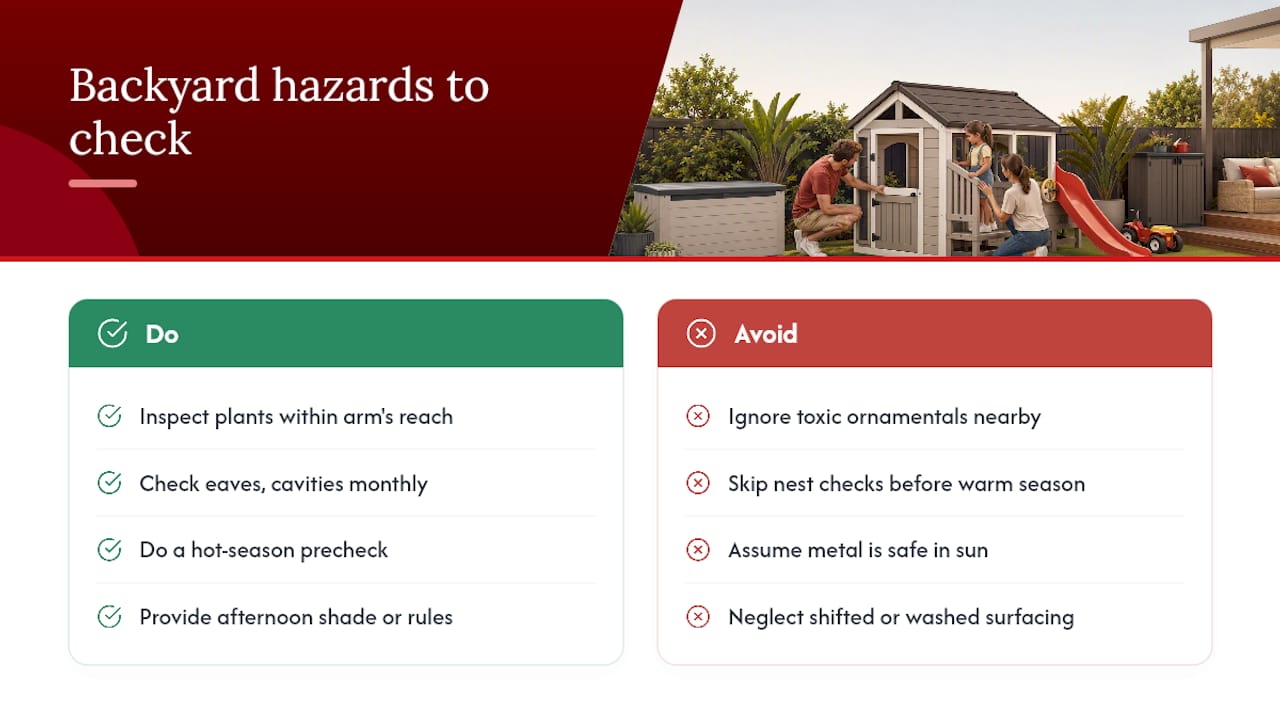
Plants. Oleander, angel’s trumpet, and some ornamental berries common in Australian gardens are toxic if a curious toddler decides to taste-test. Walk the perimeter of the play area and check what’s growing within arm’s reach of the playhouse, not just what’s directly underneath it.
Insects. Enclosed cavities, roof eaves, and gaps under floor panels are exactly where wasps and European wasps in particular like to build nests over a warm season. Check these spots each time you do your monthly inspection, and definitely before the first hot weekend of the year when kids start spending more time outside.
Sun exposure. Resin and timber playhouses left in full sun can get surprisingly hot to the touch by early afternoon, and metal fittings hotter still. If your play area doesn’t have natural shade, consider positioning the playhouse where it gets afternoon shelter, or set a rule about touching metal hinges and handles during peak sun hours.
Bushfire-prone properties. If you’re in a region with vegetation clearance obligations, that applies to structures like playhouses too. It’s worth understanding bushfire vegetation clearance rules if your backyard backs onto bushland, since clearance requirements can affect where you’re permitted to site a permanent structure.
Extreme heat and storms. Check that the playhouse hasn’t shifted after a big wind event, and that any surfacing hasn’t washed out after heavy rain.
What labelling and certification marks should you look for?
Because there’s no single mandatory standard forcing every playhouse to carry a specific certification mark, label-reading in this category takes a slightly different approach than, say, checking for a regulatory tick on a car seat.
What you’re actually looking for is transparency, not a stamp. A trustworthy playhouse listing or manual will typically state:
- A clear recommended age range, usually as a minimum rather than a vague “suitable for children.”
- Reference to the materials used, since resin, timber, and metal fittings all carry different maintenance and weathering expectations.
- Any voluntary standard the manufacturer designed against, even informally, such as AS 4685 principles for structural safety or AS 4422 for surfacing compatibility.
- Country of manufacture and importer details, which matter if you ever need to chase a recall or a replacement part.
Be wary of listings that lean entirely on marketing language like “safety tested” without specifying what was tested, by whom, or against which benchmark. That phrase alone tells you nothing verifiable. A supplier confident in their product will usually be specific about what testing actually involved, or point you to assembly and safety documentation you can read yourself.
If you can’t find this information on the packaging, check the manufacturer’s website before you buy, not after the playhouse is already assembled in the backyard.
Do playhouses need UV protection and weather resistance ratings?
Australian sun is harsh on outdoor equipment in a way that catches a lot of first-time buyers off guard. A playhouse that looks fine in a showroom or online listing can fade, crack, or become brittle within a couple of seasons if the material isn’t built for it.
There’s no single mandatory UV rating that outdoor playhouses must carry in Australia, which makes the material itself the more reliable indicator than any printed claim. Resin playhouses built with UV-stabilised material resist the fading and surface chalking that untreated plastics develop after a summer or two in direct sun. Timber, by contrast, needs regular oiling or sealing to prevent splitting as it dries out and swells with moisture cycles.
“Weather resistant” is the term to look for rather than “weatherproof,” since no outdoor material is entirely immune to extreme conditions over years of exposure. What weather resistant construction genuinely delivers is resistance to the day-to-day wear that matters most: UV fading, splintering, and moisture absorption that leads to rot or mould.
Practically, this means checking whether panels have visibly faded or become brittle after one Australian summer, and inspecting fixings for rust if they’re metal. A structure that’s holding its colour and rigidity after twelve months in full sun is doing its job. One that’s chalky, faded, or cracking at the joints after a single season wasn’t built for local conditions in the first place.
Where to check official playhouse safety guidance
A handful of official sources cover everything in this guide in more depth, and they’re worth bookmarking rather than just reading once.
- Play Australia’s surfacing guidance sets out loose-fill depths and installation buffers.
- The ACCC’s mandatory standards search lets you check for recalls on specific products.
- Kidsafe NSW’s playground standards page explains how AS 4685 and AS 4422 apply in practice.
The gap between what playhouse labels promise and what actually protects kids
Most of the anxiety around playhouse safety comes from looking for a stamp of approval that doesn’t exist. Parents scan packaging for a certification mark the way they would for a car seat, and when they can’t find one, they either assume the worst or give up checking altogether. Neither response serves anyone well.
The more useful shift is treating safety as something you verify with your hands, not something you buy pre-verified. A hinge gap takes thirty seconds to check with a ruler. A wobble test takes less. These aren’t inconveniences bolted onto the buying process, they’re the actual safety mechanism, because no manufacturer can control how a structure ages in your specific backyard, under your specific sun, on your specific soil.
Where I think the conventional advice undersells itself is surfacing. Everyone mentions it, few people actually measure their fall height before deciding whether they need it. That 600 mm threshold is the detail most parents skip past, and it’s the one doing the real work. Get the physical checks right, buy from a manufacturer that’s transparent about materials and assembly, and the paperwork gap stops mattering nearly as much as it first appears to.
— Liza
Set up a backyard play area that’s easy to keep safe
Once the playhouse itself is sorted, the rest of the backyard needs to work with it, not against it. Ketergroup makes that easier than most alternatives on the market, because everything from the storage to the seating is built from the same weather resistant resin that resists the fading, splintering, and rot that timber alternatives struggle with under Australian sun.

If loose toys and cushions near the playhouse base are your main trip hazard, the Curver Style Storage Box Set in S+M+L gives you a spot to clear it all away in minutes, and the pieces are designed to nest and stack rather than clutter a corner of the yard. For families who need to move bikes, garden gear, or off-season equipment out of the play zone entirely, the Store It Out Prime Shed with Pistons 880L offers enough capacity to keep the area around the playhouse genuinely clear. Browse the full range on Ketergroup and find the storage or seating option that suits your backyard.
Sources
- Ground surfacing in outdoor play areas | Play Australia
- Playground safety | Kidsafe Victoria
- Playground standards — Kidsafe NSW
FAQ
Is there a mandatory playhouse safety standard in Australia?
No. There’s no mandatory Australian standard specifically for backyard cubby houses or playhouses, though the ACCC provides safety guidance on hinge gaps, ventilation, and easy internal exit.
How high can a playhouse platform be before I need surfacing?
Surfacing becomes necessary once free-fall height exceeds 600 mm, with recommended loose-fill depths of 200 mm to 300 mm depending on the critical fall height.
What hinge gap prevents finger trapping on playhouse doors?
The ACCC recommends a maximum gap of 1.5 cm at the hinged side of doors, along with doors that open easily from the inside.
How often should I inspect a backyard playhouse?
Run a quick check monthly for loose fasteners, hinge gaps, and surfacing depth, then do a deeper seasonal inspection for mould, pests, and weather damage before summer and winter.
Does weather resistant resin construction reduce playhouse risks?
Yes, weather resistant resin resists the UV fading, splintering, and rot that untreated timber develops over an Australian summer, which lowers the chance of sharp edges or structural weakening over time.


