
Resin First Outdoor Storage Bench Ideas for Australian Patios

Resin is the practical default when you’re weighing up outdoor storage bench ideas, because it shrugs off UV exposure, rain and general backyard chaos with almost no upkeep. From there, the decision comes down to matching internal volume to what you’re storing and checking for reinforced lids and proper ventilation. Resin bench ranges typically cover most of that ground already, and many are built for a weekend assembly rather than a whole afternoon with a toolbox.
TL;DR:
- Reinforced lids with internal steel support are crucial for preventing sagging when sitting on the bench.
- A capacity of 100 to 170 gallons is suitable for most outdoor cushions and small accessories, with larger sizes for bulkier gear.
- Position the bench along the patio edge with at least 75 centimeters of clearance for easy access and full lid movement.
- Resin benches are preferred due to their UV resistance, low maintenance, and better durability in Australian climate conditions.
- Proper upkeep includes regular cleaning, drying stored cushions, and checking hinges and latches to maintain functionality.
Table of Contents
- Material choices: resin vs timber vs metal
- How big should your storage bench be?
- Where to put it and how to style it
- What features actually matter day to day
- Keeping your bench looking good season after season
- Why I keep steering people back to resin
- Featured Keter picks for your patio
- Sources
- FAQ
Material choices: resin vs timber vs metal
Resin wins on the things that actually wear a bench down over time. It’s UV resistant, low maintenance and built to resist warping, rot and rust, which matters more than it sounds once you’ve watched a timber box swell after a wet week. Good resin benches also mimic a timber grain closely enough that you get the look without the sanding.
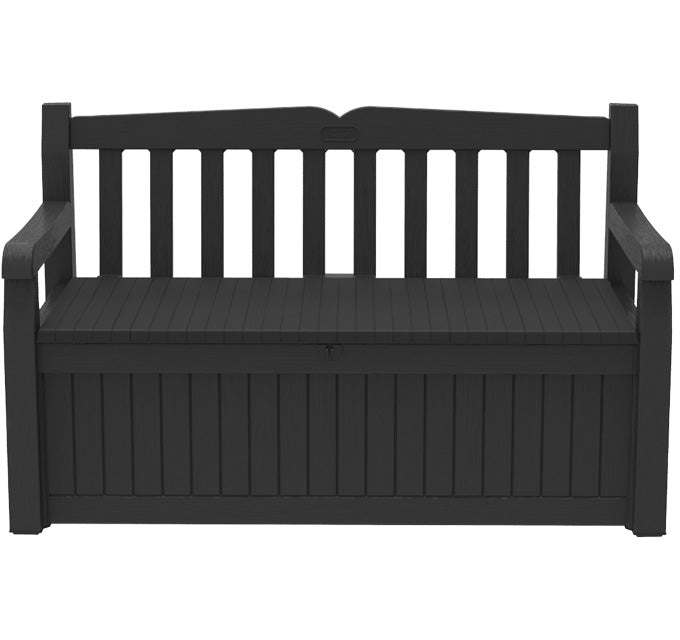
Timber has genuine appeal. It ages beautifully in the right setting and suits a cottage-style garden better than anything else. But it needs regular sealing to hold that colour, and if it sits somewhere with constant moisture, rot sets in faster than most people expect.
Metal benches feel sturdy underfoot and can look sharp against a modern patio, but two things catch owners out: corrosion in coastal air, and surface heat when they’ve been sitting in full sun all afternoon. If you do go metal, look for corrosion-resistant hardware on hinges and latches specifically.
Here’s how the three stack up on the things that matter day to day:
- Resin: low maintenance, weather resistant, holds colour well, minimal tools needed for assembly.
- Timber: natural look, but needs sealing once or twice a year and struggles in damp corners.
- Metal: strong and modern, but can corrode near the coast and heats up in direct sun.
Pro Tip: If you’re torn between looks and upkeep, remember that a wood-look resin bench gives you the timber aesthetic without the sanding schedule. It’s the easiest compromise going.
For a broader look at how these materials perform across different furniture types, this guide to outdoor furniture materials breaks it down further.
How big should your storage bench be?
Sizing is where most buyers get it wrong. Too small and you’re fighting the lid every time you add a cushion; too big and it swallows half your patio. Volume brackets roughly split into three practical tiers:
- Volumes roughly split into three practical tiers. Small benches suitable for cushions and small accessories; medium benches fitting pool toys and family gear; and larger benches for bulkier items and multiple cushions.
Measure your cushions flat, not folded, since that’s how they’ll usually sit inside. Then size up slightly. A bench with a little breathing room is far less frustrating than one you have to wrestle shut every time.
For seating comfort, look for a seat height around 40 to 45 centimetres, which matches a standard outdoor chair, and check the lid opens fully without hitting a wall, pergola post or overhanging plant.
Where to put it and how to style it
Placement decides whether a bench earns its keep or just becomes another obstacle. The most effective spot is along the edge of your patio, where it can replace two loose chairs and give the space a defined boundary instead of a scattered, unfinished look.
Keep a clear path of at least 75 centimetres in front of the bench for foot traffic, and always check the lid can swing open fully without clipping a wall, planter or umbrella pole. A bench only helps a patio when it preserves movement and keeps its contents dry — if it’s cramped into a corner where the lid can’t open properly, it becomes clutter with extra steps.
Styling is where a storage bench stops feeling functional and starts feeling like part of the room. A few ideas that work well in practice:
- Add two or three weather resistant cushions in a colour that echoes your outdoor rug or umbrella.
- Flank the bench with a pair of planters to frame it like a proper seating nook.
- Pair it with a slim side table for drinks, so it reads as a lounge setting rather than a storage unit with a lid.
- Run string lighting or a small pergola overhead if the bench sits near a dining or lounge zone.
- Match the resin tone to your deck or fence colour so it looks built in rather than added on.
If your patio is tight on space, a full-width bench can dominate the room. In that case, a slimmer bench, a built-in seat along a rendered wall, or a vertical storage cabinet often makes more sense. Specialist options like compact outdoor storage solutions are worth a look when floor space is the main constraint. For more layout thinking on smaller backyards, this collection of outdoor storage box ideas has useful angles.
What features actually matter day to day
A bench that looks the part on the product page can still feel flimsy the moment someone sits on it. The features below are what separate everyday seating from an occasional-use box.
- Reinforced lid or double-wall construction: internal steel reinforcement is what stops the lid sagging under a seated adult, and it’s the difference between a bench that feels sturdy and one that flexes.
- Ventilation and a raised floor: trapped moisture is the main reason stored cushions and gear develop mould, so look for airflow gaps or a slatted internal base.
- Corrosion-resistant hardware: hinges and latches that won’t rust or seize, especially if the bench sits somewhere exposed to rain or salt air.
- Secure latches and supported hinges: a soft-close or gas-assisted lid protects fingers and stops the lid slamming in wind.
- Simple assembly: designs that need minimal tools and come with clear instructions save you a frustrating Saturday.
Pro Tip: Press down gently on the closed lid in the showroom or in photos before buying. If it flexes noticeably, it probably doesn’t have proper internal reinforcement.
Keeping your bench looking good season after season
Upkeep on a resin bench is refreshingly simple. An occasional rinse with a hose and mild detergent keeps it looking new, while timber needs ongoing sanding and resealing to hold the same finish.
A few habits protect both the bench and whatever’s inside it:
- Wipe down scuffs with a soft cloth and soapy water rather than anything abrasive.
- Dry cushions fully before storing them, or use breathable storage bags so residual moisture doesn’t turn into mould.
- Give the bench a brief airing after heavy rain if water has pooled near the seal.
- Check hinges and latches each season, and anchor the bench if your yard gets strong wind.
For more on protecting outdoor pieces from sun damage specifically, this guide on preventing outdoor furniture fading is a useful companion read.
Why I keep steering people back to resin
Most of the frustration people report with outdoor storage benches comes down to two things they didn’t check before buying: whether the lid can actually support a seated adult, and whether the inside stays dry. Everything else, colour, finish, brand, is secondary to those two questions.
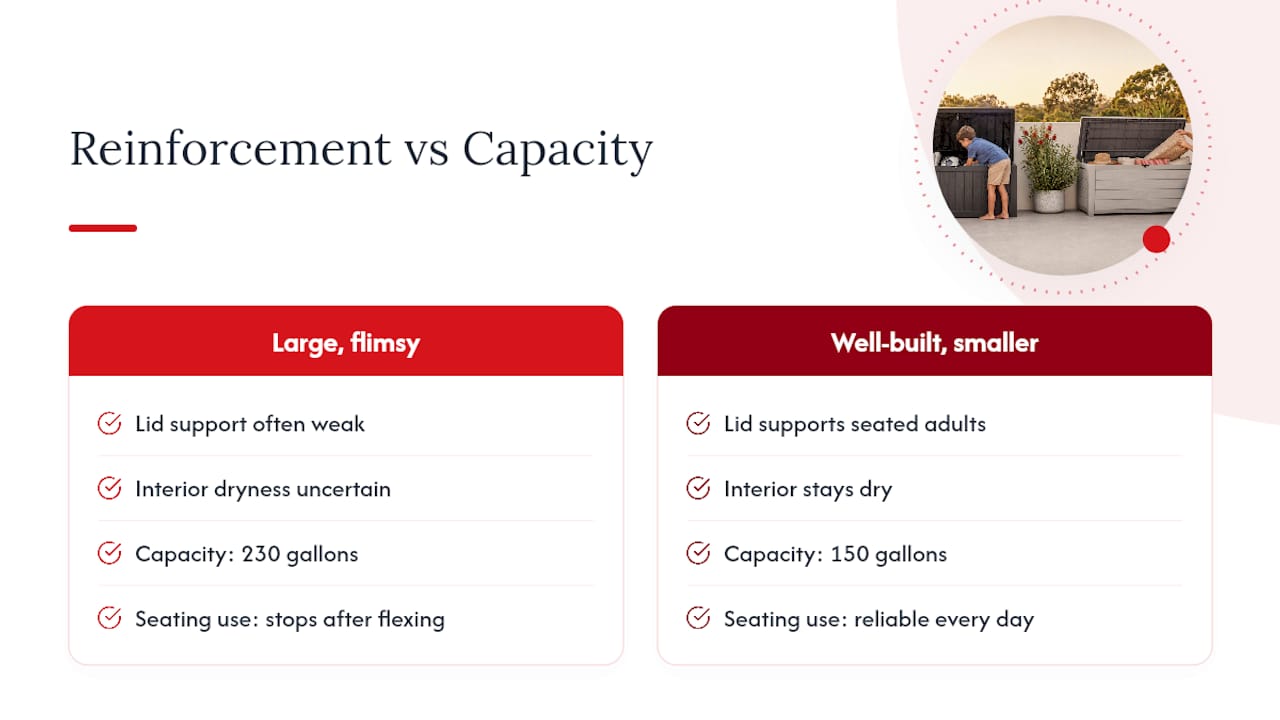
What gets underestimated is how much the reinforcement question matters compared to raw capacity. A 230-gallon bench with a flimsy lid is worse than a well-built 150-gallon one, because you’ll stop using it as seating the first time it flexes underneath someone. Keter Group has built its resin range around exactly that problem, prioritising durable, recyclable materials designed for easy assembly rather than chasing volume numbers alone. Customers consistently point to assembly ease and everyday reliability as the reasons they’d buy again, which tracks with what actually makes a bench worth keeping.
If there’s one thing worth pushing back on, it’s the idea that bigger is always better. Sizing up slightly is smart. Buying the largest bench available “just in case” usually means a bulkier footprint and a lid you’re less inclined to open every day.
— Liza
Featured Keter picks for your patio
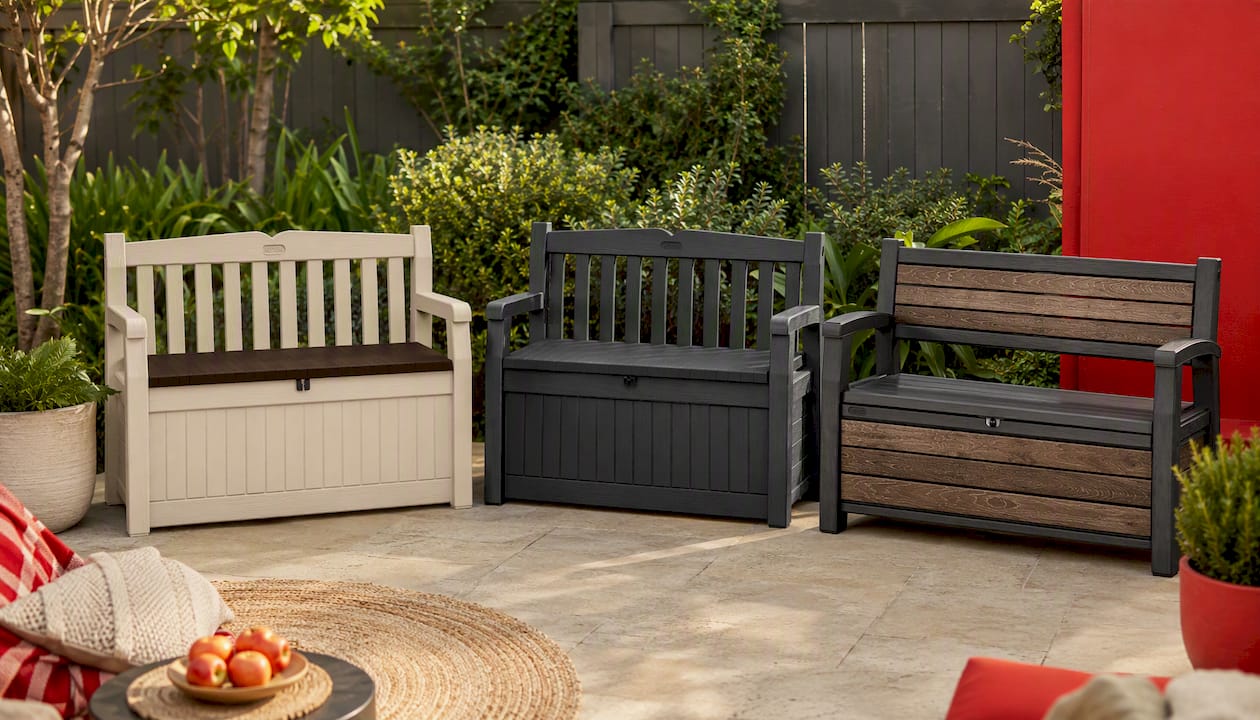
Once you know what you’re storing and where it’s going, matching that to an actual model is straightforward. The Keter Eden 265L Storage Bench in Brown/Beige suits compact cushion storage and works with neutral, warm-toned patios where you want something that blends in rather than stands out. If your outdoor space leans modern, the Keter Eden 265L Storage Bench in Dark Grey offers the same practical capacity with a palette that suits render, timber decking or a monochrome scheme.
For anyone chasing the timber look without the timber maintenance, the Keter Signature 227L Storage Bench in Walnut Look gives you that warmth in a low-maintenance resin build.
Before you buy, measure the cushions or gear you’re planning to store, confirm the seat height suits your existing outdoor chairs, and check the lid clearance against any nearby walls or pergola posts. Each product page typically lists delivery details, so it’s worth checking those before you commit to a spot on the patio.
Sources
- Weather-Resistant Resin Storage Benches - Keter US
- Outdoor storage benches: why they help some patios and hurt others - The Garden Scene
- Small garden design advice — The Garden Scene
FAQ
Is resin better than timber for an outdoor storage bench?
For most Australian conditions, yes. Resin resists UV damage, rot and warping with far less upkeep than timber, which needs regular sealing to avoid moisture damage.
What size storage bench do I need for outdoor cushions?
A bench in the 100 to 170 gallon range suits most households, with the larger end better for multiple cushion sets or bulkier pool gear.
Can I sit on a resin storage bench?
Yes, provided it has internal reinforcement such as steel supports or double-wall construction, which stops the lid sagging under a seated adult’s weight.
Where should I place a storage bench on my patio?
Along the edge of the patio works best, ideally replacing two loose chairs, with at least 75 centimetres of clear walking space in front and enough room for the lid to open fully.
Does Keter make outdoor storage benches suitable for Australian weather?
Keter’s resin bench range, including the Eden and Signature lines, is built to be weather resistant and low maintenance, which suits the sun exposure and humidity common across Australian backyards.


