
Organise garden chemicals safely: lock, label, separate

Store garden chemicals only in their original, labelled containers in a locked, cool, ventilated area, segregated by hazard. Keep a spill kit, PPE and the Poisons Information number close at hand. If you suspect poisoning or find a serious spill, call the Poisons Information Centre on 13 11 26 any time of day; dial 000 for a major spill or medical emergency.
Three things to do this weekend:
- Move all sprays, granules and fertilisers into one locked cabinet or shed, out of reach of kids and pets.
- Check every container has its original label and note which ones are missing a Safety Data Sheet (SDS).
- Put together a basic spill kit: absorbent granules or kitty litter, a dustpan, heavy gloves and a sealable bag for waste.
Getting this right also protects you legally. Councils and workplace regulators expect hazardous substances kept on a residential property to be secured and inventoried, not just tucked behind the mower.
Key Takeaways
Safe garden chemical storage means locked, ventilated, temperature-stable containment with original labels, strict segregation of incompatible products, and a spill kit and emergency numbers within reach at all times.
| Point | Details |
|---|---|
| Keep original labels | Never decant without copying the product name, active ingredient and safety directions across. |
| Separate by hazard class | Store liquids low, solids above, and keep flammables away from oxidisers. |
| Save emergency numbers | Poisons Information is 13 11 26 and 000 covers major spills or medical emergencies. |
| Inspect every quarter | Check for leaks, fading labels and temperature swings on a set schedule. |
| Choose the right shed | A weather-resistant, lockable Keter shed adapts easily with spill trays and raised shelving for safe chemical storage. |
Table of Contents
- Why original containers and SDS sheets matter
- Does temperature and ventilation affect chemical stability?
- How should you group chemicals to avoid dangerous reactions?
- What’s the safest way to mix or decant chemicals?
- What should you do if a chemical spills or someone is poisoned?
- How often should you inspect your chemical storage?
- Which storage setup actually works for garden chemicals?
- Can you reduce chemical use with better garden storage habits instead?
- How do you teach the rest of the household to stay safe?
- How do you stop a spill becoming an environmental problem?
- What should be on your garden chemical labels once decanted?
- A step-by-step checklist for getting organised this weekend
- Sources
- FAQ
Why original containers and SDS sheets matter
Every home garden chemical label carries mandatory storage and disposal wording, and the APVMA’s labelling code requires phrases like “store in the closed, original container in a cool, dry place out of the reach of children.” Strip that label off, or decant into an unmarked bottle, and you lose the dosage rate, first-aid steps and disposal instructions in one move. Agriculture Victoria is blunt about it: keep chemicals in their original containers, keep labels and SDS accessible, and never store them near food, animal feed or seed.
A simple three-step system covers most backyards:
- Choose one lockable cabinet or shed as the sole chemical storage point. Nowhere else in the house counts.
- Write a one-page register listing each product, active ingredient and purchase date, and pin it inside the door.
- Print or save the SDS for anything you use regularly. Most suppliers post these free on their websites.
For containment, non-absorbent trays under liquid containers catch drips before they hit timber or soil. Plastic boot trays, purpose-built bunded shelving, or even a cheap under-sink tub all work. It’s a small habit that stops a slow leak becoming a bigger cleanup.
Does temperature and ventilation affect chemical stability?
Yes, and it’s one of the most overlooked storage mistakes. A shed that bakes in western sun through summer, then drops near freezing on a winter night, puts real strain on herbicide and pesticide formulations. Agriculture Victoria’s storage guidance recommends purpose-built, climate-stable, well-ventilated storage. Standard sheds and garages can swing too far in temperature, degrading active ingredients faster than the label suggests.
Practical fixes that don’t require a rebuild:
- Add passive roof or wall vents to stop vapour build-up in an enclosed cabinet.
- Position storage away from north or west-facing walls that catch direct sun.
- Use a small battery-powered thermometer to spot-check summer highs.
- Keep containers off a concrete floor that radiates heat; a raised shelf helps.
A garage is fine if it stays reasonably shaded and dry. A tin shed with no airflow, less so.
Pro Tip: Check your storage spot at 3pm on the hottest day of summer. If you wouldn’t leave a esky of drinks there, it’s too hot for your chemicals either.
How should you group chemicals to avoid dangerous reactions?
Grouping isn’t about tidiness, it’s about keeping incompatible products physically apart so a knocked bottle or a leaking lid can’t trigger a reaction. Safe Work Australia’s guidance on hazardous chemicals recommends separating incompatible classes, using impervious floors and bunding, and keeping storage lockable and away from watercourses.
A workable shelf layout for most home setups:
- Liquids on the lowest shelf, on a chemical-resistant tray, so any leak doesn’t rain down onto other products.
- Solids and granules above liquids.
- Flammable products (some fuel additives, aerosols) segregated on their own shelf, away from any ignition source.
- Fertilisers stored separately from pesticides, even though both feel like “garden stuff.”
| Chemical type | Keep separate from | Why |
|---|---|---|
| Chlorine-based products (some pool or mould treatments) | Ammonia-based cleaners | Mixing can release toxic gas |
| Concentrated acids | Alkaline products (some fertilisers) | Reaction risk, heat generation |
| Oxidisers (some fertilisers) | Flammable liquids | Increased fire risk |
| Herbicides | Food, seed or animal feed | Contamination risk |
Write the purchase date on every container the moment you bring it home. Industry guidance treats any product without a manufacturer use-by date as unsafe to keep past two years, since the chemistry can degrade unpredictably beyond that point.
What’s the safest way to mix or decant chemicals?
Mixing and decanting is where most backyard accidents happen, not storage itself. A few rules make it far safer.
- Never decant into a food or drink container. Kids and adults alike have been poisoned by chemical stored in a soft-drink bottle.
- If you must transfer a smaller amount for use, keep the original label attached or copy the product name, active ingredient and safety directions onto the new container in permanent marker.
- Mix outdoors or in a well-ventilated space, on a stable bench, away from where children or pets can wander through.
- Keep a tap or hose nearby in case of splash to eyes or skin.
Minimum PPE for most home garden chemicals is gloves and safety glasses; check the label for anything requiring a respirator. Store that PPE at the chemical cabinet itself, not in a drawer three rooms away.
Pro Tip: Keep a dedicated “mixing jug” that never touches food prep. Label it, and store it with your PPE, not in the kitchen cupboard.
What should you do if a chemical spills or someone is poisoned?
Small spills are manageable if you act in order rather than panicking.
- Isolate the area. Keep kids, pets and other family members away.
- Ventilate if indoors, opening doors and windows.
- Absorb the spill with kitty litter or another absorbent material rather than washing it away.
- Sweep it into a sealable bag or container, label it as chemical waste, and keep it separate from household rubbish.
A ready-made spills kit, kept right at the storage site, cuts your response time dramatically. The EPA South Australia recommends keeping absorbent material, a shovel, broom and dedicated waste container on hand at the storage location itself, not in the garage across the yard.
If someone swallows or is exposed to a garden chemical, call the Poisons Information Centre on 13 11 26, available 24 hours a day. Call 000 immediately for anything life-threatening. Have the product label or SDS in hand when you call; it speeds up the advice enormously.
For disposal, never tip leftover chemical down a drain, into soil, or into stormwater. Most councils run periodic hazardous waste collection days, and rural properties can often use drumMUSTER for empty, triple-rinsed containers. For anything concentrated or unidentified, a licensed chemical disposal contractor is the safer route.
How often should you inspect your chemical storage?
A quarterly check keeps small problems from becoming safety issues. Walk through this list every three months:
- Check every container for leaks, swelling or rust, especially around the cap.
- Confirm labels are still legible; reprint or relabel anything faded.
- Note the shed or cabinet temperature on a warm afternoon and a cold morning.
- Test that vents aren’t blocked by cobwebs, leaves or stored gear.
- Update your register with anything bought or used up since the last check.
Keep four fields in that register: product name, active ingredient, purchase date, and expiry or planned disposal date. Any product showing a strange smell, layer separation, clumping or a rusted tin is due for disposal, not another season on the shelf.
| Point | Details |
|---|---|
| Inspect quarterly | Walk the storage area every three months checking leaks, labels and temperature. |
| Register four fields | Track product, active ingredient, purchase date and expiry or disposal date. |
| Watch for degradation signs | Odour change, separation, clumping or a rusted container mean it’s time to dispose. |
Which storage setup actually works for garden chemicals?
The right container depends on volume, not just budget. A handful of spray bottles suits a small locked cabinet inside a garage. A working collection of herbicide, fertiliser, pool chemicals and pest control products needs a proper shed with room to segregate by shelf.
Prioritise these features whatever size you choose:
- A lockable door or padlock point, non-negotiable if children or visitors use the yard.
- Non-absorbent shelving that wipes clean rather than soaking up a spill.
- A raised base so nothing sits directly on damp ground.
- Ventilation, whether built-in vents or gaps you add yourself.
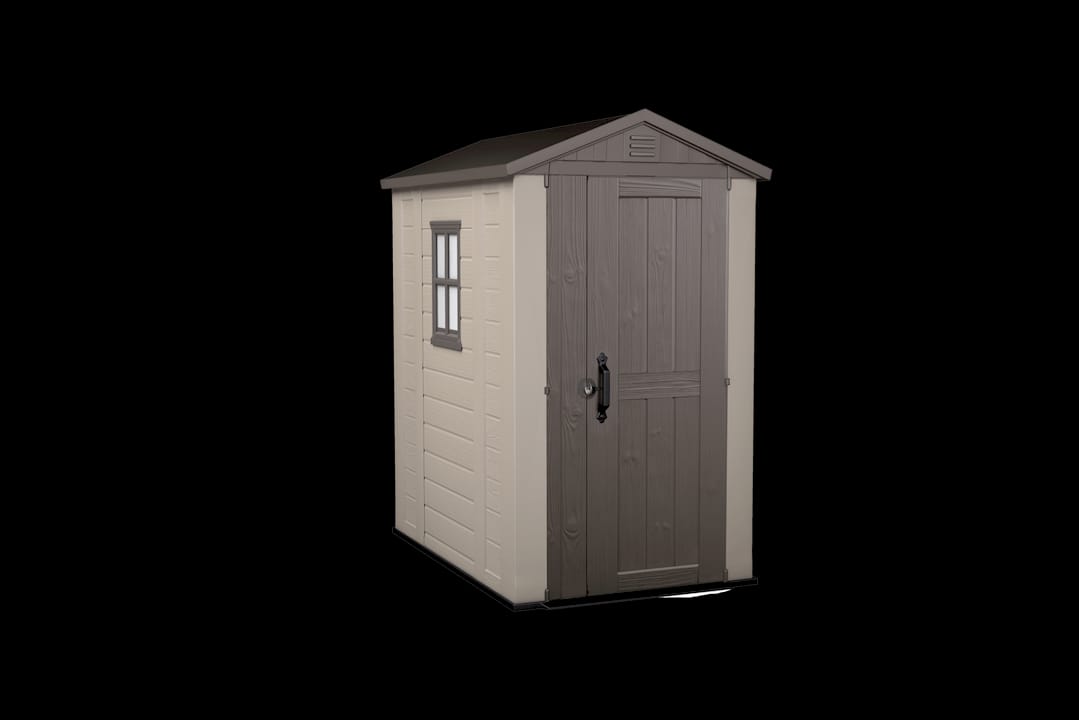
A weather-resistant resin shed like the Keter Factor 4 x 6 Garden Shed gives you a lockable, easy-clean space to set up exactly this kind of layout: liquids low on one shelf with a spill tray beneath, solids and fertilisers above, PPE and the spill kit hanging near the door, and a laminated inventory sheet taped inside. Resin doesn’t corrode the way a rusting metal cabinet can, which matters when you’re storing anything acidic or caustic.
. The gardeners who get this right treat their shed less like storage and more like a small, organised workstation, everything has a spot, and that’s what keeps a Saturday morning job from turning into a mishap.
Can you reduce chemical use with better garden storage habits instead?
The safest chemical is often the one you never needed to buy. Plenty of garden problems that push people toward a spray bottle have a physical fix that removes the storage risk entirely.
Weed matting and mulch reduce herbicide need by starving weeds of light before they establish. A thick layer of mulch around garden beds does the job a spray would otherwise handle, and it improves soil moisture retention as a bonus. Manual weeding tools, from a simple hori-hori knife to a stand-up weed puller, handle small infestations without a chemical at all.
For pest control, physical barriers work well for a lot of common backyard problems. Netting over fruit trees keeps birds and fruit fly off without a spray program. Copper tape around pots deters snails. Companion planting, marigolds near vegetable beds, for instance, can reduce aphid pressure enough that you skip a chemical treatment altogether.
Fertiliser is where storage swaps make the biggest dent. Composting kitchen scraps and garden waste produces a free, chemical-free soil conditioner, and it means one less bag of synthetic fertiliser sitting in the shed needing secure storage and eventual disposal. A simple worm farm does the same job in a smaller footprint.
None of this means going chemical-free is realistic for every garden problem, some pest and weed pressures genuinely need a targeted product. But for the gardener storing six or seven products “just in case,” a hard look at which ones a physical alternative could replace often shrinks that inventory, and the storage burden that comes with it, considerably.
How do you teach the rest of the household to stay safe?
A locked shed only works if everyone in the house understands the system, not just the person who set it up. Walk each family member through where chemicals live, why the door stays locked, and what the register on the inside of the door means.
Kids old enough to help in the garden should know three things without exception: never touch a container without an adult, never taste or smell anything from the shed, and tell an adult immediately if something spills or smells strange. Younger children need the storage simply out of reach and out of sight, full stop.
For any adult or older teenager who might use a product themselves, run through the label together the first time, pointing out the safety directions, first-aid section and PPE requirements. This is also the moment to introduce the mixing site setup, so nobody improvises with a kitchen jug because they didn’t know there was a dedicated one.
Stick a laminated card near the storage area with three numbers: Poisons Information on 13 11 26, 000 for emergencies, and your local council’s hazardous waste line. Everyone in the house, including regular visitors like grandparents doing school pickup, should know that card exists and what it’s for. Run a quick refresher once a year, ideally when you’re doing your quarterly inspection anyway, so the routine stays current rather than fading into “something we set up once.”
How do you stop a spill becoming an environmental problem?
A chemical spill that stays inside your shed is a cleanup job. One that reaches soil, a stormwater drain or a nearby creek is a different problem entirely, and a much harder one to undo.
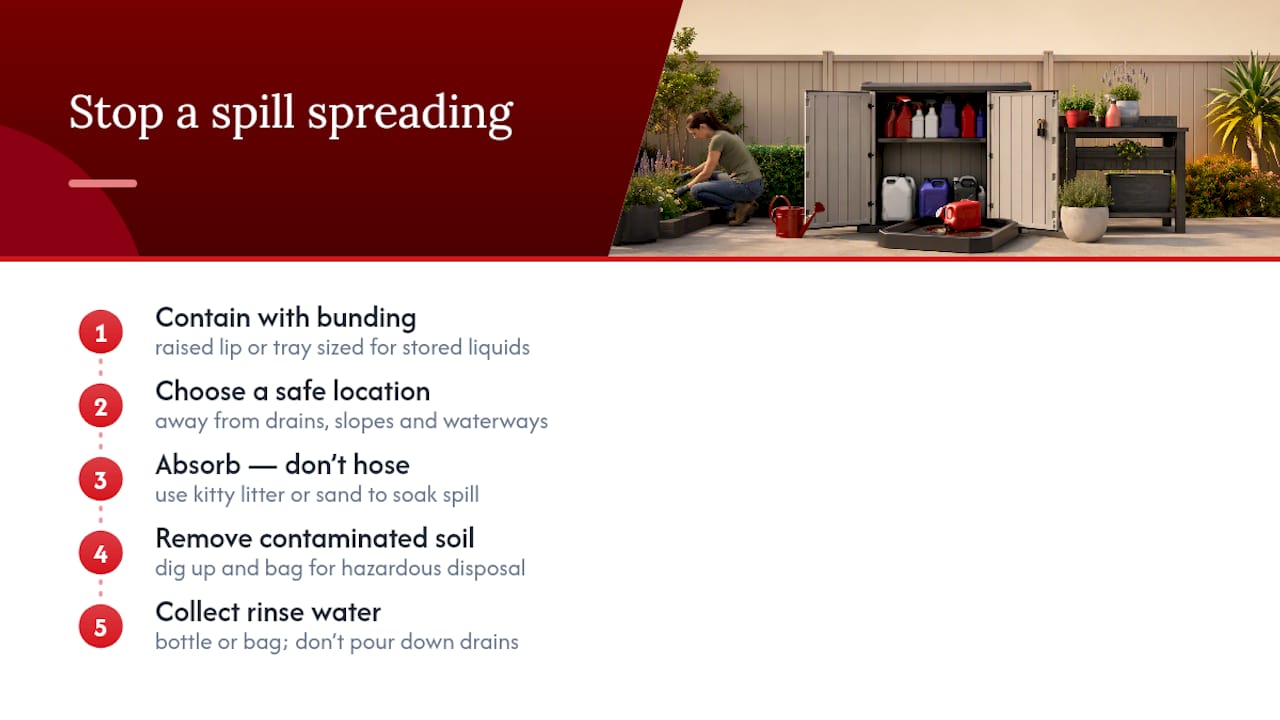
Bunding is the first line of defence. A raised lip or a bunded tray under stored liquids contains a leak before it spreads across the floor and out the door. Safe Work Australia’s guidance on hazardous chemical storage points specifically to impervious flooring and containment sized to hold a meaningful share of what’s stored, precisely so a worst-case leak doesn’t reach open ground.
Location matters just as much as containment. Position chemical storage away from stormwater drains, garden beds that slope toward a creek line, and anywhere runoff naturally collects after rain. If your property backs onto a waterway, that distance becomes more important, not less.
If a leak does escape containment, absorb it immediately with kitty litter or sand rather than hosing it away, hosing spreads contamination rather than removing it. Dig up and bag any contaminated soil for hazardous waste disposal instead of leaving it to break down naturally; some garden chemicals persist in soil far longer than most people expect.
Rinse water from cleaning up a spill is chemical waste too. Don’t tip it into a garden bed or down a stormwater drain. Bag or bottle it for the same hazardous waste collection point you’d use for the original product.
What should be on your garden chemical labels once decanted?
Decanting should be the exception, not the routine, but it happens: a smaller spray bottle for a quick job, or a measuring jug that needs a temporary top-up. When it does, the container needs enough information to be as safe as the original.
At minimum, write on the new container: the full product name exactly as it appears on the original label, the active ingredient and its concentration, the date it was decanted, and a short safety phrase such as “harmful if swallowed, keep away from children.” Permanent marker on a strip of duct tape works fine if you don’t have proper labels on hand.
Never rely on memory or on “I’ll know what it is.” A different family member, a visiting friend helping in the garden, or you yourself in six months’ time, won’t have the same context you do right now.
Keep the original container even after decanting some of its contents, rather than throwing it out. It carries the full label, the SDS reference and the batch information you might need later if there’s a reaction or a question about the product. Store the decanted portion next to the original, not in a separate spot, so anyone checking the shed sees both together.
If a product ever gets decanted into unlabelled territory and you can’t identify it with confidence, treat it as unknown hazardous waste. Take it to a council collection point rather than guessing and using it anyway.
A step-by-step checklist for getting organised this weekend
Rather than tackling everything at once, work through storage in this order:
- Gather every chemical from around the house, garage and shed into one spot so you can see what you actually own.
- Discard anything without a label, anything past its use-by date, or anything undated and older than two years.
- Choose your storage location: a locked cabinet for a small collection, a shed for a larger one.
- Fit non-absorbent shelving, with liquids on the lowest shelf and a spill tray beneath them.
- Separate incompatible classes onto different shelves, keeping flammables well away from oxidisers.
- Set up your spill kit and PPE inside the storage area, not in a separate room.
- Create your inventory register with product name, active ingredient, purchase date and expiry.
- Print or save an SDS for anything you use regularly.
- Add a laminated emergency card with 13 11 26, 000 and your council’s hazardous waste number.
- Set a calendar reminder for a quarterly inspection.
Ten steps, most of which take minutes rather than hours. The payoff is a shed you can walk into and immediately trust.
A backyard perspective on storage that actually works
Good chemical storage isn’t about buying every safety gadget going. It’s about choosing materials that make the daily habit easy. A shed with easy-clean, non-porous resin shelving means a spill wipes up in seconds instead of soaking into timber and lingering as a hazard for weeks. Durable, recyclable resin also means the structure itself isn’t adding another disposal headache down the track.
— Liza
Practical storage options if you’re setting this up from scratch
If your chemical collection has outgrown a cupboard, matching the storage to your actual volume matters more than picking the biggest option available. A handful of bottles and a bag of fertiliser can live safely in a locked cabinet tucked in the garage. Once you’re storing pool chemicals, multiple herbicides, fertiliser and pest control products together, a dedicated shed gives you the shelf space to segregate properly rather than stacking everything on top of itself.
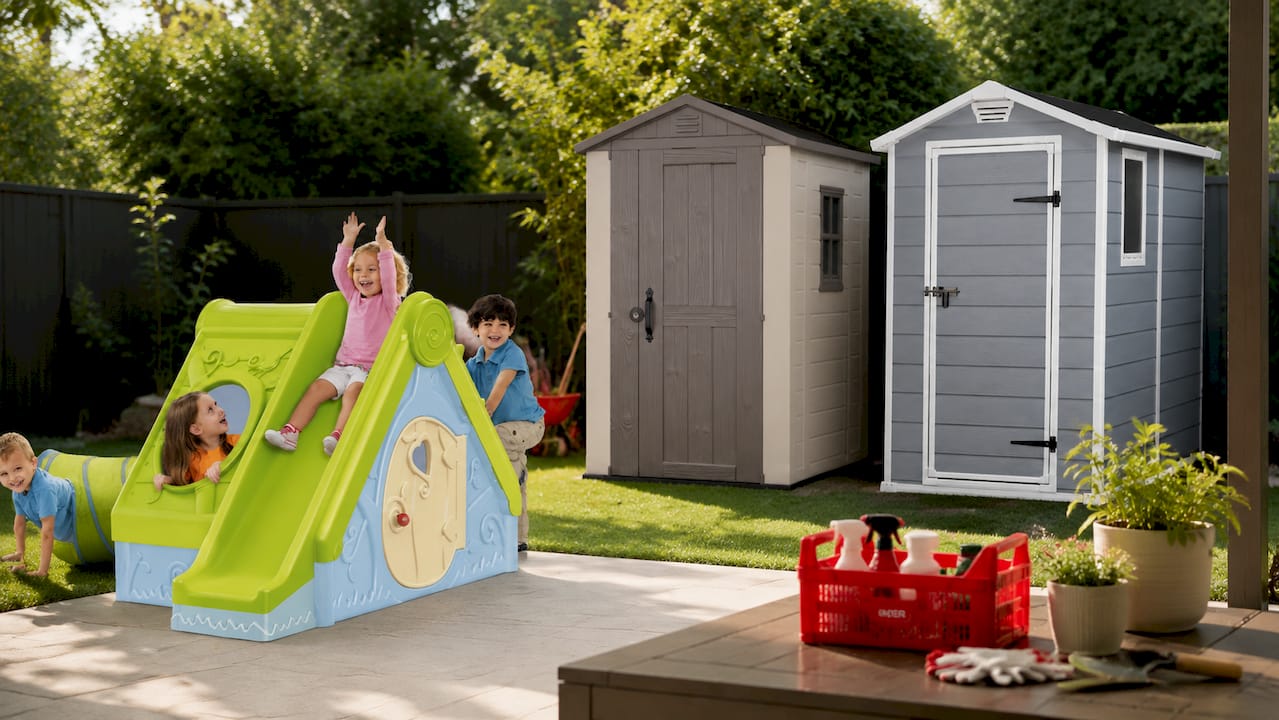
For a mid-sized collection, the Keter Factor 4 x 6 Garden Shed gives you enough floor space to run separate shelves for liquids and solids with room left for tools. If you’re storing more, or want a larger shed that doubles as general garden storage alongside your chemicals, the Keter Manor 4 x 6 Garden Shed in grey offers extra depth for that layout, spill trays under the liquids, raised shelving for everything else, PPE hanging by the door. Both are weather resistant and lockable straight out of the box, which covers two of the biggest storage requirements before you’ve adapted a single shelf.
Three quick adaptations make either shed work harder for chemical storage specifically: add a plastic spill tray under any liquid containers, raise your shelving off the shed floor so nothing sits in condensation, and fit a couple of passive vents high on the walls to stop vapour building up in summer. None of it requires tools beyond a drill.
If your chemical storage needs are modest and you’re mainly after a small, secure spot near the back door, browse the full range of outdoor storage solutions to find something that fits your space before you commit to a full-sized shed.
Sources
- Healthdirect — Poisoning
- Agriculture Victoria — Farm chemical transport, storage, mixing and disposal
- Safe Work Australia — Storing hazardous chemicals
FAQ
What chemicals should not be stored together?
Keep chlorine-based products away from ammonia-based cleaners, concentrated acids away from alkaline products like some fertilisers, and any oxidiser away from flammable liquids. Safe Work Australia recommends segregating incompatible classes on separate shelving with impervious flooring beneath.
Is it safe to store chemicals outside?
Only in weather-resistant, lockable storage that stays reasonably temperature-stable; a standard shed exposed to full sun and frost can degrade chemical formulations faster than the label suggests, according to Agriculture Victoria.
Should chemicals be stored alphabetically?
No. Alphabetical order ignores hazard class and can place genuinely incompatible products side by side. Group by chemical type and hazard instead, liquids low, solids above, flammables separated, as outlined in the segregation section above.
What is the safest way to store chemicals?
Keep them in original, labelled containers inside a locked, ventilated, temperature-stable space, segregated by hazard class, with a spill kit and PPE stored at the same location. A weather-resistant shed like the Keter Factor fitted with non-absorbent shelving covers all of these requirements in one structure.


