
Getting cushion box size right: measure first, buy once

This is the Stack and Measure method, and it’s the single most useful habit for avoiding a return.
Here’s why it matters: a box rated at 400 litres might have an internal length shorter than your stacked cushions once you account for wall thickness and hinge hardware. A gallon figure tells you volume; it says nothing about whether your 130cm bench cushions will actually lie flat.
- Stack cushions exactly how you’ll store them and measure length, width, height
- Add a small buffer to each dimension for a comfortable fit
- Compact sets (two chairs) usually need 200–300 litres; four to six chair sets often need 400L plus
Quick stat: packing efficiency for rigid items like cushions sits around 75%, which is why sizing one tier up is common advice rather than a nice-to-have.
Key Takeaways
| Point | Details |
|---|---|
| Use Stack and Measure | Stack cushions as stored and measure length, width and height before shopping. |
| Add a buffer | Add 15–20% to each dimension, since cushions pack at roughly 75% efficiency. |
| Check internal, not external, specs | Wall thickness and hinges reduce usable space, so confirm internal dimensions on the product page. |
| Match ventilation to placement | Sunny, sealed spots need better vent design than shaded, breezy ones to avoid mildew. |
| Ketergroup lists internal dimensions | Ketergroup’s resin storage boxes, from compact to large tiers, publish internal dimensions to match this sizing method. |
Table of Contents
- How do I measure cushions for the right box size?
- What size cushion box do I actually need?
- Why internal dimensions matter more than the spec sheet
- Placement and clearance checks before you buy
- A quick checklist for choosing the right cushion box
- Where Keter products fit each cushion box size tier
- How do you calculate volume for oddly shaped cushions?
- What size box suits your outdoor furniture set?
- Why ventilation matters as much as size
- Can a cushion box hold the weight of wet cushions?
- What the sizing advice gets wrong
- Find a cushion box sized right, from Ketergroup
- Sources
- FAQ
How do I measure cushions for the right box size?
Getting your cushion box size right comes down to five steps, and none of them need special tools.
- Stack your cushions as you intend to store them. Flat stacking gives one set of numbers; folding a chaise cushion in half gives another. Be honest about how you’ll actually pack them.
- Measure the stack’s length, width and height with a tape measure, rounding up to the nearest centimetre.
- Measure your intended spot too: the wall run, how far the box juts into a walkway, and any overhead eaves or window sills nearby.
- Apply a 15–20% buffer to each dimension. If your stack measures about 120cm long, 45cm wide and 35cm high, plan for internal dimensions larger enough to accommodate comfortably.
- Check delivery access, including gates, side paths and doorways, against the box’s boxed dimensions, not just its assembled size.
If you’re storing a folded market umbrella or a chaise cushion alongside your seat cushions, measure the longest single item on its own. Umbrellas often need to sit diagonally, and an internal diagonal of roughly 152cm is a common threshold for fitting one in without forcing it.
Pro Tip: Measure with the cushions slightly compressed, the way they’ll sit once the lid closes and settles under its own weight. A stack that looks 2cm too tall when loose often fits fine once compressed.
What size cushion box do I actually need?
Cushion boxes tend to fall into four practical size tiers, and matching your stack to the right one saves a lot of guesswork.
Compact or slim profile (roughly 120–150cm long by 40–50cm deep, around 200–300 litres). These are the balcony favourites, designed to sit flush against a railing while doing double duty as a bench. They typically suit two lounge chair cushions or a couple of throw cushions and a folded picnic rug, and many are seating rated so you can perch on the lid.
Medium (roughly 70–100 gallons, or 9–13 cubic feet). This is the workhorse size for a two‑ to four‑chair set, covering most standard dining chair cushions plus a couple of throw pillows.
Large (110–150+ gallons). Built for a four‑ to six‑chair dining set, or a couple of bench cushions plus assorted extras like a tablecloth and citronella candles.
Extra large (150–230+ gallons). This tier handles chaise lounge cushions, sectional sofa cushions, or a full outdoor lounge set’s worth of padding. If you’re storing anything long and stiff, like a folded umbrella, check the internal diagonal, not just the length, because a rigid item wedged corner to corner needs more room than a straight measurement suggests.
- Compact/slim: 200–300L, balcony friendly, often seating rated
- Medium: 70–100 gallons, two to four chairs
- Large: 110–150+ gallons, four to six chairs or bench sets
- XL: 150–230+ gallons, chaise and sectional cushions
Why internal dimensions matter more than the spec sheet
Manufacturers list external dimensions and volume ratings because they’re easy to compare at a glance, but they routinely overstate the usable space inside. Double‑wall construction, piston hinges and moulded wheel wells all eat into the cavity, sometimes by several centimetres on each side.
Internal usable space is often noticeably less than external dimensions suggest. Never rely on the gallon figure alone. Check the listed internal length specifically, and look for how the lid shape and hinges intrude into the cavity.
A domed lid can claw some of that height back, giving you a few extra centimetres for a taller stack even when the box’s footprint looks modest. Always look for the internal length, width and height on the product page rather than assuming the advertised capacity translates directly to your cushions.
On material, UV‑stabilised resin outperforms wood for long‑term cushion storage. Resin resists warping, doesn’t need annual sealing, and shrugs off moisture that would otherwise rot timber joints or rust hardware.
- Check the internal dimensions listed on the product page, not just the headline capacity
- Favour a domed or gable lid if you need a bit more stacking height
- Choose UV‑stabilised resin over wood for lower maintenance and better weather resistance
- Wipe down and dry the interior occasionally, especially after storing damp cushions
Placement and clearance checks before you buy
A box that fits your cushions can still be the wrong purchase if it doesn’t fit your space. Run these checks before you commit.
- Measure the wall run where the box will sit, then subtract a few centimetres for handling clearance on each side so you’re not scraping paint every time you open the lid.
- Allow 60–75cm of standing or front approach room where possible, so you can bend down and lift cushions out comfortably. Narrower balconies may call for a slimmer profile box instead of a deep one.
- Check overhead clearance, including eaves, window sills and awnings, against the box’s lid‑open height. If the lid needs to swing up 90 degrees, make sure nothing blocks it.
- Confirm boxed and unboxed dimensions against your delivery path, side gate width and any steps, especially for larger sheds or extra-large boxes.
If the lid is meant to double as seating, factor in a little extra front clearance so people can sit and swing their legs without kicking the wall.
A quick checklist for choosing the right cushion box
Run through these five checks on any product page before you add a cushion box to your cart.
- Internal length first, then internal height and depth, always with your 15–20% buffer already added
- Material, favouring UV‑stabilised resin over wood for weather resistance and less upkeep
- Size up one tier if you’re between two categories. Cushions pack at roughly 75% efficiency, so a slightly larger box makes loading easier and leaves room for cushions you buy later
- Lid type, checking whether it’s flat, domed or gabled and how far it swings open
- Ventilation and drainage features, plus whether the lid is rated for sitting or standing
Pro Tip: When in doubt between two sizes, go up. A box that’s slightly too big costs you a bit of floor space; a box that’s slightly too small costs you a return and a second delivery wait.
Where Keter products fit each cushion box size tier
Ketergroup designs its storage range around exactly this kind of sizing logic, from slim balcony boxes through to large capacity chests, all in UV‑stabilised, recyclable resin built for easy DIY assembly.
- Compact/balcony tier: a two‑pack option like the Keter City Box 113L suits small cushion sets or splitting cushions from garden tools
- Slim seating tier: boxes designed to sit against railings while functioning as a bench, ideal for narrow balconies
- Large capacity tier: the Keter Cortina 570L storage box handles a four‑chair set’s worth of cushions with room to spare
- Modular tier: the Curver Style Storage Box Set lets you split cushions across separate sizes rather than committing to one large chest
Whichever product you’re looking at, check its listed internal dimensions against your Stack and Measure numbers before ordering; that’s the step that prevents most returns.
Quick stat: buyers who size up one tier for easier packing rarely regret it, since packing efficiency for rigid cushions sits around 75%, not 100%.
| Tier | Typical internal footprint | Best for |
|---|---|---|
| Compact/balcony | Slim profile, 200–300L | Two chairs, small cushion sets |
| Medium | 70–100 gallons | Two to four chair sets |
| Large | 110–150+ gallons | Four to six chair sets |
| Extra large | 150–230+ gallons | Chaise, sectional, umbrella storage |
How do you calculate volume for oddly shaped cushions?
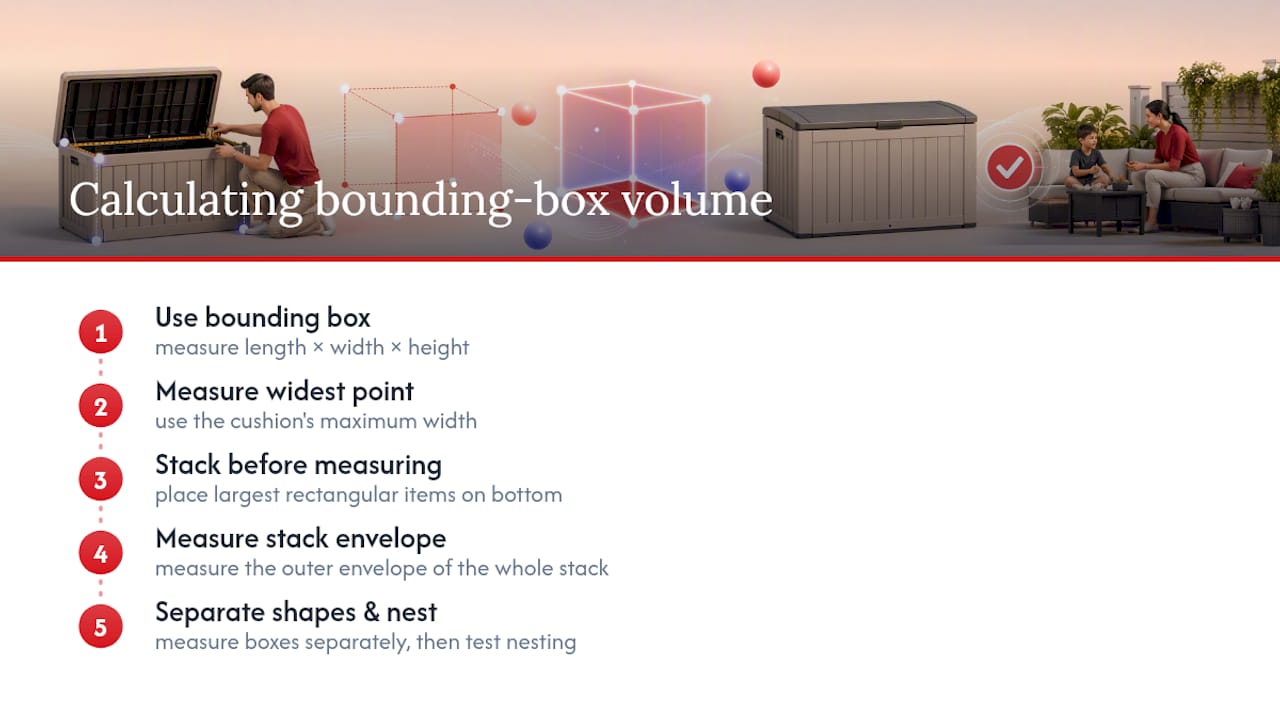
Straight length times width times height works fine for square dining cushions, but it falls apart the moment you’re dealing with a curved chaise cushion, a round ottoman topper, or a bolster‑shaped lumbar cushion.
The practical fix is to measure the item’s bounding box rather than its true shape. Treat every cushion, however curved, as if it fits inside an invisible rectangular block, then measure that block’s length, width and height. A curved chaise cushion that tapers from 60cm to 40cm wide still gets measured at its widest point, because that’s the number that determines whether it clears the box opening and lies flat inside.
For a mixed pile, stack the largest, most rectangular items on the bottom and build up, then measure the whole stack’s outer envelope rather than trying to add up individual cushion volumes. Individual volume figures rarely translate into a combined storage footprint anyway, since cushions compress unevenly and leave gaps around curved edges.
If your set includes several irregular shapes, like a round pouf plus rectangular seat cushions, measure each shape’s bounding box separately, then check whether they nest together (a round item can often sit in a corner beside rectangular ones) or need to be stacked in sequence.
What size box suits your outdoor furniture set?
Matching box size to your actual furniture set is easier than guessing from volume alone, because most cushion sets follow predictable patterns.
A two‑seater outdoor sofa, like a Rosalie 2 seater Sofa or an Emma 2 seater Sofa, typically pairs with two to three seat and back cushions. A compact or medium box, somewhere around 200–400 litres, usually covers this comfortably once you’ve stacked the cushions and added your buffer.
A set built around something like the Keter Salta 2 Seater Sofa with oat cushions plus matching armchairs, such as an Emma Arm chair 2 Pack, pushes you into medium to large territory, since you’re now stacking four to six cushions of varying shapes.
Full lounge sets with a coffee table and multiple seating pieces generally call for the large or extra-large tier, especially if the set includes deep-seat cushions that don’t compress well. Chaise loungers and sun loungers deserve their own measurement pass, since a single chaise cushion can be as long as an entire dining set’s cushions combined.
- Two-seater sofa sets: compact to medium box
- Sofa plus armchair combinations: medium to large box
- Full lounge sets with coffee table: large to extra-large box
- Chaise or sun lounger cushions: measure separately, size up if combining with other cushions
Why ventilation matters as much as size
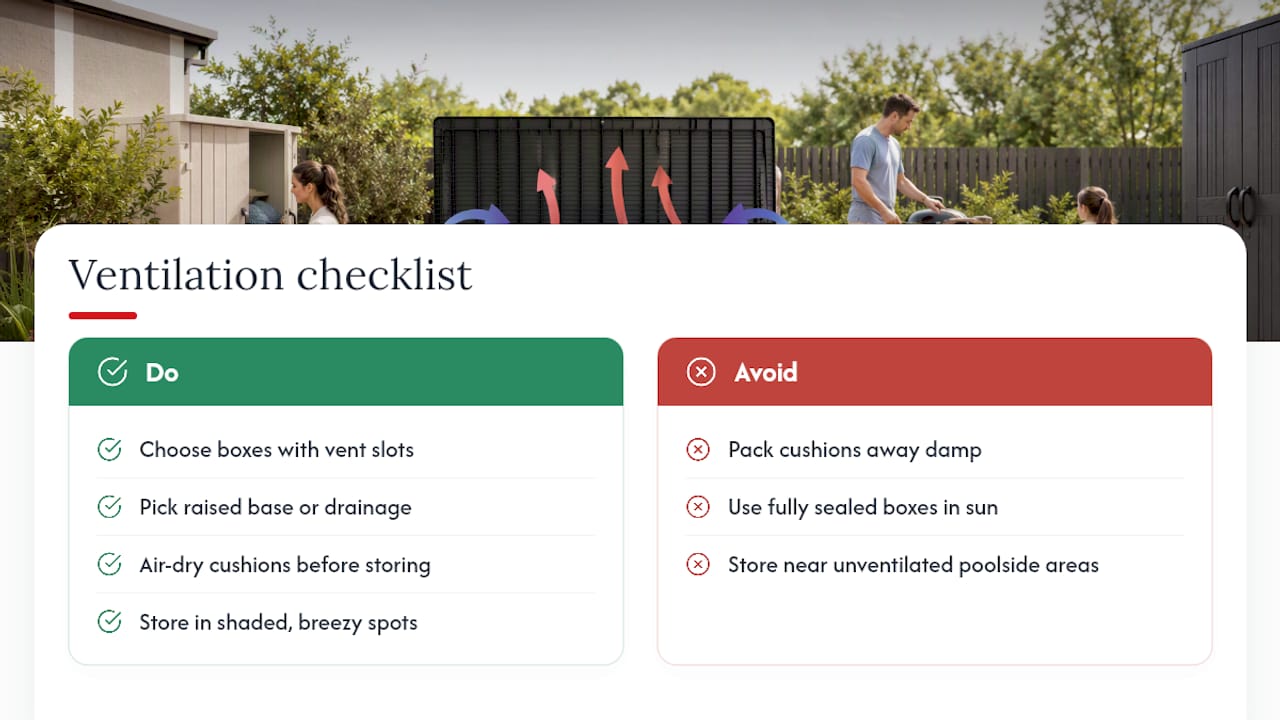
A cushion box sized perfectly for your stack can still ruin your cushions if moisture has nowhere to go. Outdoor cushions absorb ambient humidity even when they look dry, and a fully sealed box traps that moisture against the fabric.
Look for boxes with small vent slots or gaps near the base, often built into the design rather than added as an afterthought. These let trapped air move without letting rain or insects in. A raised base or drainage channel helps too, keeping any moisture that does get in away from direct contact with cushion fabric.
Mould and mildew take hold fastest in warm, humid, still air, exactly the conditions inside a tightly sealed plastic box left in full sun. If you’re storing cushions after a swim day or a wet weekend, give them a chance to air dry on a clothesline first rather than packing them away damp, even into a box with good ventilation.
For readers storing cushions near a pool area, the same moisture principles that apply to pool enclosures and weather damage prevention apply here: trapped humidity is the enemy, and airflow is the fix. Boxes stored in shaded, breezy spots naturally need less built‑in ventilation than ones baking in direct summer sun, so factor placement into how much ventilation design actually matters for your situation.
Can a cushion box hold the weight of wet cushions?
Wet cushions are considerably heavier than dry ones, and a box that comfortably handles dry storage can be pushed close to its limit once cushions come in soaked from an unexpected downpour.
This matters most for the lid and hinge assembly, since these carry the load every time you open and close the box, and for the base, which needs to support the combined weight without buckling or cracking over years of use. UV‑stabilised resin holds up well here because it doesn’t absorb moisture the way wood does, so it doesn’t swell, warp or weaken from repeated wet loading.
If your box doubles as a seat, the same wet‑weight consideration applies again: a lid rated for sitting when empty needs to keep that rating even when the cushions underneath are damp. Check the product’s seating rating rather than assuming it, since not every storage box lid is built to be sat on regardless of what’s inside.
Practically, this means giving cushions a rough shake or a few minutes to drip dry before boxing them after rain, rather than packing them away soaking wet as a matter of habit. It also means choosing a box with a sturdy, wide base rather than a narrow footprint if you know you’ll regularly be storing cushions straight off a rained‑on outdoor setting.
What the sizing advice gets wrong
Most cushion box guides treat sizing as a volume problem: pick the box with enough litres and you’re sorted. That’s backwards. Volume is the number that gets you into trouble, because it hides exactly the detail that determines whether your cushions fit: the internal length.
The conventional advice to “measure your cushions” isn’t wrong, it’s just incomplete. Measuring once, against your current cushion set, ignores that most households add cushions over time, whether that’s a new outdoor rug, a couple of extra throw pillows, or a chaise cushion bought the following summer. Sizing up one tier isn’t a hedge against uncertainty; it’s a hedge against the fact that outdoor furniture collections grow.
What I’d prioritise first, above material, above brand, above price, is the internal length on the spec sheet, checked against your stacked measurement plus buffer. Everything else, ventilation, seating rating, lid style, matters, but none of it fixes a box that’s simply too short inside. Get that one number right and the rest of the decision gets a lot easier.
— Liza
Find a cushion box sized right, from Ketergroup
Ketergroup builds its storage range around the exact sizing logic covered in this guide, so you’re choosing between clearly specified internal dimensions rather than guessing from a gallon figure on a box.

Where a generic hardware store box gives you a rough capacity and hopes it fits, Ketergroup lists internal dimensions on its Australian product pages so you can run the Stack and Measure method before you buy, not after. Every box is made from UV‑stabilised, recyclable resin, so it handles wet cushions, harsh sun and years of lid use without warping or fading the way timber storage often does.
If you’re furnishing a whole outdoor setting rather than just storing cushions, pair a properly sized box with pieces like the Keter Salta 2 Seater Sofa or check the Keter Cortina 570L storage box for a larger cushion collection. Measure your stack, add your buffer, then browse ketergroup.com.au for the internal dimensions that match.
Sources
- How to choose the right size deck box - Keter US
- Outdoor deck box buying guide - FindsBeacon
- Plastic, resin and metal outdoor storage box sizing — GardeningHub
FAQ
What is the Stack and Measure method?
It means stacking your cushions exactly as you’ll store them, then measuring the total length, width and height to define the minimum internal dimensions you need in a box.
Should I go by litres or internal dimensions when choosing a cushion box?
Internal dimensions matter more, since litre and gallon ratings don’t account for wall thickness, hinges or wheel wells that reduce usable space.
How much buffer should I add to my cushion measurements?
Add 15–20% to each dimension, since rigid items like cushions only pack at around 75% efficiency inside a box.
What size box do I need for a four-chair dining set?
A large box, roughly 110–150+ gallons, typically fits a four‑ to six‑chair set’s worth of cushions comfortably.
Are resin cushion boxes better than wooden ones?
Yes, UV‑stabilised resin resists moisture, warping and insect damage far better than wood, and it needs less ongoing maintenance.


