
6 Circular Economy Cycles to Cut Furniture Waste in Australia

Circular economy furniture keeps pieces, parts and materials in use for as long as possible through repair, refurbishment and smart design, rather than sending them to landfill after one life cycle. The practical takeaway is simple: designers and manufacturers should build for disassembly and repair from day one, while buyers and maintenance teams should prioritise keeping what they own working before replacing it.
TL;DR:
- Repair and preventative maintenance preserve the highest value in furniture by maintaining functionality and avoiding full replacements, especially for localized faults.
- Designing furniture with disassembly-friendly features like mechanical fasteners, modular components, and clear documentation facilitates repair, reuse, and recycling.
- Circular business models such as leasing, take-back programs, and refurbishment extend furniture lifespan and incentivize manufacturers to prioritize durability.
- Policy gaps, particularly in Australia, hinder scaling circular practices, but procurement requirements and international standards are gradually driving industry change.
- Digital product passports containing material, repair, and certification data are key tools for ensuring traceability and supporting circular management at end of life.
Table of Contents
- Why circular economy furniture matters for value and the environment
- The six circular cycles for furniture and how they rank by value
- Designing furniture for disassembly, repair and reuse
- Circular business models: leasing, take-back and refurbishment services
- Policy, procurement and the barriers holding back circular furniture
- Digital product passports: the traceability layer furniture needs
- A practical roadmap for designers, manufacturers and procurement teams
- What buyers and facility managers can do right now
- Keter Australia’s approach to circular design in practice
- Why repair culture needs to come back faster than it’s returning
- Choosing furniture built for a longer life with Keter Australia
- Sources
- FAQ
Why circular economy furniture matters for value and the environment
Furniture is one of the more wasteful categories in the built environment. Millions of items end up discarded every year across developed economies, many with decades of useful life left in a frame, a joint, or a cushion that could have been replaced instead of the whole chair. Australia’s own furnishing sector shows this gap clearly. National circularity levels remain low, even though the economic and emissions upside from circular practices is substantial, according to the Australian Furniture Association’s sector blueprint.
The commercial case is straightforward once you follow where value actually sits. A discarded office chair is not waste, it’s a bundle of steel, foam, fabric and plastic that took energy, water and labour to assemble. Breaking that bundle apart for raw material recovery captures only a fraction of what it cost to make. Keeping the chair whole, or at worst harvesting its components for a second product, preserves far more of that original investment.
Sector-level research backs this logic directly. Reports from the European Commission’s circular economy work identify design-for-disassembly, repair and remanufacture as the interventions that preserve the most economic and material value across a furniture product’s life. That is not an abstract preference for tidier supply chains. It is a value-preservation argument with real commercial teeth for manufacturers willing to redesign around it.
A few concrete examples show how this plays out:
- Office fit-outs increasingly favour furniture that can be reconfigured or partially replaced rather than gutted and rebought each lease cycle.
- Hospitality venues refurbish timber and metal frames repeatedly, only replacing upholstery and finishes, which cuts both cost and waste.
- Schools and universities run long replacement cycles on desks and chairs precisely because durable, repairable stock outlasts cheaper alternatives by years.
None of this requires exotic technology. It requires designing and buying with the item’s second, third and fourth year in mind, not just the day it leaves the showroom.
The six circular cycles for furniture and how they rank by value
Not every circular action is equal. Some preserve almost all of an item’s original value; others recover only its raw materials. Understanding where an intervention sits in this hierarchy tells you when to repair, when to refurbish, and when recycling is genuinely the best remaining option.
European sector research groups furniture circularity into six core cycles: preventative maintenance, repair, reuse, refurbish or remanufacture, repurpose, and recycle. Each sits at a different point on the value scale.
- Preventative maintenance. Routine care, like re-tightening joints, re-sealing timber, or replacing worn glides, stops small issues becoming write-offs. This is the cheapest intervention and the one most consumers skip entirely.
- Repair. Fixing a broken part (a snapped leg, a torn seam, a cracked panel) restores the item to its original function without altering its design or materials. Repair keeps the highest share of embodied value because nothing needs remaking.
- Reuse. Passing a still-functional item to a new owner, whether through resale, donation, or an office relocation, extends its working life with zero manufacturing input.
- Refurbish or remanufacture. This goes beyond repair, restoring an item to near-original condition or better, often with updated components, finishes, or upholstery. Commercial furniture leasing operations run heavily on this cycle.
- Repurpose. When an item can no longer serve its original function, its components can start a new life. A cabinet door becomes shelving; a table frame becomes a bench base.
- Recycle. Breaking a product down into raw material streams (timber fibre, metal, plastic resin) is the last resort in the value hierarchy, recovering material but sacrificing everything invested in shaping it.
The practical decision rule follows directly from this order: keep the item as itself first, keep it as a usable component second, and recover raw material only when the first two options are exhausted. Environmental agencies back this sequencing on health and impact grounds too, noting that prioritising reuse and repair over downcycling or incineration reduces environmental and health impacts more consistently than skipping straight to material recovery.
Pro Tip: Before assuming a piece is beyond saving, check whether the fault sits in a replaceable component (a hinge, a cushion, a caster) rather than the frame itself. Most furniture failures are localised, not structural.
Designing furniture for disassembly, repair and reuse
Every circular outcome downstream of manufacturing depends on decisions made at the design table. A product engineered with glued joints and mixed materials cannot be repaired, refurbished, or cleanly recycled, no matter how motivated the eventual owner is. Design-for-disassembly and related design-for-X strategies are consistently identified as the highest-impact levers available to manufacturers making the shift toward circular models.
Several practical rules make the difference between furniture that lasts and furniture that gets thrown out at the first fault:
- Use mechanical fasteners over adhesives. Screws, bolts and snap-fit connectors allow a joint to be opened, repaired and closed again. Permanent glue bonds usually mean the whole assembly gets replaced together.
- Standardise components across a product range. A manufacturer using the same hinge, leg fitting or caster across several models makes spare parts cheaper to stock and easier for owners to source.
- Build in modular subassemblies. A sofa with a separable frame, cushion set and leg unit lets an owner replace one worn element without discarding the rest.
- Choose single-material sections where possible. Mixing plastic, metal and timber in one bonded piece makes recycling almost impossible; separating materials into distinct, removable sections keeps recovery options open.
- Select finishes that tolerate touch-up repair. A finish that can be sanded and resealed extends a piece’s cosmetic life far longer than one that requires full replacement to fix a scratch.
Documentation matters as much as the physical design. A spare-parts list published alongside a product, even a simple PDF naming the exact fitting sizes and where to buy replacements, turns a repair from a guessing game into a ten-minute job. Manufacturers that skip this step are effectively designing repairability into the product and then hiding it from the customer.
Pro Tip: If you’re assessing a piece of furniture’s repairability before buying, ask whether the retailer can name the fastener type used in the joints. A supplier who can answer instantly has usually designed for disassembly on purpose.
Material selection deserves its own scrutiny here too. Recycled and recyclable resin, for instance, holds up structurally over years of outdoor exposure while remaining recoverable at end of life, which is why material choice increasingly shapes how outdoor furniture ranges are engineered for durability rather than just appearance.
Circular business models: leasing, take-back and refurbishment services
Design changes alone don’t shift an industry. The commercial model around a product has to reward keeping it in use, or the incentive to build disposable furniture never goes away. A handful of business models are proving this can work at scale.
Furniture-as-a-service and leasing flip the ownership equation. Instead of buying a desk outright, a business leases it, and the manufacturer retains responsibility (and financial incentive) for keeping it functional across multiple tenants. This model rewards durability and easy servicing because the manufacturer, not the customer, bears the cost of premature failure.
Take-back schemes let manufacturers reclaim products at end of life, either for refurbishment and resale or for material recovery. This only works when the original design supports disassembly, which is why take-back and design-for-disassembly tend to appear together in mature circular operations rather than as separate initiatives.
Refurbishment-for-resale services give commercial buyers a mid-life option between new purchase and disposal. Office furniture refurbishers strip, repair and reupholster used stock, then resell it at a fraction of new pricing, often with a shorter lead time than ordering new.
Running any of these models requires real operational infrastructure, not just good intentions:
- Asset tracking to know where a leased or take-back item is and its service history.
- Servicing capacity, whether in-house technicians or a contracted repair network.
- Financing structures that spread revenue across a lease term rather than a single upfront sale.
Institutional buyers are often where these models get tested first. Education-sector purchasing is frequently the earliest high-impact adopter of circular procurement, given the volume of furniture universities and schools cycle through and their appetite for predictable, budgeted service arrangements. Office fit-outs and healthcare facilities follow a similar logic, favouring vendors who can guarantee ongoing servicing over one-off suppliers.
Policy, procurement and the barriers holding back circular furniture
Good design and smart business models only travel as far as policy lets them. Furniture stewardship in Australia remains genuinely patchy, and that fragmentation is the single biggest structural barrier to scaling circular practices nationally.
Australia’s Productivity Commission has looked directly at this gap. Its interim report on the circular economy flagged inconsistent regulation across states and territories and the absence of a comprehensive furniture stewardship scheme as significant barriers to uptake. Without a unified national framework, manufacturers face different rules depending on where they sell, and buyers have no consistent standard to check compliance against.
Procurement policy is one of the more effective levers governments have to shift this. Environmentally Sustainable Procurement requirements can mandate that furniture purchased for institutional use meet durability and repairability benchmarks, carry third-party certification, or participate in a recognised product stewardship scheme. When a government department or university sets these conditions in a tender, suppliers respond, because institutional contracts are large enough to justify redesigning a product line.
International regulation is shaping expectations too, even for manufacturers who never export. The EU’s circular economy regulatory direction and the ISO 59000 series of circularity standards are increasingly referenced in supply chain contracts, meaning Australian manufacturers selling into global markets, or sourcing components from them, feel the pressure to align regardless of domestic policy timing.
Smaller manufacturers face a distinct set of obstacles that policy alone doesn’t solve:
- Upfront cost of redesigning tooling and supply chains for disassembly-friendly components.
- Skills gaps in design-for-disassembly methodology, which most trade training doesn’t cover.
- Reverse logistics infrastructure, since take-back and refurbishment need transport and storage that many SMEs don’t have in place.
- Limited access to institutional buyers who could justify the investment through volume.
Sector groups suggest starting small rather than waiting for a perfect regulatory framework. Restrictions on materials like single-use plastics are already reshaping what packaging and component choices businesses can rely on, a sign that regulatory tightening is coming from multiple directions at once, not just furniture-specific stewardship schemes.
Digital product passports: the traceability layer furniture needs
A furniture item’s biggest circular liability is often simply not knowing what it’s made of. Digital product passports solve exactly that problem by attaching a permanent, checkable record to a product covering its materials, construction and service history.
A useful furniture passport typically holds four categories of information:
- Material composition, down to resin type, timber species, or fabric blend, so a future recycler or refurbisher knows exactly what they’re handling.
- Repair and disassembly guides, ideally the same documentation a manufacturer’s own technicians would use.
- Certifications and compliance records, relevant to procurement teams checking a product against sustainability tenders.
- Carbon and lifecycle metrics, increasingly requested by institutional buyers reporting on their own supply chain emissions.
This is not a theoretical future requirement. The EU’s regulatory direction and the ISO 59000 series already reference digital product passports as compliance and traceability tools, and industry bodies expect large buyers to treat them as standard procurement documentation within a few years, not decades.
Australia has its own version underway. The Australian Furniture Association and AFISC are developing the Furniture Passport Australia System, aimed at giving the local sector lifecycle traceability that supports both procurement decisions and long-term asset management. Industry commentary around the initiative notes that product passports are becoming a competitive requirement rather than a nice-to-have for suppliers chasing large institutional contracts.
Manufacturers don’t need a full digital system to start. A spreadsheet recording material composition, fastener types and supplier contacts for spare parts is a legitimate first step, and it’s the same data a formal passport will eventually require.
A practical roadmap for designers, manufacturers and procurement teams
Turning circular principles into daily practice works best as a short, sequential process rather than an all-at-once overhaul. Here’s a workable order of operations.
- Audit current products and material flows. Map what materials go into your best-selling lines, where they come from, and what happens to them at end of life. You can’t redesign what you haven’t measured.
- Run a single-product design-for-disassembly pilot. Pick one high-volume SKU, swap adhesive joints for simple fasteners, and document every disassembly step as you go. This keeps the experiment contained while proving the concept works.
- Build a spare-parts list from that pilot. Name every replaceable component and where to source it, then publish it alongside the product.
- Set measurable targets. Repair rate, average product lifespan, or percentage of take-back stock refurbished rather than landfilled are all trackable metrics that show whether circular claims hold up.
- Find refurbishment and reverse logistics partners early. Very few manufacturers can run take-back and refurbishment entirely in-house at first; a contracted partner network gets a program running faster.
- Test the model with an institutional buyer. A small take-back trial with a university or office client gives you real operational feedback before scaling company-wide.
Pro Tip: Run your first design-for-disassembly pilot on a product you already sell in volume, not a new concept. You’ll get faster, more honest feedback on what breaks the model in practice.
Procurement teams on the buying side can mirror this same sequencing: start by writing durability and repairability clauses into one tender before rolling them across an entire purchasing category. Small, provable wins build the internal case for wider policy change far more effectively than an ambitious framework nobody has tested.
What buyers and facility managers can do right now
Individual purchasing decisions add up faster than most people expect, and the actions that matter most are refreshingly unglamorous.
A sound buying checklist starts with three questions before any purchase: is the piece built to be repaired rather than replaced, are spare parts actually available, and can the seller tell you what it’s made of? A supplier who can answer all three without hesitation is usually one who has designed with longevity in mind, not just appearance.
Maintenance is where most of the preserved value actually happens, and where most owners fall short:
- Clean and reseal outdoor furniture surfaces on a seasonal schedule rather than waiting for visible wear, particularly for pieces exposed to strong sun where UV degradation shortens material life faster than most people realise.
- Tighten fittings and hardware every few months on frequently used items like dining chairs and outdoor tables.
- Replace worn components early, a cushion cover or a glide, before the underlying frame takes damage from compensating for the fault.
- Store or cover items during extreme weather when possible, extending the interval between necessary repairs.
When an item genuinely reaches the end of its usefulness for you, rehoming beats bin day almost every time. Local buy-swap-sell groups, charity furniture collection services, and manufacturer take-back programs (where they exist) all keep a working item in circulation rather than in landfill.
Greenwashing is a real risk in this space, so treat vague claims with scepticism. A genuine sustainability claim points to something checkable: a named certification, a specific recycled-material percentage, or a product passport you can actually view. “Eco-friendly” printed on a swing tag with nothing behind it is marketing, not evidence.
Keter Australia’s approach to circular design in practice
Liza here, and this section is where the principles above meet actual product decisions. Keter Australia builds much of its outdoor furniture and storage range from durable, recycled and recyclable resin, a material choice the brand states is central to how it approaches both product longevity and end-of-life recovery.
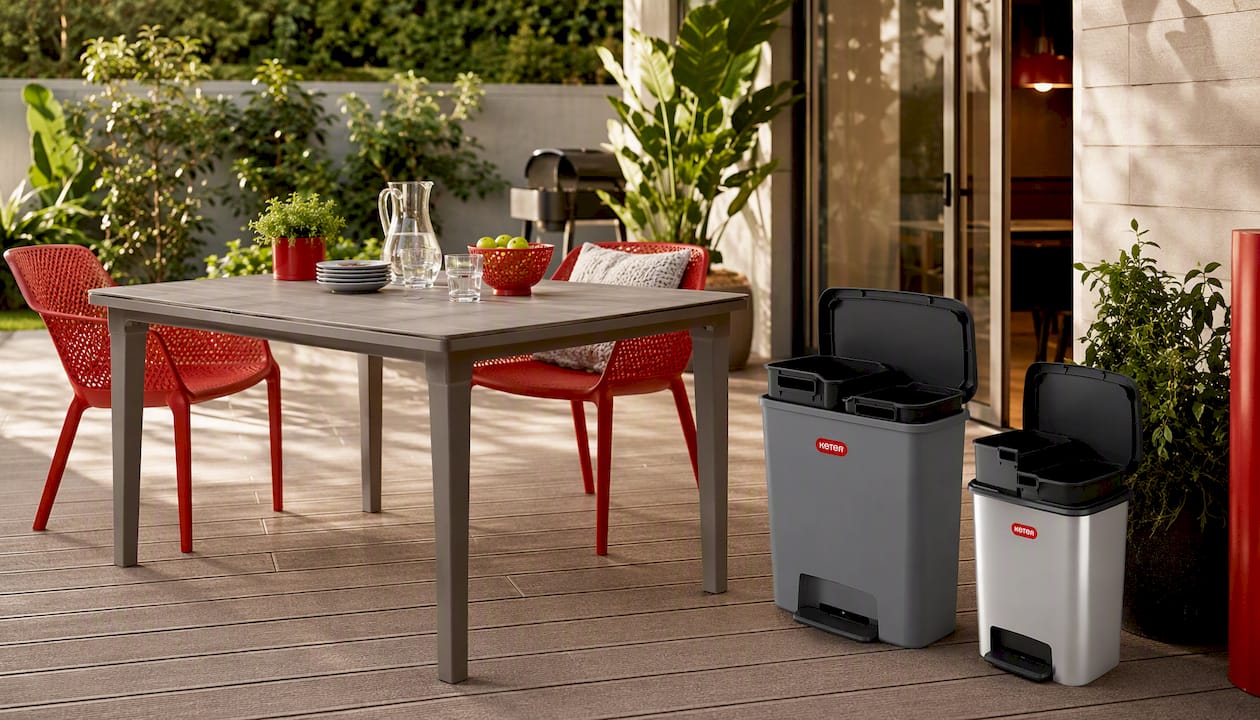
Three products illustrate how this plays out on the shelf. The Keter Futura Dining Table in Cappuccino uses a resin construction designed to resist the fading, cracking and warping that typically shortens an outdoor table’s life, which maps directly onto the durability checklist covered earlier: a piece built to last multiple seasons outlasts several cheaper replacements over the same period.
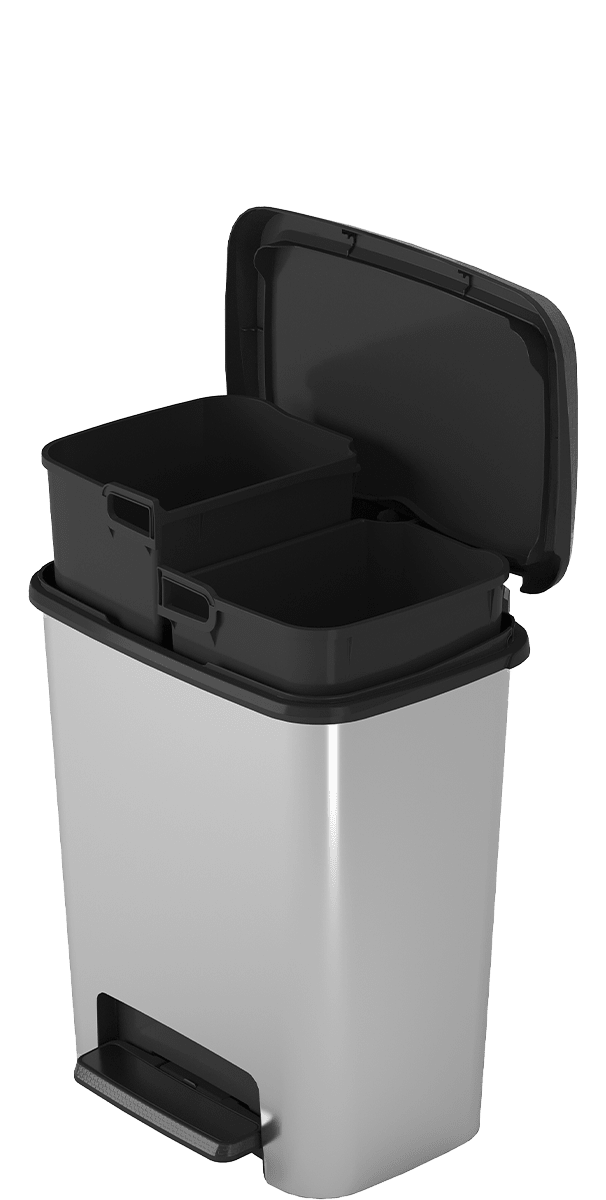
On the household recycling side, the Curver Compatta Duo 11+11L Recycling Bin in Steel Look and the Curver Compatta 50L Duo 23+23L Recycling Bin in Grey are practical tools for the material-separation habits this article keeps circling back to. Sorting recyclables properly at home is a small action, but it’s the exact behaviour that keeps recovered materials clean enough to re-enter manufacturing rather than ending up contaminated and landfill-bound.
None of these examples claim to solve furniture stewardship on their own. They show what applying design-for-longevity thinking looks like at the product level, which is ultimately the scale where circular economy furniture succeeds or fails.
Why repair culture needs to come back faster than it’s returning
The biggest gap I see between circular economy theory and furniture industry practice isn’t design capability, it’s habit. Manufacturers increasingly know how to build disassembly-friendly products. What’s missing is a broad cultural expectation that repair is the default first move, not a last resort before the item goes to the tip.
That shift needs pressure from both directions at once. Procurement teams setting durability clauses in tenders send a signal manufacturers actually respond to, because institutional contracts carry weight that consumer preference alone doesn’t. At the same time, individual buyers asking suppliers about spare parts before purchase, rather than after something breaks, changes what gets rewarded in the market.
I’d like to see more cross-sector pilots, education procurement working directly with manufacturers on take-back trials, rather than each side waiting for the other to move first. If you work in either camp, the roadmap in this piece is genuinely built to be tested on a single product line or a single tender, not rolled out company-wide on day one. Start small, measure honestly, and share what you learn.
— Liza
Choosing furniture built for a longer life with Keter Australia
There are options available that offer an alternative to furniture you might replace frequently. Some outdoor furniture is made from weather resistant resin designed for durability and longevity, helping to reduce replacements and waste.
If you’re applying the buying checklist covered earlier, durability, material transparency, easy upkeep, Keter Australia’s outdoor furniture and storage range is a genuinely solid place to start looking. The Garden, Planters and Elevated Garden Beds collection suits anyone building out a more self-sufficient backyard setup, while the recycling bins covered above make sorting materials at home simple enough that it actually sticks as a habit. Have a browse through the current range and pick a piece that’s built to still be doing its job in a decade, not a season.
Sources
- Productivity Commission interim report — circular economy inquiry
- Circular economy in the furniture industry — European Commission deliverable
- Australian government product stewardship guidance
FAQ
What is circular economy furniture?
It’s furniture designed and managed to stay in use as long as possible, through repair, reuse, refurbishment and recyclable materials, rather than being discarded after a single life cycle.
What is the highest-value circular action for a piece of furniture?
Preventative maintenance and repair preserve the most embodied value because they keep the item functioning in its original form, ahead of reuse, refurbishment, repurposing and recycling.
What is a furniture product passport?
It’s a digital record attached to a product detailing its materials, disassembly and repair instructions, certifications and carbon metrics, used by buyers, refurbishers and recyclers to make informed decisions.
Does Keter Australia use recycled materials in its furniture?
Yes, Keter Australia’s outdoor furniture and storage range uses durable, recycled and recyclable resin, designed for long product life and easier end-of-life recovery.
How can I tell if furniture is genuinely built for circularity?
Check whether the seller can name the fastener types used, confirm spare parts are actually available, and provide material composition details rather than vague sustainability language.


