
Weekend DIY Carport Storage Ideas: Secure Your Gear Without a Builder

The best carport storage solution combines a lockable enclosed module, either a side unit or rear closet, with vertical wall systems and an overhead rack for seasonal items. Weather-resistant, lockable storage matters more than floor space in an open carport. Before buying or building anything, measure your vehicle, including mirrors and roof racks, plus the clearance you need to open doors and walk through comfortably.
TL;DR:
- Weather-resistant lockable storage options like lockable boxes or small framed rooms offer better security, especially for valuable tools or chemicals.
- Vertical and overhead storage systems should be mounted into structural studs with spreading plates to safely support heavy loads and maximize available space.
- Proper measurement of vehicle dimensions, door swing, and clearance is essential to avoid blocking access or fitting storage units improperly.
- Resin, powder-coated metal, or treated timber are preferred materials for outdoor storage solutions to withstand moisture, temperature changes, and pests.
- Combining a few storage types, such as cabinets, pegboards, and overhead racks, provides the best organization and accessibility without extensive construction.
Table of Contents
- Quick shortlist: the main carport storage idea types
- Vertical and overhead storage: what to use and how to install it safely
- Enclosed and lockable solutions: build-in vs freestanding
- Materials and weather resistance: the right choices for outdoor storage
- Plan and measure: a concise layout and clearance checklist
- DIY and budget-friendly hacks you can do in a weekend
- Keter product options and practical pairing ideas
- Lighting, security and accessibility considerations
- Organising tools and garden equipment effectively within carport storage
- Tips for maintaining cleanliness and pest control in carport storage areas
- Author’s practical viewpoint and two starter projects
- Browse Keter storage solutions for your carport
- Sources
- FAQ
Quick shortlist: the main carport storage idea types
Not every idea suits every carport. Some need a concrete pad and council paperwork, others you can bolt up on a Saturday afternoon. Here’s the fast version so you can jump straight to what fits your space and budget.
- Side storage room: attached enclosed unit for tools and equipment; DIY-friendly with basic framing skills, may need a permit and slab.
- Rear storage closet: framed closet with a roll-up door, best for workshop-style security; usually needs a concrete slab and drainage slope.
- Overhead racks: ceiling-mounted platforms for seasonal or rarely used items; DIY-friendly if your roof structure can take the load.
- Pegboard or wall systems: ideal for tools and small equipment you use often; no permit needed, weekend project.
- Freestanding cabinets: lockable, movable storage for the middle ground between a chest and a built room; no permit required.
- Lockable boxes or chests: fast, cheap, weather-resistant storage for garden gear and outdoor cushions; no permit, no tools beyond assembly.
- Bike hoists: pulley systems that lift bikes off the floor; DIY-friendly, needs solid ceiling anchoring.
- Fold-down benches: workspace that tucks away when not needed; DIY-friendly with basic hardware.
Most homeowners get the best return combining three or four of these rather than betting everything on one.
Vertical and overhead storage: what to use and how to install it safely
Vertical storage is where most carports waste the most usable space. Wall-mounted shelves, pegboards and ceiling racks reclaim floor space and put frequently used items within easy reach, while pushing seasonal gear up and out of the way.
- Pegboard for hand tools and small equipment you grab weekly.
- Heavy-duty wall shelves for bulkier items like paint tins or car care supplies.
- Ceiling-mounted racks for Christmas decorations, camping gear, or anything you touch twice a year.
Always mount into studs or structural members, never just plasterboard or thin cladding. For older carport roofs, add a 12mm plywood spreader plate across the joists before bolting on a rack. It spreads the load instead of concentrating weight on one point, which is exactly how tradespeople avoid pulling fixings straight through the timber.
Pro Tip: Keep anything you need in a hurry, like jumper leads or a torch, below shoulder height. Save the ceiling racks for stuff you can plan ahead to retrieve.
Enclosed and lockable solutions: build-in vs freestanding
A framed side or rear storage room gives you the most security and the best protection from weather, but it comes with real commitments. Converting the back wall into a closet with a roll-up door needs a concrete slab, proper ventilation, and a slight floor slope so water drains away rather than pooling. Depending on your council, it may also need a building permit, particularly once it becomes an enclosed structure rather than an open bay.
Freestanding lockable options skip all of that. You place them, you use them, and you can move them if you rearrange later.
- A framed room suits anyone storing power tools, chemicals, or anything genuinely valuable long-term.
- Lockable chests or cabinets suit renters, or anyone not ready to commit to permanent building work.
- A hybrid approach, one small enclosed cupboard plus a couple of lockable boxes, often covers both needs without the full cost of framing a room.
For most carports, experts recommend combining a lockable cabinet or small framed room with vertical storage, keeping daily items accessible while securing anything worth stealing.
Materials and weather resistance: the right choices for outdoor storage
Indoor-grade furniture doesn’t survive an open carport. Resin, powder-coated metal, and treated or engineered timber all hold up against damp, temperature swings, and salt air far better than anything designed for a spare room. Resin storage boxes in particular shrug off moisture without rusting, rotting, or fading the way cheaper materials do.
A few habits protect whatever you choose:
- Sit boxes and cabinets on a raised base rather than directly on concrete or gravel, which keeps trapped moisture away from the base.
- Use liners inside chests for anything fabric-based, like cushions or covers.
- Seal gaps around fixed units with silicone, and leave a little airflow so condensation doesn’t build up inside.
Check hinges and seals every season, and wipe down any metal fittings before they start showing surface rust.
Plan and measure: a concise layout and clearance checklist
Buying storage before measuring is the single most common mistake homeowners make with carports. Get this wrong and you end up with a cabinet you can’t open fully, or a shed clipping the car door.
- Measure your vehicle at its widest and tallest points, mirrors extended and roof racks fitted, not folded down.
- Note door swing on both sides and add at least 700 to 900mm of walk space beyond that.
- Decide storage depth based on what’s left. Single carports typically only support shallow wall-mounted or overhead options; double carports can usually fit a full side room.
- Work through a final checklist: slab or gravel base, roof overhang for weather protection, a slight drainage slope away from the vehicle, and whether you need lighting or a power point run.
Combo carport-and-storage setups typically range from 80 to 240 square feet depending on how much enclosed space you add, so match the numbers to what you actually measured rather than what looks good in a catalogue.
DIY and budget-friendly hacks you can do in a weekend
You don’t need a tradesperson for most of this. A sheet of plywood mounted to the wall studs, fitted with off-the-shelf pegboard hooks, gives you a full tool wall for the cost of a hardware store trip. Stack bins on a couple of raised pallets instead of the bare slab, and you’ve solved damp storage without spending a cent on shelving.
- Mount a bike hook into a joist for vertical bike storage.
- Build a simple fold-down bench from a hinged board and two brackets.
- Cover anything you can’t store fully enclosed with a tarpaulin, and add a rubber mat underneath to stop scratching.
- Fit a basic hasp-and-padlock to any cabinet doors for cheap security.
Pro Tip: A motion-sensor LED light near your storage zone costs very little and makes a real difference at night, both for finding your gear and for deterring anyone who shouldn’t be there.
Keter product options and practical pairing ideas
Once you know which idea suits your carport, matching it to the right product is straightforward. A Keter City Box works well as a quick lockable floor unit for garden tools or cushions, while a larger Store It Out Prime shed suits anyone wanting enclosed storage without framing a full room. For a dedicated tool zone, an outdoor utility cabinet gives you lockable, weather-resistant space at bench height.
- Pair floor units with overhead racks so you’re using height, not just footprint.
- Add pegboard above a cabinet for tools you reach for constantly.
- Choose resin over timber if you want less seasonal upkeep.
All Keter storage is built from recyclable resin, genuinely easy to assemble without a tradesperson, and designed to handle Australian weather without the rot or rust issues that indoor furniture develops outdoors.
Lighting, security and accessibility considerations
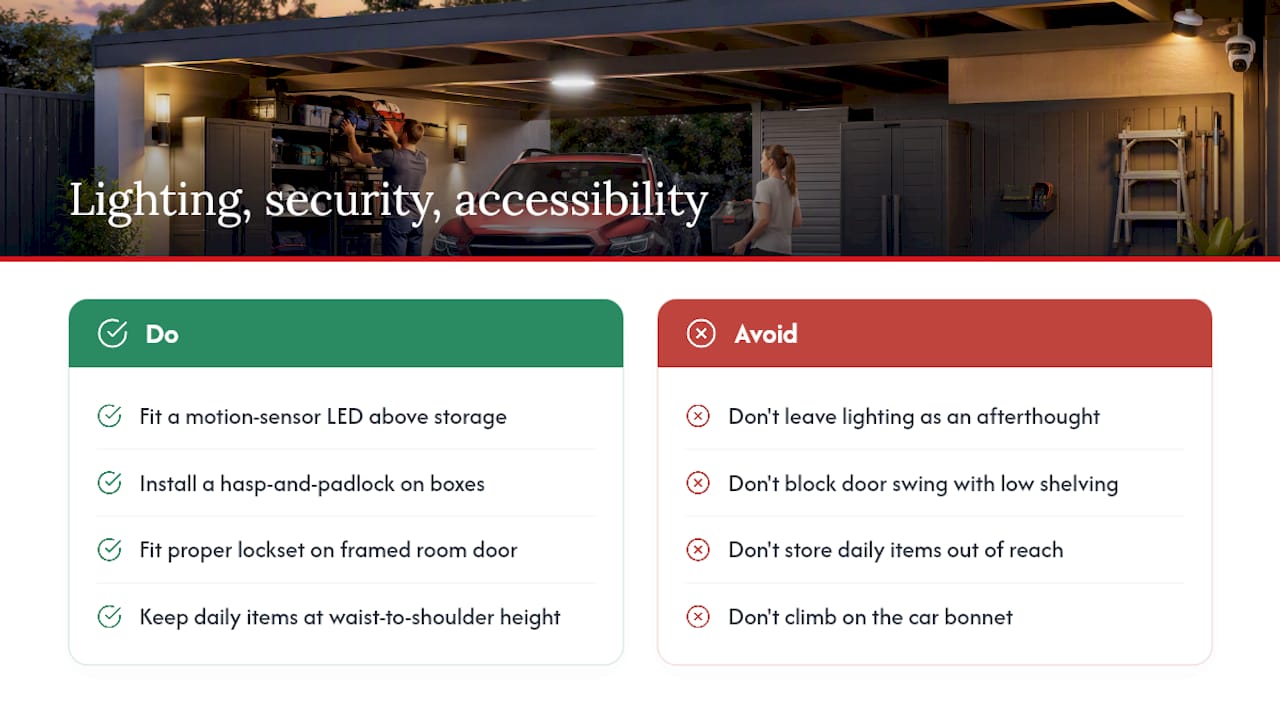
A carport is often the darkest, least secure part of a property, which makes lighting and security worth prioritising early rather than as an afterthought. A motion-sensor LED fitted above your storage zone solves two problems at once: you can actually see what you’re grabbing at night, and unexpected movement lighting up the area tends to discourage anyone poking around where they shouldn’t be.
Security doesn’t need to mean an alarm system. A simple hasp-and-padlock on any cabinet or storage box stops casual opportunists, and it’s cheap enough to fit to almost anything with a lid or door. If you’ve built a framed storage room, a proper lockset on the door and a solid roller or hinge mechanism matter more than anything decorative.
Accessibility is just as important as security, and it’s easy to overlook. Storage you can’t reach without climbing over the car, or shelving positioned so low it blocks the door swing, ends up unused within a month. Keep daily items, keys, bags, garden tools you use weekly, at waist to shoulder height. Push ceiling racks and top shelves for things you touch only a few times a year. If you’re storing anything heavy overhead, make sure there’s a stable step or small ladder kept nearby, rather than relying on balancing on the car bonnet, which is how most garage injuries happen.
Wide, clear walkways matter too, particularly if you’re sharing the carport with kids, pets, or simply carrying groceries in from the car. A well-lit, well-organised carport doesn’t just look better. It gets used properly, which is really the whole point of adding storage in the first place.
Organising tools and garden equipment effectively within carport storage
Tools and garden equipment fail differently to everything else stored in a carport, mostly because they’re used constantly and left out just as often. The fix is zoning: group items by how often you use them, not by category alone.
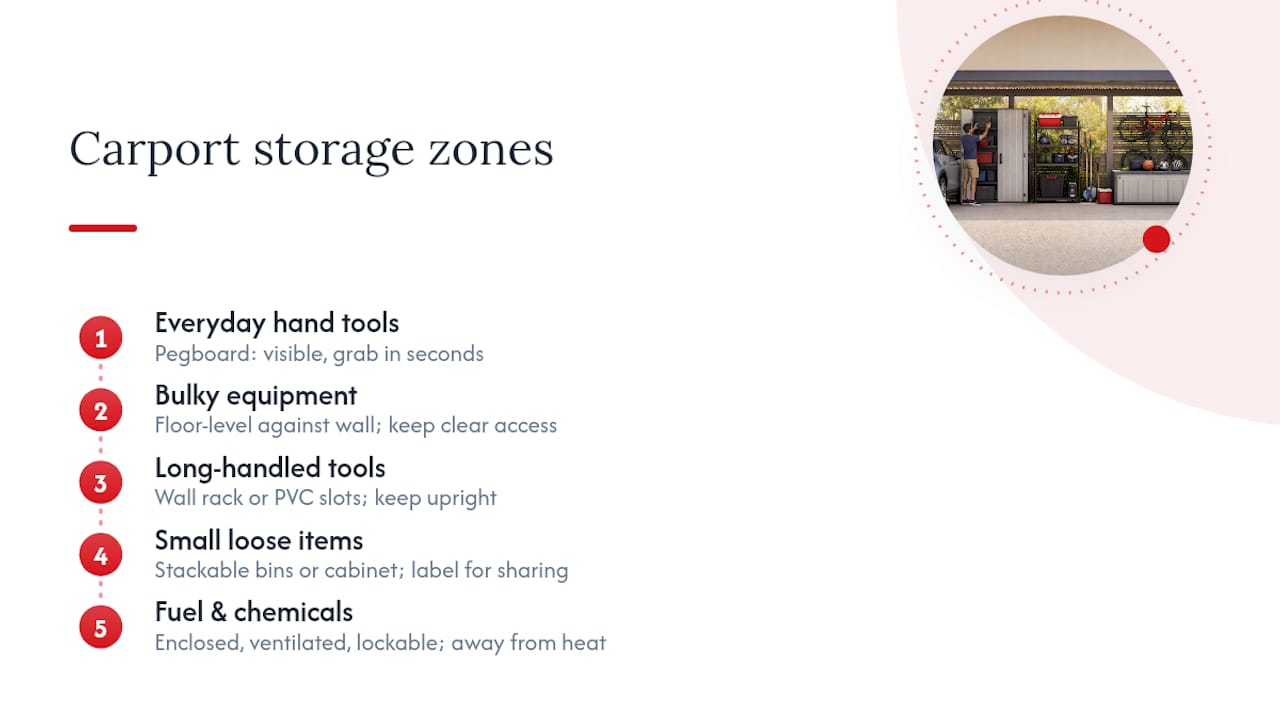
Everyday hand tools, secateurs, a trowel, a hose nozzle, belong on a pegboard where you can see and grab them in seconds. Bulkier equipment like mowers, whipper snippers, and edgers need floor-level space, ideally against a wall rather than in a walkway, with enough clearance that you’re not manoeuvring around the car to reach them.
Long-handled tools, rakes, shovels, brooms, are notorious for toppling over and blocking access. A simple wall-mounted rack or a length of PVC pipe cut into vertical slots keeps them upright and off the ground, which also stops blades and tines rusting from ground moisture.
Smaller loose items, like sprinkler fittings, gloves, and spare fasteners, disappear fast without containment. Stackable bins or a freestanding cabinet with drawers keeps them sorted and searchable instead of tipped into a milk crate you dig through every time. Label bins if more than one person uses the carport; it saves the constant “where did you put it” conversation.
Fuel, chemicals, and anything flammable need their own enclosed, ventilated spot, away from any heat source and ideally lockable if kids are around. Keep that separate from your everyday tool zone rather than mixed in with the pegboard hooks.
Tips for maintaining cleanliness and pest control in carport storage areas
An open carport attracts dust, leaves, and moisture in a way an enclosed garage never does, which means storage areas need a slightly different maintenance rhythm to stay usable.
Sweep the slab or base area monthly at minimum, more often if you’re near trees or in a windy spot. Debris that builds up against storage units traps moisture against the material, which is exactly the condition that encourages rust on metal fittings and mould on timber.
Pests are drawn to carports for the same reasons they’re drawn to sheds: shelter, warmth, and often food residue from garden fertilisers or forgotten snacks in a car. Spiders and rodents in particular favour dark, undisturbed corners behind or underneath storage units. A few habits keep this in check:
- Keep a small gap between the back of cabinets and the wall so you can inspect and sweep behind them.
- Store any pet food, fertiliser, or seed in sealed containers rather than the original paper or cardboard packaging.
- Check weatherstripping and door seals on enclosed units regularly. Gaps that let in rain also let in insects.
- Avoid piling cardboard boxes directly on the ground. They’re a favourite nesting material for rodents and hold moisture against the slab.
Resin and powder-coated metal storage make this easier by default, since neither material offers pests anything to chew through the way untreated timber can. A quick seasonal check, hinges, seals, and the ground beneath each unit, catches most problems before they become an infestation rather than after.
Author’s practical viewpoint and two starter projects
The mistakes I see most often are blocking door clearances, dragging indoor furniture outside, and ignoring drainage until water pools under a cabinet. Start small: a pegboard wall paired with one overhead bin, or a lockable box plus a couple of wall hooks. Run your measuring checklist before you buy or build anything.
— Liza
Browse Keter storage solutions for your carport
Ketergroup gives you a faster, cheaper path to organised carport storage than framing a room from scratch. A weekend with off-the-shelf lockable boxes and cabinets gets you protected, weather-resistant storage without hiring a builder or waiting on permit approval.

For small, grab-and-go storage, the Keter City Box handles garden tools and outdoor cushions in a compact, lockable footprint. If you need something closer to a full storage room, the Store It Out Prime shed gives you enclosed, weather-resistant space without the framing work. For a dedicated tool zone at bench height, look at the outdoor utility base cabinet.
Whichever you choose, measure your vehicle and clearance first, sit the unit on a raised base, and check the assembly guide before you start. Browse the full Keter storage range to find the size and configuration that fits your carport.
Sources
- 7 innovative storage ideas for carports
- Best weatherproof outdoor storage cabinets you’ll actually rely on year round
- Brilliant ways to organize your garage
- Carports With Storage FAQ’s: Costs, Sizes & Permit Guide
FAQ
How do I add storage to a carport?
Add a lockable enclosed unit, either a side cabinet or a rear closet, then layer in vertical storage like pegboard and overhead racks to use the space above and around your vehicle without blocking access.
What are some creative ways to enclose a carport?
Reclaimed windows, pegboard feature walls, and built-in plywood cabinets can enclose a carport affordably while still looking finished, particularly when paired with a proper concrete slab and drainage slope.
How can I enclose a carport on a budget?
Frame with basic timber studs and plywood cladding rather than premium materials, and add a roll-up or hinged door instead of a full custom-built entry system to keep costs down.
What are some cheap storage options for my garage or carport?
Lockable resin storage boxes, wall-mounted pegboard, and bins stacked on raised pallets are all low-cost options that need only a weekend to set up and protect gear from weather.
Do I need a permit for carport storage?
Enclosed rooms built on a concrete slab, particularly rear closets with a roll-up door, often need council approval, while freestanding cabinets and lockable boxes typically don’t.


