
Resin Storage and Raised Base Protect Outdoor Sports Gear in Australia

The quickest, lowest-maintenance way to store most outdoor sports gear is a weather-resistant resin deck box or compact resin shed, paired with a simple wall or hook system for the items you grab every week. Keter has built its reputation on exactly this kind of durable, easy-assembly resin storage. The rest of this guide walks through the product types, how to pick the right size and security level, layout ideas, and the upkeep that keeps everything working for years.
TL;DR:
- Resin deck boxes are ideal for small gear like balls and cushions, but larger households should consider small sheds for volume and security.
- Colorbond steel offers superior protection against coastal corrosion, while timber requires ongoing sealing and tends to warp without regular maintenance.
- Proper ventilation, raised bases, and moisture control are critical to prevent mold, rust, and pest damage in outdoor storage solutions.
- Wall-mounted hooks and zone-based bins enable quick access to daily-use gear, reducing clutter and organizing by sport or season.
- Budgeting should factor in extra costs for anchors, moisture absorbers, and seal maintenance to protect gear and maximize storage lifespan.
Table of Contents
- What’s the best outdoor sports equipment storage option?
- How do you choose the right storage for your climate and gear?
- How should you organise outdoor gear for easy access?
- Where should you install storage and how do you maintain it?
- Why resin storage suits Australian sports gear
- How do you stop pests getting into stored sports gear?
- How portable should your storage be?
- What should you budget for outdoor storage?
- What actually matters when you’re choosing storage
- How Keter’s Store It Out Prime range covers these needs
- Sources
- FAQ
What’s the best outdoor sports equipment storage option?
Not every backyard needs the same setup, and the right choice depends on how much gear you own, how often you use it, and how exposed your yard is to sun, rain, or salt air. Five main product families cover almost every scenario, from a single set of tennis racquets to a garage’s worth of bikes and boards.
Resin or HDPE deck boxes are the workhorse of casual outdoor storage. They’re light enough to reposition, immune to rust, and sized well for balls, cushions, pool noodles, and smaller kit that doesn’t need vertical space. Double-wall construction adds insulation and rigidity without adding much weight, and UV-stabilised resin resists the fading and brittleness that cheaper plastics develop after a couple of Australian summers.
Tall outdoor cabinets solve a different problem: vertical clutter. If you’re storing paddles, cricket bats, or a stack of labelled bins, a cabinet with adjustable shelving keeps everything visible and off the ground, which matters more than people expect when floor space is tight.
Wall systems and slatwall panels are for the gear you touch constantly. Hooks, slotted rails, and small ceiling hoists work well for bikes, skateboards, and surfboards that would otherwise end up leaning against a fence. Roomia’s storage tips point to wall panels and zone-based hooks as one of the simplest upgrades for keeping gear tidy without buying a single new box.
Ball racks and trolleys exist because balls left in a box tend to go flat, mouldy, or scuffed. A rack keeps them aired and separated, and a trolley adds portability if you’re rolling gear out to the car for weekend sport. Retail demand for these is strong, which tells you a lot of households prefer a ready-made rack over improvising with a milk crate.
Small sheds, whether resin or Colorbond steel, come into play once you’ve got more than a few items or need a lockable space for higher-value equipment like e-bikes or batteries. A shed also gives you room for internal shelving, which a deck box simply can’t match.
Here’s a quick way to think about which family fits:
- Casual outdoor toys and cushions: resin deck box
- Racquets, bats, helmets: tall outdoor cabinet
- Bikes, boards, daily-use gear: wall system or slatwall
- Balls and quick-grab kit: rack or trolley
- Bulky or valuable equipment: small resin or Colorbond shed
How do you choose the right storage for your climate and gear?
Material choice matters more than most people realise until their timber cabinet starts swelling after its second wet season. Resin handles UV exposure and moisture without rotting or rusting, which is why it dominates the outdoor storage market. Colorbond steel offers strong security and holds up well against coastal corrosion when properly coated, making it a solid pick for exposed or salt-affected properties, as Smalltrades notes in its comparison of Colorbond and plastic cabinets. Timber looks the part but demands regular sealing and repainting, and it’s the material most likely to warp or split if you skip a season of maintenance.
Size decisions come down to what you’re actually storing. As a rough guide:
- Two bikes plus a set of balls and helmets typically needs a shed in the 400 to 900 litre range, or a wall system for the bikes with a smaller deck box for the rest.
- Cushions, pool toys, and casual outdoor gear for a family of four usually fits a mid-size deck box around 300 to 600 litres.
- Multiple sports kits (cricket, football, tennis, swimming gear) across a household often justifies a small shed with internal shelving rather than several separate boxes.
Security is worth thinking through before you buy. A basic padlock hasp deters casual theft, but if you’re storing anything valuable, an anchor kit bolted to a slab gives real peace of mind and stops the entire unit from being carried off. For freestanding boxes on paving, weighting the base or bolting into a paver joint achieves a similar result without a full concrete pour.
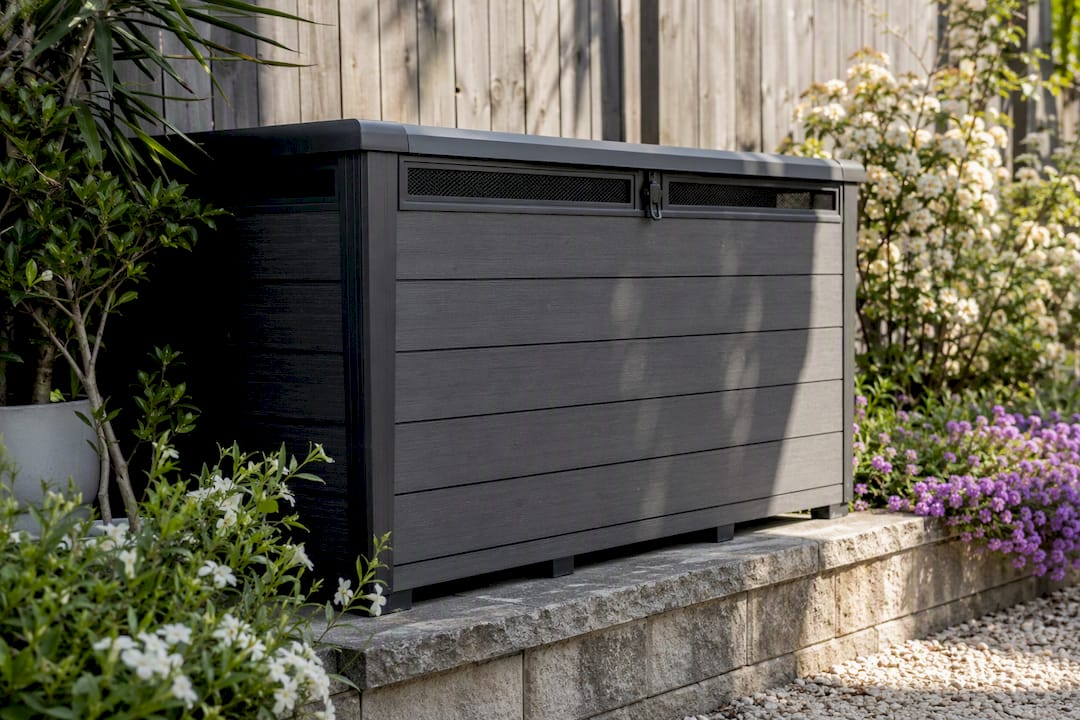
Ventilation is the detail that separates gear that lasts from gear that doesn’t. Look for vents fitted with insect mesh, a raised base or plinth, and a lid that seals without trapping moisture inside. Smalltrades’ guide also flags drip edges as worth checking, since a poorly designed lid can funnel rainwater straight onto your gear instead of away from it.
Pro Tip: Before buying, measure your gear at its bulkiest, not its average, since a folded bike or an inflated ball takes up more room than you’d expect when you’re packing a box in a hurry.
How should you organise outdoor gear for easy access?
A good layout saves you from digging through a jumbled box every time you want to use something, and it doesn’t need to be complicated. The zone-and-bin method works well: assign each sport or season its own zone, then use labelled bins within that zone so anyone in the household can find and return gear without guessing. Practical home-storage advice consistently points to purging unused gear before organising as the single highest-impact step, since half the clutter problem disappears the moment you stop storing things nobody uses anymore.
Vertical and overhead storage solves the bike-and-board problem that eats floor space. Wall-mounted hooks or a ceiling hoist keep bikes off the ground, just make sure you leave enough clearance for the door or garage roller to still operate freely, and fix hooks into studs or masonry rather than plasterboard.
For balls, you’ve got three realistic options:
- A wall-mounted rack keeps balls separated and aired, but takes up wall space.
- A basket is cheap and portable, though balls can pile up and scuff each other.
- Mesh bags hang neatly and dry quickly, but don’t suit heavier balls like soccer or basketballs long-term.
Small items deserve their own system too. Labelled tubs for shin pads, mouthguards, and swim goggles stop the “where did I put that” scramble, and a lockable box is worth adding if you’re storing anything you’d rather kids or visitors not access unsupervised.
Three layouts cover most Australian backyards. A compact patio corner suits a single deck box plus a small wall rack for balls. A side-of-garage strip works well with a slim cabinet and overhead bike hooks, keeping the garage floor clear for the car. A small shed interior can house full shelving, a ball rack, and hanging space for wetsuits or boards, all under one lockable roof. IKEA’s ideas for sports equipment storage show how shelves, baskets, and pegboards combine well in tighter spaces where a full shed isn’t practical.
Where should you install storage and how do you maintain it?
Placement decisions made on day one affect how well your storage performs for years afterwards, so it’s worth getting right before you commit to a spot. Avoid low points in the yard where water pools after rain, and think about how often you’ll be walking gear to and from the unit. If you’re installing a fixed shed, check your local council’s setback rules first. Requirements vary by property and structure size.
- Raise it off the ground. A raised base or plinth stops splashback and moisture wicking up into the unit, which is one of the most common causes of mould and mildew in stored gear.
- Anchor and lock properly. Bolt sheds and heavy cabinets to a slab where security matters, and check hinges and hasps annually for wear.
- Rinse and dry gear before storing it. Salt, sweat, and pool chlorine all accelerate corrosion and odour if sealed inside a closed box.
- Use moisture absorbers in fully enclosed spaces, particularly if you’re storing leather goods or electronics, since even a well-sealed box can trap humidity.
- Inspect seals and vents each season. A perished seal or blocked vent mesh undoes a lot of the moisture protection you paid for.
Some equipment needs more than a backyard box regardless of how well it’s ventilated. High-value leather gear or anything sensitive to temperature swings does better in a climate-controlled storage setup than in an outdoor unit exposed to a 40 degree summer day.
Why resin storage suits Australian sports gear
Keter has built its outdoor storage range around materials that hold up to exactly the conditions Australian backyards deliver: harsh UV, sudden downpours, and long stretches of heat. Double-wall resin construction resists the cracking and fading that thinner plastics suffer, and it needs nothing more than an occasional wipe-down, unlike timber, which demands sanding and resealing to avoid warping.
Eliminating ground contact and ensuring airflow is one of the most effective ways to protect stored kit long-term. Raised bases combined with vents and insect mesh cut down rot and mildew dramatically.
Ease of assembly matters just as much as material quality, particularly for anyone setting up storage solo on a weekend. Customers consistently point to straightforward assembly and solid build quality as reasons they’d choose resin storage again, which lines up with why Keter recommends raised bases as standard practice rather than an optional extra.
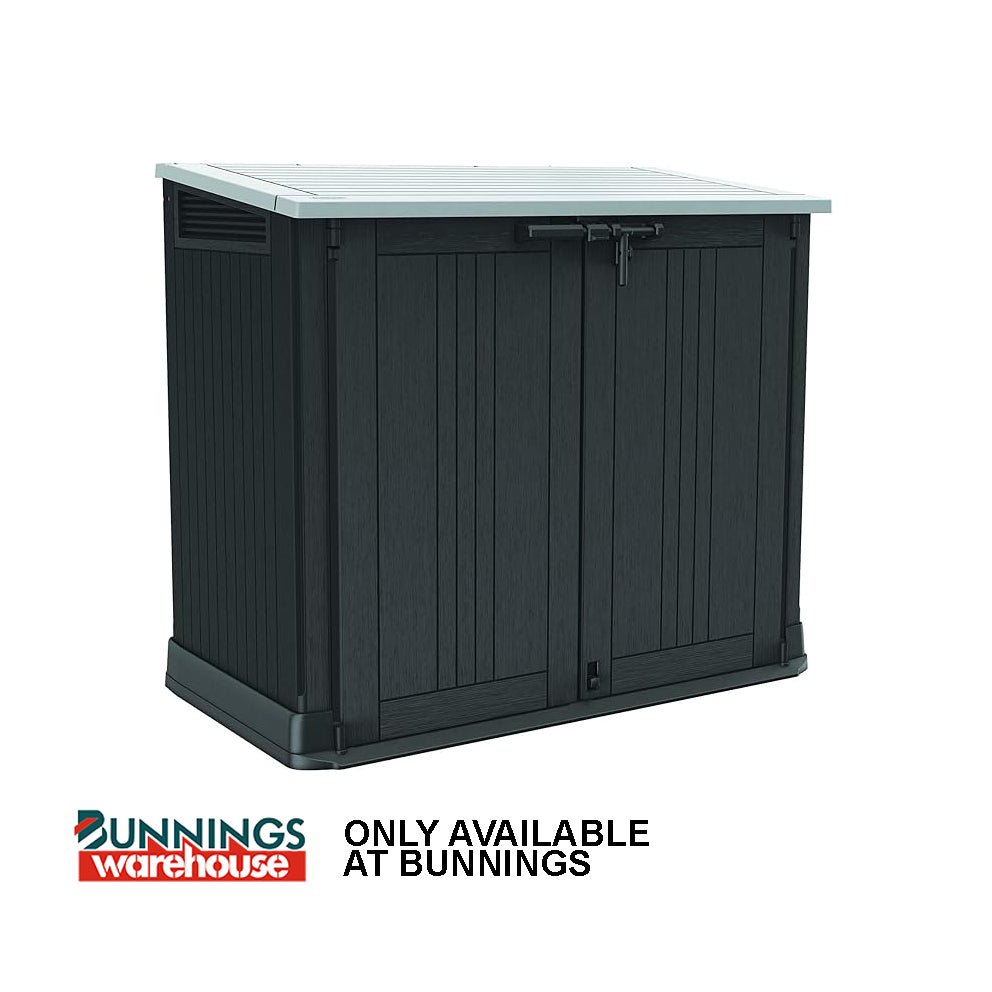
A shed becomes the better choice over a deck box once you need genuine security, room for a bike battery or charger, or shelving for a season’s worth of mixed sports gear.
How do you stop pests getting into stored sports gear?
Damp, dark storage is exactly what spiders, cockroaches, and rodents look for, and sports gear with sweat or food residue on it makes an even more attractive target. The good news is that most pest problems in outdoor storage trace back to the same few gaps.
Seal any vents with insect mesh rather than leaving them open, since ventilation and pest exclusion aren’t actually in conflict when the mesh is fine enough. Check door and lid seals for gaps large enough for insects or mice to squeeze through, and replace perished rubber seals as soon as you spot cracking. Raising storage off the ground on a plinth also does double duty here: it removes the direct path ants and termites use to reach timber or cardboard packed inside.
Inside the unit, avoid storing gear with food wrappers, half-empty drink bottles, or sweat-soaked clothing left unwashed, since these attract pests faster than the storage material itself matters. A light dusting of a pest deterrent safe for outdoor use around the base of a shed can help in termite-prone areas, and it’s worth an annual check underneath and around the base for nesting signs, particularly after a wet season when insects seek out dry shelter.
Cedar blocks or natural deterrents inside cabinets can help with moths and silverfish around fabric items like wetsuits or padded gear, though they’re a supplement to good sealing, not a replacement for it.
How portable should your storage be?
Portability comes down to how often you move gear versus how much protection you need. A lightweight resin deck box can be shifted around the patio in minutes, which suits renters or households that rearrange their outdoor space seasonally. A bolted-down shed trades that flexibility for stability and security, and it’s not something you’ll be relocating on a whim.
Trolleys and wheeled racks solve a specific access problem: getting bulky or heavy gear from storage to the car or the park without multiple trips. If your household is regularly loading up for weekend sport, a wheeled option under the bench or in the shed saves genuine time and effort compared to carrying everything by hand.
Ease of access matters as much as portability itself. A deck box with a hinged lid gives full top access but can be awkward if it’s jammed against a fence. A cabinet with front-opening doors and internal shelving usually wins for anything you need to grab quickly and often, since you’re not lifting a heavy lid every time. For daily-use items like a bike or a set of clubs, wall-mounted hooks beat any box on convenience, because there’s no lid, no digging, and no repacking required.
If you’re likely to move house or rearrange your yard within a few years, weigh that into your decision now. A shed anchored to a slab is a bigger commitment than a box you can simply pick up and relocate.
What should you budget for outdoor storage?
Outdoor storage spans a wide price range, and the right spend depends on what you’re protecting and how long you want the solution to last. A basic deck box sits at the affordable end and suits households with a modest amount of casual gear, cushions, or pool toys. Tall cabinets and wall systems cost more but spread that cost across better organisation and longer service life, since quality resin and steel components resist the wear that cheaper alternatives can’t.
Small sheds represent the bigger investment, but they also replace what would otherwise be several separate purchases: a box, a cabinet, and a rack all rolled into one lockable structure. If you’re storing enough gear across multiple sports, a shed’s per-litre value often works out better than buying several smaller units piecemeal.
Beyond the unit itself, budget for the extras that protect your investment: an anchor kit if you’re bolting to a slab, moisture absorbers for fully sealed spaces, and occasional seal replacements over the unit’s life. These are minor costs next to the price of replacing water-damaged or pest-affected gear, and they’re the kind of spending that pays for itself the first time a storm rolls through.
Buying once for the right capacity, rather than upgrading twice as your gear collection grows, is usually the more economical path over several years.
What actually matters when you’re choosing storage
Most advice on outdoor storage focuses on capacity and price, and both matter, but they’re not where the real failures happen. The gear that gets ruined in backyard storage almost always fails because of moisture, not lack of space. A box that’s slightly too small is an inconvenience. A box sitting flat on wet paving, with no ventilation and a perished seal, is where mildew, rust, and pest damage actually start.
That’s why raised bases and proper ventilation deserve more attention than they usually get in buying guides that lead with dimensions and price. A shed with excellent capacity but no airflow will still ruin gear stored inside it during a humid summer. If you take one thing from this guide, prioritise moisture control and material quality before you compare litre capacities between products, because a slightly smaller unit that keeps gear bone dry beats a larger one that lets damp creep in.
The other overlooked factor is matching storage to how you actually use your gear, not how you imagine using it. Daily-access items belong on a wall, not buried in a box you’ll stop opening within a month.
— Liza
How Keter’s Store It Out Prime range covers these needs
If you’ve read this far and want a resin option that ticks the boxes above, Keter’s Store It Out Prime range is built around exactly the trade-offs discussed: weather resistance, low maintenance, and enough capacity to handle a genuinely mixed load of sports gear.
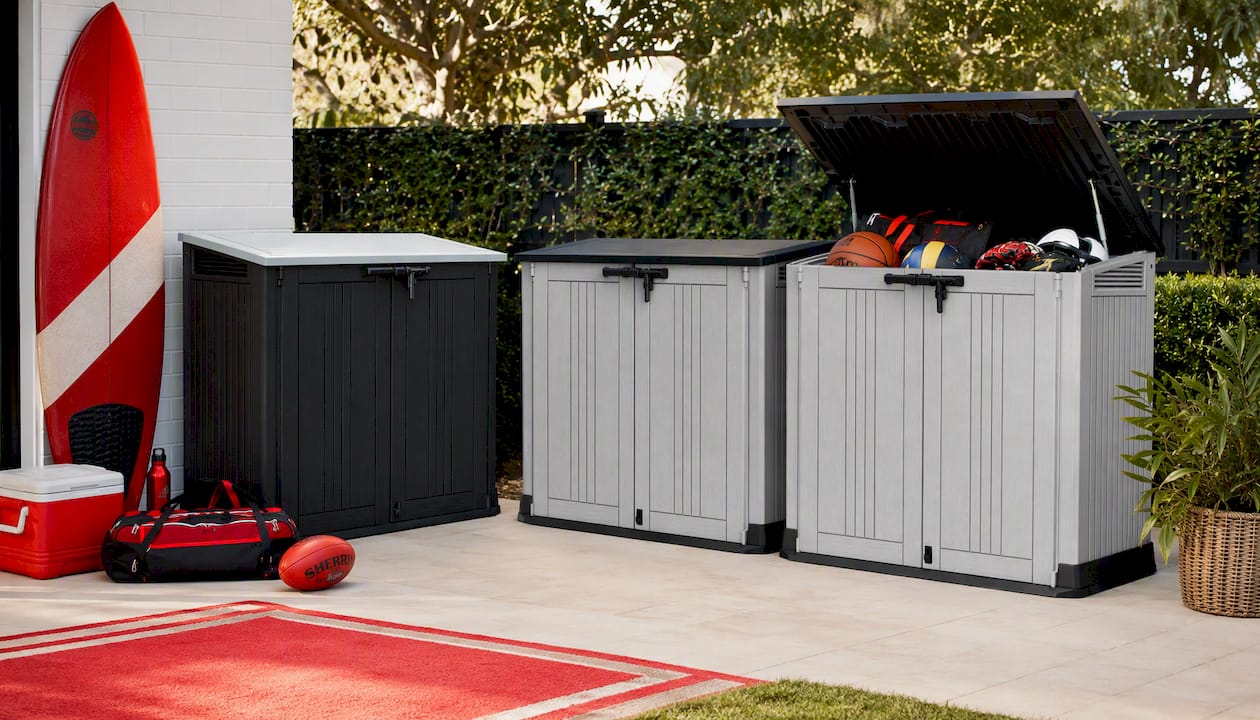
The Store It Out Prime Shed suits households after straightforward, secure 880 litre storage for bikes, balls, and bulkier kit, with the double-wall resin construction and UV stabilisation covered earlier in this guide. If you’d prefer a lid that stays open on its own while you’re loading or unloading gear, the Store It Out Prime Shed with Pistons adds gas-strut support for easier one-handed access, handy when your hands are already full of cricket pads or a wetsuit. A third option in the same 880 litre Store It Out Prime family gives you flexibility on style while keeping the same weather resistant resin build and simple panel assembly.
Before you buy, measure your available space and the bulkiest items you’ll be storing, since that’s the detail that determines whether an 880 litre shed or a smaller deck box suits you better. Once you know your capacity, head to the product page for full dimensions and assembly guidance, and set your new storage on a raised base from day one.
Sources
FAQ
What is the best way to store sports equipment?
A weather-resistant resin deck box or small shed for bulk items, combined with wall-mounted hooks or a rack for daily-use gear, covers most households. Raising the unit off the ground prevents moisture damage, which is the most common cause of ruined gear.
What is the best organiser for sports equipment?
Zone-and-bin systems with labelled tubs work best for mixed gear, while wall panels and pegboards suit daily-access items like bikes and racquets. A dedicated ball rack keeps balls aired and prevents flat spots.
What are the best ways to store fitness equipment?
Vertical storage, wall hooks, and slim cabinets suit small training spaces where floor room is limited, an approach echoed in Couch & Dumbbells’ guide to organising a small training area. Keep frequently used items on open racks and pack occasional-use gear into sealed bins.
What is the best type of storage for outdoors?
Resin or HDPE storage is generally the best all-round outdoor option because it resists UV damage, moisture, and rust without needing regular maintenance. Colorbond steel is a strong alternative where security or coastal corrosion resistance matters more than weight and portability.


