
Polypropylene UV Resistance: What It Means for Outdoor Gear

Plain polypropylene (PP) is not naturally UV resistant. Left unprotected in strong sun, it fades, cracks and turns brittle. Polypropylene that is built for the outdoors is a different story: UV stabilisers are blended into the plastic itself, which slows that ageing and is why well-made garden furniture, storage boxes and sheds can sit in the Australian sun season after season. Our outdoor furniture, storage and sheds are made from recycled and recyclable resin designed to resist weathering, and they do not rot, rust or warp. Below is what is actually happening to plastic in the sun, what stabilisers do, and how to look after your gear.
TL;DR
- Unstabilised polypropylene is sensitive to sunlight. Its UV-B and UV-A wavelengths break down the plastic and make it brittle over time.
- UV stabilisers are mixed into the material, not painted on, so protection runs right through the product.
- Stabilisers slow ageing rather than stop it, so shade, covers and regular washing still add years.
- For a deck box, shed, lounge setting or playhouse, choose products designed for outdoor use from the start. That is what our range is made for.
Table of Contents
- Why sunlight damages polypropylene
- What UV stabilisers are and how they work
- UV stabilised polypropylene, resin and recycled plastic: how it fits together
- How this applies to what you are buying
- Keeping outdoor plastic looking good for years
- Common questions about the science
- Why outdoor-ready resin is a smart choice for Australian homes
- Perspective
- Ready to shop outdoor gear made for the Aussie sun?
- FAQ
- Sources
Why sunlight damages polypropylene
Polypropylene is a tough, light, low-cost plastic, which is why it turns up in everything from food containers to garden furniture. Its weak spot is sunlight. A Springer chapter on photostabilisers explains that the 290 to 400 nanometre part of the solar spectrum drives photo-oxidation in PP, and that the result is discolouration, loss of mechanical strength and eventually embrittlement. The same chapter notes PP is the biggest market for light stabilisers, because outdoor use depends on them.
Not all UV is equal. The United Nations Environment Programme’s 2023 assessment of environmental effects says the shorter UV-B wavelengths (290 to 315 nm) are far more effective than UV-A or visible light at oxidising and embrittling common plastics such as polyethylene and polypropylene. It also confirms that adding UV-protective substances to plastics is a widespread practice that prolongs the useful life of outdoor products.
In plain terms: sunlight triggers a slow chemical chain reaction in the plastic. The long molecular chains that give it strength get cut into shorter pieces. The surface chalks, loses colour, and eventually develops fine cracks.
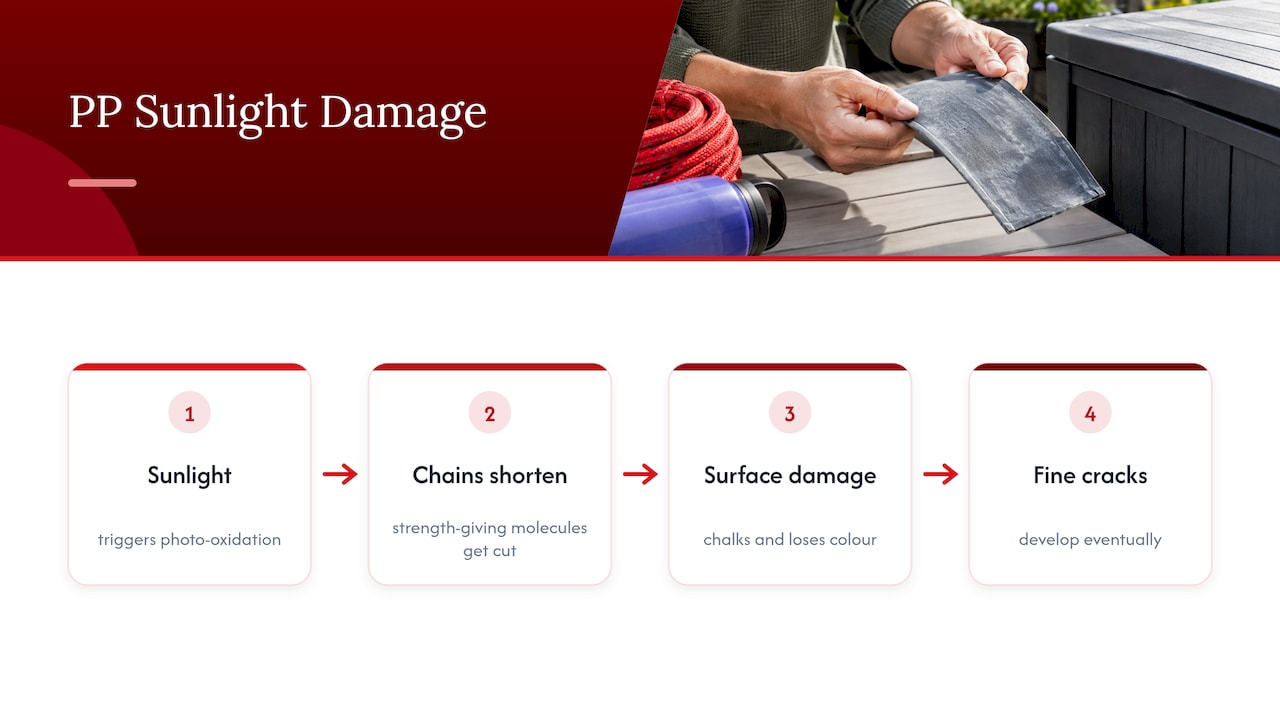
What it looks like over time
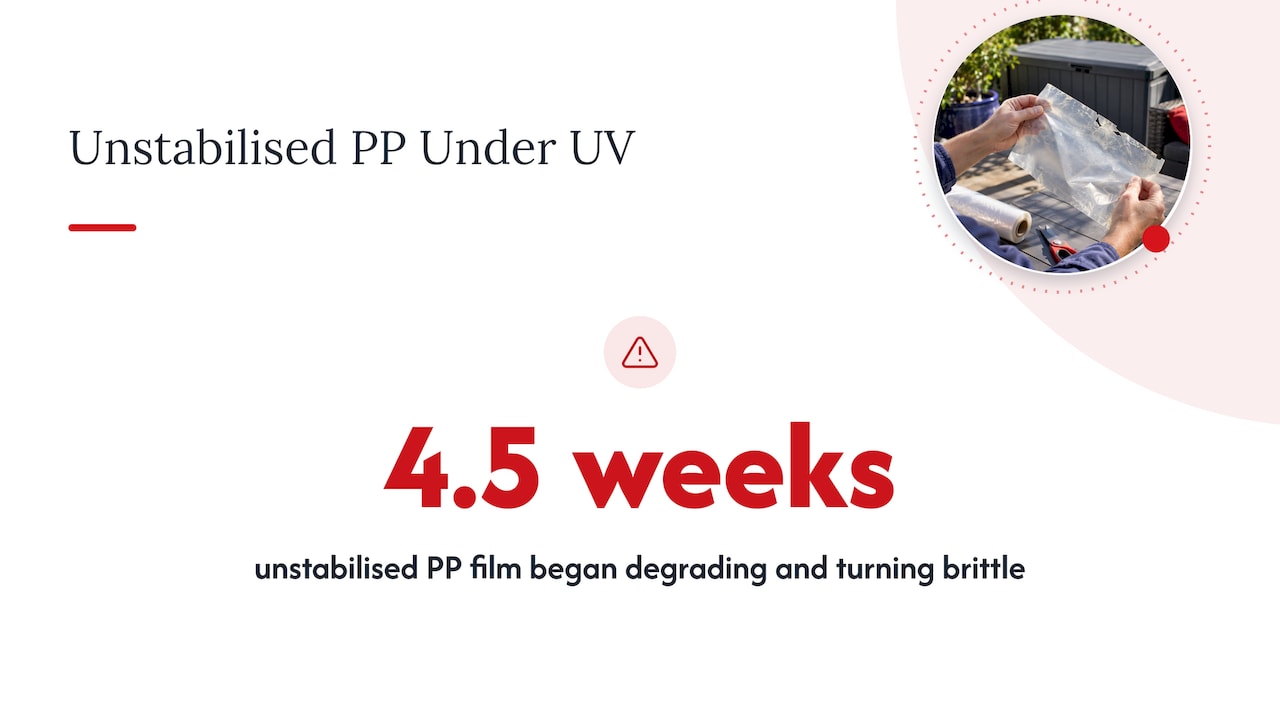
Researchers have measured this. A 2020 peer-reviewed study in the journal Materials found that pure, unstabilised PP film began to degrade and turn brittle after about 4.5 weeks of UV exposure in the test. A natural weathering study found that PP films develop surface cracks once chemical oxidation rises sharply, at which point mechanical properties drop suddenly. Summer weathering was driven mainly by UV and cumulative solar radiation.
Those results are for bare film with no protection, which is exactly why they matter: they show what stabilisers are there to prevent. Australia’s high UV levels make that protection worth caring about, especially on surfaces facing the sun all day.
The damage is not unique to plastic either. Roofing faces the same sun, and these roof UV protection benefits are a reminder that anything left outdoors needs a plan for UV.
What UV stabilisers are and how they work
A UV stabiliser is an additive that protects a plastic from sunlight. There are two main types you will hear about:
- UV absorbers soak up harmful UV radiation and release it as harmless heat before it can damage the plastic.
- Hindered amine light stabilisers (HALS) do not absorb UV at all. They mop up the reactive fragments (free radicals) that start the breakdown chain, and they are regenerated in the process rather than used up.
The Materials study above reports that HALS can have a photo-stabilising effect two to four times higher than conventional UV stabilisers, with low volatility and high resistance to being washed out. It also found that nano zinc oxide stabilisers gave PP film strong UV resistance, and that combining HALS with nano zinc oxide made the film harder.
How much is added
It takes surprisingly little. A Canadian National Research Council review of photostabilisation states that outdoor use of UV-susceptible plastics such as polypropylene is practical with stabilisers added at an economical level of 0.1 to 1.0 per cent by weight. Small amounts, mixed in evenly, do the job.
Built in, not painted on
This is the key point for anyone comparing products. Stabilisers are blended through the material during manufacture, so protection is present throughout the thickness of the product rather than sitting in a thin layer that can wear off. A scratch or scuff on the surface does not remove it. That is the practical difference between a product designed for outdoor life and a general-purpose plastic item that happens to be left outside.
Stabilisers slow ageing, they do not freeze it. Over many years even protected plastic will gradually lose a little colour in relentless sun. That is normal for every outdoor material, from timber to powder-coated metal, and it is why simple habits (covered below) are worth building in.
UV stabilised polypropylene, resin and recycled plastic: how it fits together
If you are shopping, you will see PP, HDPE, resin and “recycled plastic” used loosely. Outdoor furniture and storage in this category is typically made from moulded plastic resin, and the right formulation for the job includes UV protection and colour pigment, tuned for sun exposure. Our range is made from recycled and recyclable resin or plastic, designed for durability and easy DIY assembly. If you want a deeper comparison of the two most common materials, our guide to HDPE vs polypropylene outdoor furniture walks through them, and our recycled plastic outdoor furniture buyer’s guide covers what recycled content means for you.
A few things set outdoor-ready products apart from everyday plastic:
- Designed for outdoor service. The plastic is formulated for sun, rain and temperature swings, not for a kitchen cupboard.
- Colour all the way through. Pigment is part of the material, so everyday knocks do not reveal a different colour underneath.
- No rot, rust or warp. Unlike timber or metal, resin does not need sealing, painting or rust treatment.
- Light weight. You can move a chair or box into the shade without a second pair of hands.
For a broader look at how plastic compares with timber, metal and wicker, see our outdoor furniture materials guide, and for sun-specific detail, our page on UV resistant outdoor furniture for Australian sun.
How this applies to what you are buying
Outdoor furniture
Lounge sets, Adirondack chairs, dining settings and sun loungers sit in direct sun for hours, so UV performance matters most here. Resin furniture does not need sanding, oiling or repainting, and it shrugs off rain. Browse our Adirondack chairs or a lounge such as the Keter Orlando Outdoor Lounge Set if you are planning a patio refresh. Our patio makeover ideas show how furniture and storage can work together.
Deck boxes and outdoor storage
Storage boxes live on patios, balconies and beside pools, often in full sun. Because the colour and stabilisers are built into the resin, a box keeps its look through summer after summer. Dark colours absorb more heat than light ones, so a lighter box in a very exposed spot will feel cooler to touch. Our outdoor storage range covers everything from a compact box such as the Keter City Box to larger options like the Keter Westwood 570L.
Sheds and garage or tool cabinets
A shed has big panels facing the sun all day, so material choice is crucial. Resin panels do not rot, rust or warp, which is a real advantage on an exposed side fence or in a backyard corner. Place a shed where the walls get at least some relief from afternoon sun if you can, and keep the doors clear so they open and close freely. Our shed collection and our guide to the best sheds for your garden are good places to start. For cabinets that live in a garage or covered area, UV is less of a concern, since they spend less time in direct sun.
Planters, garden beds and playhouses
Planters and raised beds sit in the sun by design, because plants need it. Resin suits them well, because it does not rot when wet soil sits against it. The same family of durable resin is used for children’s playhouses. Choosing a playhouse position with a little natural shade makes the area more comfortable for kids on hot days, and it is kind to the plastic too. Browse our garden range for planters and elevated beds.
Keeping outdoor plastic looking good for years
Built-in UV protection does most of the work, and a few easy habits do the rest. They also suit anyone who likes keeping the garden tidy without a big weekend project.
- Position with the sun in mind. Where you have a choice, put furniture and boxes under a verandah, pergola or tree for part of the day. Shade reduces the total UV the plastic receives.
- Use covers when you are away. Furniture covers, moving pieces under cover when not in use, or adding shade with outdoor blinds are all simple ways to limit direct sun, as this guide to protecting outdoor furniture suggests.
- Wash regularly. Dust, pollen and grime hold moisture and can dull the surface. Warm water and a mild detergent with a soft cloth is plenty. Avoid harsh abrasives that scratch the finish.
- Rinse after pool or salt exposure. A quick hose-down stops residue building up.
- Keep an eye on colour. If you want to slow fading on a deck box, our tips on preventing deck box fading cover shade and a regular wash routine.
Treat the above as normal care rather than a fix. The plastic is designed for the outdoors, and these habits simply help it look its best for longer.
Common questions about the science
Does the sun make polypropylene weaker or just change its colour?
Both, if it is unprotected. Colour change is usually the first sign, followed by a chalky surface, loss of strength and cracking. That chain of events is what stabilisers are added to slow, as the research above describes.
Is a stabiliser the same as a coating?
No. In quality outdoor plastics, stabilisers are mixed into the raw material before the product is moulded, so they are present throughout. A coating sits on the surface and can scratch away.
Are all plastics affected the same way?
No. Different plastics and different formulations respond differently to UV, which is why products made for outdoor service use a recipe suited to sunlight, with stabilisers and pigments chosen for it.
Why outdoor-ready resin is a smart choice for Australian homes
Australian backyards are tough on materials: strong UV, heat, sudden storms and, near the coast, salt air. Timber needs regular oiling, metal can rust, and fabric fades. Resin built for outdoor use sidesteps most of that routine upkeep. Our recycled and recyclable materials also support a circular economy, which many homeowners value as much as durability. If sustainability matters to you, our guide to eco friendly outdoor furniture goes further.
The point is simple. UV resistance is not a lucky property of plastic. It is something that is designed into outdoor products, and it is a good reason to choose furniture, storage and sheds that were made for the job.
Perspective
When people ask us about UV, they are really asking a bigger question: will this still look good, and still work, in a few summers’ time? The science is clear that sunlight is the biggest challenge for any outdoor plastic, and that stabilisers blended into the material are the established answer.
That is how we think about our range. Our furniture, storage boxes, sheds and playhouses are made from durable recycled and recyclable resin designed to resist weathering, so they do not rot, rust or warp. You do not need to sand, oil or repaint anything. Put a lounge on the patio, a shed in the corner or a planter by the fence, and get on with enjoying the space.
Add a little shade, a cover when you are away and a wash now and then, and you are giving good materials the best chance to last. Easy DIY assembly means you can be set up the same weekend.
Liza
Ready to shop outdoor gear made for the Aussie sun?
Whether you want a shed to tidy up the backyard, a deck box for the patio cushions or a lounge setting for long summer afternoons, our range is made from recycled and recyclable resin designed for durability and easy DIY assembly. Start with the Keter Australia range to see sheds, outdoor storage, cabinets, furniture and garden products in one place.
If storage is your priority, head straight to our outdoor storage collection to compare sizes and colours.
FAQ
Is polypropylene UV resistant?
On its own, plain polypropylene is sensitive to UV and becomes brittle in prolonged sunlight. With UV stabilisers blended in during manufacture, it is well suited to outdoor products. Stabilisers slow ageing rather than stop it, so shade and cleaning still help.
What are UV stabilisers in outdoor plastics?
They are additives that protect plastic from sunlight. UV absorbers turn UV energy into harmless heat, while hindered amine light stabilisers capture the reactive fragments that start the breakdown. Both are mixed through the material, so protection is not just on the surface.
Do I need to cover outdoor plastic furniture or a deck box?
You do not need to, because outdoor resin is designed to live outside. Still, a cover or a shady spot when you are away limits direct sun, and a regular wash keeps the surface fresh. These habits help any outdoor furniture look its best for longer.
How should I look after a shed or playhouse in strong sun?
Pick a spot with some natural shade if you can, wash the panels with mild detergent and water, and keep doors and vents clear. Resin does not rot, rust or warp, so there is no sealing or painting to schedule.
Sources
- UNEP Environmental Effects Assessment Panel Update 2023
- Effects of UV Stabilizers on Polypropylene Outdoors, Materials, 2020
- Natural Weathering Studies of Polypropylene, Springer
- Photostabilizers, Springer chapter
- Photostabilisation mechanisms in polymers: a review, NRC Canada
- How to Protect Outdoor Furniture from the Elements
- Roof UV Protection Benefits


